Aluminum vs Carbon Arrows: Complete 2026 Comparison Guide
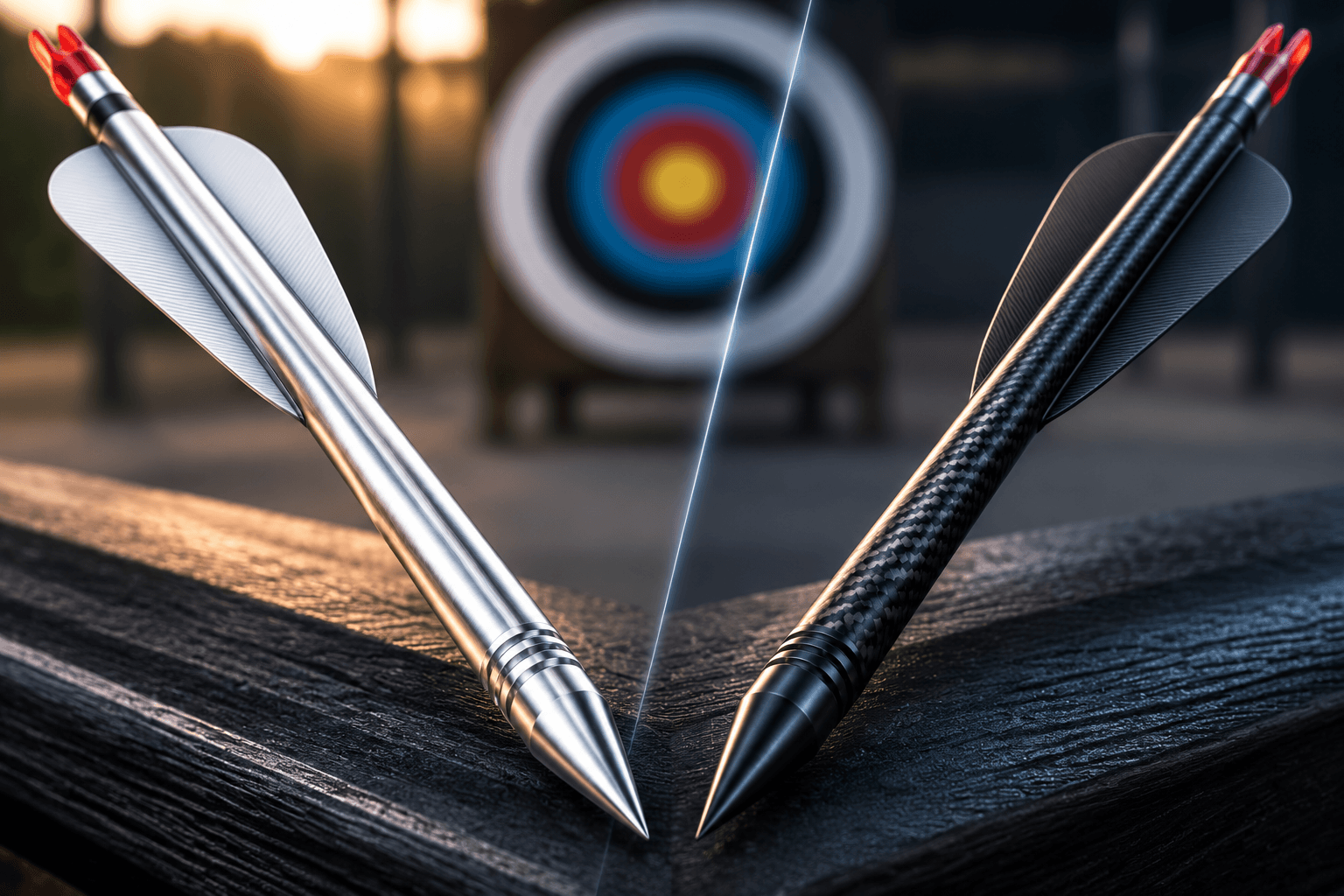
Aluminum arrows offer straightness, durability, and lower cost, while carbon arrows deliver more speed, lighter weight, and better penetration for hunting.
Affiliate Disclaimer: We are a participant in the Amazon Services LLC Associates Program, an affiliate advertising program designed to provide a means for sites to earn advertising fees by advertising and linking to Amazon.com. As an Amazon Associate I earn from qualifying purchases. We also participate in other affiliate programs.
Quick Answer: Aluminum arrows offer exceptional straightness, durability for target shooting, and lower cost, while carbon arrows provide superior speed, lighter weight, and better penetration for hunting. Carbon arrows typically cost $8-15 per shaft compared to aluminum’s $5-10, but carbon breaks more easily on hard impacts while aluminum bends and can often be straightened. The best choice depends on your shooting discipline, budget, and whether you prioritize consistency (aluminum) or performance (carbon).
Key Takeaways
Carbon arrows fly 15-20% faster than aluminum due to lighter weight, making them ideal for hunting and outdoor target shooting
Aluminum arrows bend rather than shatter, offering better durability for beginners and indoor target archers who frequently hit hard surfaces
Professional Olympic recurve archers use aluminum, while compound hunters and 3D shooters overwhelmingly choose carbon
Carbon arrows cost roughly 50% more upfront but may save money long-term if you avoid hard target impacts
Spine consistency matters more than material, both aluminum and carbon can deliver tournament-level accuracy when properly matched to your bow
Indoor archery favors aluminum because concrete walls and floors destroy carbon arrows on misses
Carbon arrows require careful inspection after every shooting session to detect micro-fractures that can cause catastrophic failure
Hybrid aluminum-carbon arrows exist but serve niche applications and cost significantly more than either pure material
What Is the Difference Between Aluminum and Carbon Arrows?
Aluminum arrows are made from aerospace-grade aluminum alloy tubes that are drawn, heat-treated, and precision-straightened to create a hollow shaft. Carbon arrows consist of carbon fiber strands woven together and bonded with epoxy resin, creating a composite material that’s lighter and stiffer than aluminum.
The fundamental differences extend beyond just materials:
Construction and Manufacturing
Aluminum arrows are extruded from a single piece of metal, then anodized for protection and color
Carbon arrows use layered fiber construction, with different manufacturers using varying weave patterns and resin formulas
Aluminum offers perfectly uniform wall thickness throughout the shaft
Carbon can have slight variations in fiber density that affect spine consistency
Physical Properties
Weight: Carbon arrows typically weigh 5-7 grains per inch (GPI), while aluminum ranges from 8-12 GPI
Stiffness: Carbon provides higher stiffness-to-weight ratio, meaning less flex during the shot
Straightness tolerance: Premium aluminum can achieve ±0.0005″ straightness; carbon typically ranges from ±0.001″ to ±0.006″
Durability pattern: Aluminum bends on impact but rarely shatters; carbon maintains shape until catastrophic failure
Performance Characteristics
Carbon arrows recover from paradox (the flex around the riser) faster, improving accuracy at longer distances
Aluminum’s consistent density makes spine matching more predictable across different shaft sizes
Carbon’s lighter weight allows for heavier broadheads or field points without sacrificing arrow speed
Aluminum transmits less vibration to the bow hand, creating a smoother shooting experience
For archers just getting started with archery equipment, understanding these material differences helps explain why certain arrows perform better in specific situations.
Are Carbon Arrows Better Than Aluminum for Beginners?
Aluminum arrows are generally better for beginners because they’re more forgiving of shooting mistakes, less expensive to replace, and easier to diagnose when damaged. A bent aluminum arrow is immediately visible, while a cracked carbon arrow may look fine but fail catastrophically during the next shot.
Why Aluminum Works Well for New Archers:
Visual damage assessment: You can see a bent aluminum arrow from across the room, no special inspection needed
Lower replacement cost: Losing or damaging arrows during the learning phase hurts less financially
Safer failure mode: Aluminum bends rather than exploding into sharp carbon splinters
Better for indoor ranges: Most beginners start indoors where concrete backstops destroy carbon arrows
Easier spine selection: Aluminum spine charts are more straightforward, with fewer variables to consider
When Carbon Makes Sense for Beginners:
Carbon arrows can work for beginners in specific situations:
You’re starting with hunting bow setups and shooting exclusively outdoors into soft targets
You have access to an outdoor range with quality backstops that won’t destroy arrows on misses
Your budget allows for the higher initial investment and potential replacement costs
You’re committed to learning proper arrow inspection techniques from day one
Common Beginner Mistake: Buying expensive carbon arrows before developing consistent shooting form. New archers often miss the target entirely, sending arrows into hard surfaces that destroy carbon shafts. Start with mid-grade aluminum arrows until you’re consistently hitting the target, then upgrade to carbon if your shooting discipline requires it.
For those exploring archery for beginners, aluminum provides a more economical learning path while you develop proper form and technique.
How Much Do Carbon Arrows Cost Compared to Aluminum?
Carbon arrows typically cost $8-15 per shaft for quality options, while aluminum arrows range from $5-10 per shaft, making carbon roughly 50-80% more expensive upfront. A complete dozen carbon arrows with components (nocks, inserts, vanes) runs $150-250, compared to $100-180 for comparable aluminum arrows.
Price Breakdown by Category:
Arrow Type
Budget Range
Mid-Range
Premium
Aluminum
$4-6/shaft
$7-9/shaft
$10-13/shaft
Carbon
$6-8/shaft
$9-12/shaft
$13-20/shaft
Aluminum-Carbon Hybrid
N/A
$15-18/shaft
$20-30/shaft
Total Cost of Ownership Considerations:
The upfront price difference doesn’t tell the complete story. Consider these factors:
Replacement rate: Indoor target shooters may destroy 2-3 carbon arrows monthly hitting concrete, but only bend 1-2 aluminum arrows that can be straightened
Longevity: Carbon arrows maintain performance indefinitely if undamaged; aluminum gradually work-hardens and becomes brittle after years of use
Component costs: Carbon arrows require specialized inserts ($2-4 each) that differ from aluminum’s simpler point systems
Inspection time: Carbon requires careful inspection after every session, adding time investment
Real-World Example: An indoor target archery shooter practicing twice weekly might spend $200 annually replacing carbon arrows versus $80 on aluminum arrows and occasional straightening. An outdoor 3D shooter who rarely misses targets might replace only 1-2 arrows per year regardless of material.
Budget-Friendly Strategy: Many experienced archers maintain two sets, aluminum for practice and carbon for competitions or hunting. This approach balances cost with performance when it matters most.
Why Do My Carbon Arrows Keep Breaking?
Carbon arrows break primarily from three causes: hitting hard surfaces (concrete, rocks, metal), developing micro-fractures from target impacts that weaken the shaft, or using arrows with insufficient spine stiffness that flex excessively during the shot. Unlike aluminum that bends visibly, carbon maintains its appearance until catastrophic failure occurs.
Primary Failure Modes:
Impact Damage (Most Common)
Hitting concrete backstops, floors, or walls creates immediate fractures
Striking rocks or hard ground on outdoor misses
Arrow-on-arrow impacts (Robin Hoods) that crack both shafts
Hitting metal target frames or stands
Accumulated Stress Fractures
Repeated impacts into hard foam targets create internal delamination
Flexing during the shot gradually weakens the resin matrix
Dry-firing or shooting arrows that are too light for your bow’s energy
Using broadheads that are too heavy, causing excessive flex
Manufacturing Defects or Damage
Micro-fractures from dropping arrows on hard surfaces
Damage during installation of inserts or nocks
Over-tightening field points that crack the insert area
Purchasing low-quality carbon arrows with inconsistent resin distribution
Prevention Strategies:
Flex test every arrow before each shooting session: Hold the arrow at both ends and flex it gently while rotating, listen for cracking sounds
Inspect visually under good lighting: Look for splintering, white stress marks, or separation of carbon layers
Use arrow pullers: Twisting arrows out of targets stresses the shaft near the point
Avoid hard backstops: If shooting indoors, ensure proper netting or foam backstops catch misses
Match spine correctly: Arrows that are too weak flex excessively and fail prematurely
Warning Signs Before Failure:
Unusual whistling sound during flight
Arrows suddenly grouping differently than usual
Visible fraying near the nock or point
White stress marks appearing on the shaft surface
Critical Safety Note: A carbon arrow that fails during the shot can send sharp splinters through your bow hand or forearm. Never shoot an arrow you suspect might be damaged, the $12 replacement cost is trivial compared to a medical emergency.
Which Arrows Are More Durable: Aluminum or Carbon?
Aluminum arrows are more durable for target archery because they bend rather than break, can be straightened multiple times, and survive impacts with hard surfaces that would shatter carbon arrows. Carbon arrows are more durable for hunting applications because they resist bending in brush, maintain straightness indefinitely when undamaged, and don’t corrode or dent from normal field use.
Durability by Use Case:
Indoor Target Shooting: Aluminum Wins
Survives concrete floor and wall impacts that destroy carbon
Bent arrows can be straightened with an arrow straightener tool
Aluminum arrows can last multiple seasons with proper care
Visible damage means you know exactly when replacement is needed
Outdoor Target Shooting: Depends on Backstop
Quality foam targets: Carbon and aluminum perform similarly
Hard-packed dirt or gravel backstops: Aluminum survives better
Bag targets: Both materials work well
3D foam targets: Carbon edges ahead due to easier extraction
Hunting Applications: Carbon Wins
Maintains straightness when carried through brush and branches
Doesn’t dent or ding from incidental contact
Resists corrosion from blood and moisture
Lighter weight means less noise when arrow contacts bow or quiver
Lifespan Comparison:
Aluminum arrows: 2-5 years of regular target use, with periodic straightening needed; eventually work-harden and become brittle
Carbon arrows: Indefinite lifespan if undamaged; single hard impact can end an arrow’s life immediately
Hybrid arrows: 3-4 years typical lifespan; aluminum core provides some impact resistance while carbon exterior resists bending
Common Mistake: Assuming carbon’s higher price means better durability in all situations. Carbon is more durable against bending forces but far less durable against impact forces. Choose based on what type of stress your arrows will encounter most frequently.
Do Professional Archers Use Carbon or Aluminum Arrows?
Professional Olympic recurve archers almost exclusively use aluminum arrows (specifically X10 or X23 models) because the discipline prioritizes extreme accuracy at fixed distances where arrow speed matters less than consistency. Professional compound archers in field, 3D, and hunting competitions overwhelmingly choose carbon arrows because the speed advantage and flatter trajectory improve scoring at varied distances.
Reason: Penetration, durability in field conditions, weight-forward balance with broadheads
Popular models: Easton 5mm FMJ, Gold Tip Hunter Pro
Cost: $13-18 per arrow
Why the Split Exists:
The difference comes down to what each discipline values most:
Recurve Olympic archery shoots fixed distances where a 2-3 fps speed difference is meaningless, but a 0.0001″ straightness improvement matters significantly
Compound archery involves varied distances where arrow speed directly affects holdover and wind drift
Hunting applications require penetration and durability in unpredictable field conditions
Interesting Trend: Some professional indoor compound shooters are returning to aluminum arrows because the durability savings outweigh carbon’s speed advantage at short indoor distances (18-20 meters) where arrows frequently hit concrete.
For archers working on their draw weight and setup, understanding what professionals use in your specific discipline provides valuable guidance for equipment selection.
Can You Use Carbon Arrows for Hunting and Target Shooting?
Yes, carbon arrows work excellently for both hunting and target shooting, but you should maintain separate sets for each purpose because hunting broadheads damage target faces and target points don’t provide adequate penetration for game animals. Many archers use the same carbon arrow model for both applications, simply swapping between field points (target) and broadheads (hunting).
Using the Same Arrow Shafts:
Carbon arrows can serve double duty effectively if you follow these guidelines:
Spine Matching Considerations
Broadheads typically weigh 100-125 grains versus 100-125 grain field points
Match your practice point weight to your broadhead weight for identical arrow flight
Heavier points require stiffer spine, verify your arrows work with both configurations
Practical Setup Strategy
Purchase arrows cut to length for your hunting setup (typically shorter for better penetration)
Install inserts designed for interchangeable points
Keep field points installed for practice, swap to broadheads only for final pre-season tuning and hunting
Mark hunting arrows distinctly so you don’t accidentally shoot broadheads into target faces
When Separate Sets Make Sense:
Consider maintaining dedicated arrow sets in these situations:
Different shooting distances: Indoor target (18m) versus outdoor hunting (20-40 yards) may benefit from different arrow weights
Spine requirements differ: Your compound bow setup with heavy broadheads needs stiffer spine than your target setup with light points
Target type concerns: Shooting into hard foam targets accelerates wear; save your best arrows for hunting
Competition regulations: Some target competitions restrict arrow specifications that differ from your hunting setup
Cost-Benefit Analysis:
Single set approach: Lower upfront cost ($150-200 for one dozen), requires point swapping before hunting season
Dual set approach: Higher investment ($300-400 for two dozen), but your hunting arrows stay perfectly tuned and ready
Common Mistake: Practicing all season with light field points, then switching to heavy broadheads right before hunting season. The different weight changes arrow flight significantly. Always practice with the same total arrow weight you’ll hunt with, even if you use field points instead of broadheads for most practice sessions.
What Are the Disadvantages of Carbon Arrows?
Carbon arrows have four primary disadvantages: they shatter catastrophically rather than bending, require careful inspection after every use, cost significantly more than aluminum, and can fail without visible warning signs if internal damage goes undetected. These drawbacks make carbon arrows riskier for beginners and more expensive for target archers who frequently miss backstops.
Safety Concerns:
Catastrophic Failure Mode
Carbon arrows explode into sharp splinters when they fail during the shot
Splinters can penetrate skin, causing serious hand and forearm injuries
No warning before failure, arrow appears fine until it doesn’t
Dry-firing with a damaged carbon arrow is extremely dangerous
Inspection Requirements
Must flex-test every arrow before each shooting session
Visual inspection under good lighting is mandatory
Requires learning to identify subtle damage indicators
Time-consuming compared to aluminum’s obvious bend visibility
Financial Disadvantages:
Higher upfront cost: 50-80% more expensive than comparable aluminum arrows
Total loss on impact: Hitting concrete or rocks destroys the arrow completely, no repair possible
Specialized components: Carbon-specific inserts and outserts add cost
No resale value: Used carbon arrows have minimal resale value due to unknown damage history
Performance Limitations:
Not Ideal for All Disciplines
Indoor target archery: Concrete backstops destroy carbon arrows on misses
Beginner archery: High miss rate makes carbon financially impractical
Youth archery: Safety concerns with young archers who may not inspect properly
Manufacturing process is more energy-intensive than aluminum production
When These Disadvantages Matter Most:
Choose aluminum instead of carbon if you:
Shoot primarily indoors where concrete impacts are common
Are learning archery and have inconsistent accuracy
Have a limited budget for arrow replacement
Prefer equipment that shows damage visibly rather than requiring inspection
Shoot at ranges with poor backstops or hard surfaces behind targets
For archers exploring different bow selection options, understanding carbon’s limitations helps match arrows to your specific shooting situation.
Are Aluminum Arrows Better for Indoor Archery?
Yes, aluminum arrows are significantly better for indoor archery because they survive impacts with concrete walls and floors that instantly destroy carbon arrows, they’re easier to see and retrieve in dimly lit indoor ranges, and their lower cost makes the inevitable backstop misses less financially painful. Most serious indoor target archers use aluminum exclusively, saving carbon arrows for outdoor competitions.
Why Indoor Ranges Favor Aluminum:
Backstop Reality
Indoor ranges typically have concrete walls and floors behind and around targets
Even experienced archers miss occasionally, especially during warm-up or when trying new techniques
A single concrete impact destroys a carbon arrow but only bends an aluminum arrow
Bent aluminum arrows can be straightened with an arrow straightener tool for $30-50
Financial Impact
Indoor practice sessions 2-3 times weekly can destroy 2-4 carbon arrows monthly ($24-60 loss)
Same shooting with aluminum might bend 2-4 arrows monthly ($10-20 replacement, or $0 if straightened)
Annual savings of $300-500 by using aluminum for indoor practice
Visibility Advantages
Aluminum arrows with bright anodized colors are easier to spot in corners and behind equipment
Carbon’s matte black finish disappears in shadows and dark areas
Indoor ranges often have limited lighting in backstop areas
Performance Considerations for Indoor Shooting:
Distance Factor
Indoor target distances (18-20 meters) are short enough that carbon’s speed advantage is meaningless
Arrow drop at 18 meters is minimal regardless of arrow weight
Accuracy depends more on shooter consistency than arrow speed at these distances
Scoring Advantage
Some archers find aluminum’s slightly heavier weight helps “punch through” paper targets more cleanly
Heavier arrows are less affected by indoor air currents from HVAC systems
Aluminum’s consistent spine makes tuning more predictable
When Carbon Makes Sense Indoors:
Carbon arrows can work for indoor shooting if:
Your range has professional foam or rubber backstops with no concrete exposure
You’re shooting in competitions where every point matters and you’re confident in your accuracy
You’re practicing for outdoor competitions and need identical arrow flight characteristics
Your range has excellent lighting and soft flooring throughout
Hybrid Approach:
Many competitive archers use this strategy:
Practice: Aluminum arrows for all indoor practice sessions
Competition: Carbon arrows for actual indoor tournaments where accuracy matters most
Warm-up: Aluminum arrows for competition warm-up, switching to carbon only for record rounds
This approach balances cost savings with competitive performance.
Equipment Recommendation for Indoor Shooters:
Easton Protour or X7 aluminum arrows for practice (±0.002″ straightness)
Bright anodized colors (red, blue, orange) for easy visibility
Durable vanes that survive target face contact
Arrow straightener tool for maintenance
How to Choose Between Carbon and Aluminum Arrows for My Bow
Choose carbon arrows if you shoot outdoors primarily, hunt, need maximum arrow speed, or compete in 3D archery where varied distances favor flat trajectory. Choose aluminum arrows if you shoot indoors frequently, are learning archery, prioritize durability and cost savings, or compete in Olympic recurve where extreme consistency matters more than speed.
Decision Framework:
Step 1: Identify Your Primary Shooting Activity
Hunting: Carbon (95% of cases)
Indoor target: Aluminum
Outdoor target (fixed distance): Either works; personal preference
3D archery: Carbon
Olympic recurve: Aluminum or aluminum-carbon hybrid
Casual recreational: Aluminum (better value)
Step 2: Assess Your Shooting Environment
Answer these questions:
Do you frequently miss the target? (Yes = Aluminum)
Does your range have concrete backstops? (Yes = Aluminum)
Do you shoot in brush or wooded areas? (Yes = Carbon)
Is your backstop soft foam or dirt? (Either works)
Step 3: Consider Your Budget
Calculate total cost of ownership:
Initial investment: Carbon costs 50-80% more upfront
Replacement rate: How many arrows do you lose or destroy monthly?
Annual cost: Multiply replacement rate by arrow cost
Break-even analysis: If aluminum saves $200+ annually, it’s the better choice regardless of performance
Step 4: Match Arrow Spine to Your Bow
Both materials require proper spine matching:
Measure your bow’s draw weight at your actual draw length
Account for point weight (heavier points need stiffer spine)
Consult manufacturer spine charts specific to your arrow material
Carbon spine charts often differ from aluminum charts for the same bow specs
Step 5: Consider Your Experience Level
Beginner (0-6 months): Aluminum, more forgiving and economical
Intermediate (6-24 months): Either material works; choose based on primary activity
Advanced (2+ years): Choose based on competitive discipline or hunting requirements
Specific Recommendations by Bow Type:
Compound Bow Shooters:
Hunting: Carbon arrows, 400-500 spine, 5mm or 4mm diameter
Target (outdoor): Carbon arrows for speed advantage at longer distances
Recurve Bow Shooters:
Olympic style: Aluminum or aluminum-carbon hybrid (X10, ACE)
Traditional/barebow: Aluminum for durability and cost
Hunting: Carbon for penetration and field durability
Crossbow Shooters:
Carbon arrows almost exclusively due to high kinetic energy requirements
Quick Decision Matrix:
If You Value…
Choose…
Maximum speed
Carbon
Lowest cost
Aluminum
Best durability (target)
Aluminum
Best durability (hunting)
Carbon
Easiest maintenance
Aluminum
Lightest weight
Carbon
Straightest tolerance
Aluminum (premium grades)
Penetration
Carbon
Common Mistake: Choosing arrows based on what professionals use without considering that professionals have different priorities, budgets, and shooting conditions than recreational archers. A professional 3D shooter who practices 20 hours weekly and rarely misses targets has different needs than a weekend archer learning the sport.
For those still deciding on their overall setup, reviewing beginner bow options alongside arrow selection creates a more cohesive equipment package.
Do Carbon Arrows Fly Faster Than Aluminum?
Yes, carbon arrows fly 15-25 feet per second faster than aluminum arrows of comparable spine stiffness because carbon’s lighter weight (5-7 grains per inch) compared to aluminum (8-12 grains per inch) means the bow transfers its energy to less mass. This speed advantage translates to flatter trajectory, less wind drift, and reduced aiming adjustments at varied distances.
Speed Comparison by Setup:
Typical Compound Bow (60 lbs, 28″ draw)
Aluminum arrow (350 spine, 9 GPI): 270-280 fps
Carbon arrow (350 spine, 6 GPI): 290-305 fps
Speed advantage: 15-25 fps (5-9% faster)
Typical Recurve Bow (40 lbs, 28″ draw)
Aluminum arrow (1716, 10 GPI): 180-190 fps
Carbon arrow (500 spine, 7 GPI): 195-210 fps
Speed advantage: 15-20 fps (8-11% faster)
Why Speed Matters:
Trajectory Benefits
Flatter trajectory means less holdover/hold-under at varied distances
Critical for 3D archery where distances are unknown
Reduces aiming error at longer ranges (40+ yards)
Faster arrows are less affected by slight range estimation errors
Wind Drift Reduction
Faster arrows spend less time in flight, giving wind less time to push them off course
Particularly important for outdoor target shooting and hunting
A 300 fps arrow drifts roughly 20% less than a 270 fps arrow in a 10 mph crosswind
Hunting Applications
Faster arrows give game animals less reaction time
Flatter trajectory improves accuracy on shots where distance estimation is imperfect
Better penetration due to higher kinetic energy (though total arrow weight also matters)
When Speed Doesn’t Matter:
Indoor Target Archery
Distances are fixed and short (18-20 meters)
No wind drift concerns
Trajectory difference is negligible at these ranges
Consistency and accuracy matter more than raw speed
Olympic Recurve Competition
Fixed distance (70 meters) means you can dial in exact sight settings
Extreme accuracy requirements favor consistency over speed
Heavier arrows can score better by “punching through” wind rather than outrunning it
The Speed-Accuracy Trade-off:
Faster isn’t always better:
Lighter arrows amplify form flaws and release inconsistencies
Heavier arrows are more forgiving of minor shooting errors
Very light carbon arrows can be “too fast” for some shooting styles
Optimal arrow weight balances speed with forgiveness
300 fps carbon arrow: Drops approximately 18 inches, requires less holdover
Difference: 6 inches less drop makes range estimation errors more forgiving
This speed advantage is why carbon dominates hunting and 3D archery, where unknown or varied distances are the norm.
Common Mistakes When Switching From Aluminum to Carbon Arrows
The most common mistake when switching from aluminum to carbon arrows is failing to re-tune your bow for the different arrow weight and spine characteristics, resulting in poor arrow flight and decreased accuracy. Carbon arrows typically weigh 30-40% less than aluminum, which changes your bow’s dynamic spine requirements, nocking point position, and rest timing on compound bows.
Critical Mistakes to Avoid:
1. Using the Same Spine as Your Aluminum Arrows
Aluminum and carbon spine charts differ significantly:
A 1916 aluminum arrow (common beginner size) doesn’t equal a 500 spine carbon arrow
Carbon’s lighter weight means you often need a stiffer spine than your aluminum setup
Heavier field points or broadheads require even stiffer carbon spine
Solution: Consult carbon-specific spine charts and consider getting professionally fitted
2. Skipping the Re-tuning Process
Your bow was tuned for aluminum arrow characteristics:
Paper tuning will likely show tears when you first shoot carbon
Nocking point may need adjustment (typically moves slightly up)
Rest position often requires fine-tuning
Cam timing on compounds may need verification
Solution: Plan to spend 1-2 hours re-tuning when you switch materials
3. Not Adjusting Sight Settings
Carbon’s faster speed changes your sight picture:
All sight pins will need to move (typically down/closer to the riser)
Gap between pins changes due to flatter trajectory
Indoor and outdoor sight tapes need recalculation
Solution: Re-sight your bow completely; don’t try to adjust from aluminum settings
4. Failing to Inspect Carbon Arrows Properly
Aluminum’s visible damage made inspection easy:
Carbon requires flex testing before every shooting session
Visual inspection under good lighting is mandatory
Many new carbon users skip this step until they experience a failure
Solution: Learn proper carbon arrow inspection techniques before your first shooting session
5. Using Aluminum Arrow Accessories
Carbon arrows require specific components:
Carbon-specific inserts (not aluminum inserts)
Proper adhesive (hot-melt doesn’t work well with carbon)
Nocks designed for carbon arrow walls
Solution: Purchase carbon-specific components and installation supplies
6. Cutting Arrows Incorrectly
Carbon requires different cutting techniques:
Must use an arrow saw with carbon-specific blade
Cutting with aluminum tools creates dangerous fraying
Improper cutting leaves sharp edges that can cause injury
Solution: Have arrows cut professionally or invest in proper carbon arrow cutting equipment
7. Over-tightening Field Points
Carbon arrows are more sensitive to insert damage:
Over-tightening can crack the insert area internally
Aluminum tolerated more installation force
Damaged inserts cause arrow failure during the shot
Solution: Use proper torque (hand-tight plus 1/4 turn) and thread-locking compound
Different arrow flight characteristics require adjustment period
Your shooting form may need refinement for lighter arrows
Accuracy improvements come from proper tuning and practice, not just material change
Solution: Give yourself 2-3 weeks to adjust to carbon arrow behavior before judging performance
Transition Strategy:
Follow this process for a smooth transition:
Purchase a half-dozen carbon arrows initially (not a full dozen) to test before full commitment
Get professional spine selection help from a pro shop with arrow selection software
Plan a tuning session immediately after receiving your carbon arrows
Practice with field points extensively before switching to broadheads (hunters)
Keep your aluminum arrows for indoor shooting or as backups
Learn inspection techniques before your first shooting session
Document your new sight settings so you can switch between arrow types if needed
Cost of Mistakes:
Poor transitions can be expensive:
Wrong spine selection: $150-200 wasted on unusable arrows
Damaged arrows from improper installation: $10-15 per arrow
Injury from failed arrow: Medical costs and lost shooting time
Frustration and decreased accuracy: Priceless
Taking time to transition properly saves money and maintains your shooting performance during the switch.
Are There Hybrid Arrows That Combine Aluminum and Carbon?
Yes, hybrid arrows combine an aluminum core with a carbon fiber exterior, offering the straightness consistency of aluminum with the speed and durability benefits of carbon. The most famous hybrid is the Easton X10, used by Olympic recurve archers worldwide, though these premium arrows cost $30-40 per shaft compared to $8-15 for pure carbon or $5-10 for pure aluminum.
How Hybrid Arrows Work:
Construction Method
Thin-walled aluminum tube forms the core structure
Carbon fiber layers wrap around the aluminum exterior
Bonding process creates a unified composite shaft
Final product combines benefits of both materials
Performance Characteristics
Straightness: Achieves ±0.0005″ tolerance (better than most pure carbon)
Weight: Lighter than pure aluminum, slightly heavier than pure carbon (7-8 GPI)
Durability: Better impact resistance than pure carbon, doesn’t bend like pure aluminum
Consistency: Aluminum core provides uniform spine throughout the shaft
Popular Hybrid Arrow Models:
Easton X10
Application: Olympic recurve competition
Cost: $35-40 per shaft
Straightness: ±0.0005″
Weight: 7.2-8.5 GPI depending on size
Users: Virtually all Olympic medal-winning recurve archers
Better impact resistance than pure carbon: Aluminum core prevents catastrophic shattering
Proven competition record: X10 arrows have won more Olympic medals than any other arrow
Disadvantages of Hybrid Arrows:
Extremely expensive: 2-3x the cost of pure carbon, 4-6x the cost of aluminum
Overkill for most applications: Performance benefits only matter at elite competition levels
Limited availability: Fewer models and sizes than pure carbon or aluminum
Still require inspection: Can still fail, though less catastrophically than pure carbon
Who Should Consider Hybrid Arrows:
Hybrid arrows make sense if you:
Compete at national or international levels in Olympic recurve
Need the absolute best straightness tolerance available
Have the budget for premium equipment
Shoot in conditions where every 0.1% performance improvement matters
Who Should Skip Hybrid Arrows:
Stick with pure carbon or aluminum if you:
Shoot compound bow (carbon offers better value)
Hunt (FMJ is the only hunting-appropriate hybrid, and pure carbon often performs as well)
Have budget constraints (pure materials offer 80% of the performance at 30% of the cost)
Shoot recreationally or at local competition levels
The Reality Check:
Hybrid arrows represent the absolute pinnacle of arrow technology, but their benefits only materialize at elite competition levels. A recreational archer shooting an X10 arrow gains no practical advantage over a quality pure carbon arrow costing one-third as much. The X10’s ±0.0005″ straightness tolerance matters when you’re competing for Olympic medals; it’s irrelevant when you’re shooting for fun or hunting.
Alternative Approach:
Instead of spending $400 on a dozen hybrid arrows, consider:
$150 on quality carbon arrows
$100 on professional coaching
$150 on additional practice time and range fees
This investment typically improves performance more than equipment upgrades for non-elite archers.
Frequently Asked Questions
Can you mix aluminum and carbon arrows in the same quiver?
No, you should never mix aluminum and carbon arrows in the same shooting session because they have different weights, spine characteristics, and flight trajectories that require different sight settings. Mixing arrow types leads to inconsistent grouping and makes it impossible to diagnose accuracy problems. Keep separate quivers if you use both materials for different purposes.
How long do carbon arrows last compared to aluminum?
Carbon arrows last indefinitely if undamaged and properly maintained, while aluminum arrows typically last 2-5 years before work-hardening makes them brittle. However, carbon arrows can fail catastrophically from a single hard impact, while aluminum arrows gradually degrade with visible bending. Lifespan depends more on shooting conditions and impact frequency than material age.
Do carbon arrows work with recurve bows?
Yes, carbon arrows work excellently with recurve bows and are the preferred choice for most recurve hunters and many target archers. However, Olympic recurve competitors typically use aluminum or aluminum-carbon hybrid arrows because extreme straightness consistency matters more than speed at fixed 70-meter distances. Match spine carefully, as recurve bows are more sensitive to arrow spine than compounds.
Can you straighten a bent carbon arrow?
No, carbon arrows cannot be straightened once bent because the carbon fiber structure has failed internally. Unlike aluminum arrows that bend visibly and can be straightened with tools, a bent carbon arrow indicates broken fibers and resin damage. Discard any carbon arrow that shows bending, as it will likely fail catastrophically if shot.
Why are some carbon arrows more expensive than others?
Carbon arrow prices vary based on straightness tolerance (±0.001″ vs ±0.006″), carbon fiber quality, manufacturing precision, and brand reputation. Premium arrows like Easton 5mm Axis or Gold Tip Pierce use higher-grade carbon, tighter quality control, and more precise manufacturing, resulting in better consistency and durability. Budget carbon arrows work fine for recreational shooting but may have more spine variation between shafts.
Do carbon arrows penetrate better than aluminum for hunting?
Yes, carbon arrows typically penetrate better because their lighter weight allows hunters to use heavier broadheads and field points without sacrificing arrow speed, creating better kinetic energy and momentum. Carbon’s smaller diameter (4mm-5mm) also reduces friction as the arrow passes through tissue. However, total arrow weight matters more than material, a heavy aluminum arrow can penetrate better than a very light carbon arrow.
Can beginners use carbon arrows safely?
Yes, beginners can use carbon arrows safely if they learn proper inspection techniques and shoot at ranges with appropriate backstops that won’t destroy arrows on misses. However, aluminum arrows are generally recommended for beginners because they’re more forgiving of shooting mistakes, less expensive to replace during the learning phase, and safer because damage is immediately visible rather than hidden internally.
How do you know when to replace carbon arrows?
Replace carbon arrows immediately if they show any of these signs: visible cracks or splintering, white stress marks on the shaft, unusual whistling during flight, cracking sounds during flex testing, or separation of carbon layers. Also replace arrows that have hit concrete, rocks, or other hard surfaces even if no damage is visible. When in doubt, discard the arrow, the replacement cost is trivial compared to injury risk.
Do carbon arrows require special nocks?
Carbon arrows use the same standard nock sizes (such as G, H, X, or S nocks) as aluminum arrows, but the nock must fit the specific carbon arrow’s inside diameter properly. Some carbon arrows have thinner walls requiring nocks designed for carbon construction. Always use nocks recommended by your arrow manufacturer to ensure proper fit and prevent cracking during installation or shooting.
Are carbon arrows louder than aluminum when shot?
Carbon arrows are typically slightly quieter than aluminum arrows because carbon dampens vibration better than metal. However, the difference is minimal and depends more on arrow weight, vane type, and bow setup than arrow material. Hunters concerned about noise should focus on total arrow weight (heavier is quieter) and vane configuration rather than choosing between carbon and aluminum based on sound alone.
Can you use aluminum arrow components on carbon arrows?
No, carbon arrows require carbon-specific inserts, outserts, and installation adhesives because carbon’s different material properties need specialized components. Aluminum inserts designed for aluminum arrows won’t bond properly to carbon shafts and may fail during shooting. Always purchase components specifically designed for carbon arrow construction and follow manufacturer installation instructions.
Do carbon arrows lose accuracy over time?
Carbon arrows maintain their accuracy indefinitely if undamaged because carbon fiber doesn’t degrade under normal shooting stress like aluminum work-hardens. However, carbon arrows can develop micro-fractures from repeated impacts that weaken the shaft and eventually affect flight. Regular inspection and replacement of damaged arrows maintains accuracy. Properly maintained carbon arrows shoot as accurately after 1,000 shots as they did when new.
Conclusion
The aluminum vs carbon arrows debate ultimately comes down to matching arrow material to your specific shooting discipline, budget, and skill level. Carbon arrows deliver superior speed, lighter weight, and better hunting performance, making them the clear choice for bowhunters, 3D archers, and outdoor target shooters who need flat trajectory at varied distances. Aluminum arrows provide better durability for target shooting, lower cost, visible damage assessment, and safer failure modes that make them ideal for beginners, indoor archers, and anyone shooting near hard backstops.
Your Next Steps:
Identify your primary shooting activity, hunting, indoor target, outdoor target, or 3D archery
Assess your shooting environment, do you have soft backstops or risk hitting concrete?
Calculate your budget, factor in replacement costs, not just initial purchase price
Get professionally fitted, visit a pro shop with arrow selection software for proper spine matching
Start with a half-dozen arrows, test before committing to a full dozen
Re-tune your bow, if switching materials, plan time for complete bow re-tuning
For most archers, the best solution involves owning both materials: aluminum for practice and indoor shooting where durability and cost matter most, and carbon for competitions, hunting, or outdoor shooting where performance takes priority. This hybrid approach balances economics with performance, ensuring you have the right arrow for every situation.
Remember that arrow selection matters less than proper form, consistent practice, and correct bow tuning. The best arrow is the one that’s properly matched to your bow, fits your budget, and suits your shooting conditions, whether that’s aluminum, carbon, or a combination of both.
Ready to make your choice? Start by exploring archery equipment options and consider visiting a local pro shop for hands-on testing. The right arrow material can improve your shooting experience, but only when combined with proper technique and regular practice.

 ByTravis