Newsletter Subscribe
Enter your email address below and subscribe to our newsletter

All voices matter
All voices matter
 ByTravis
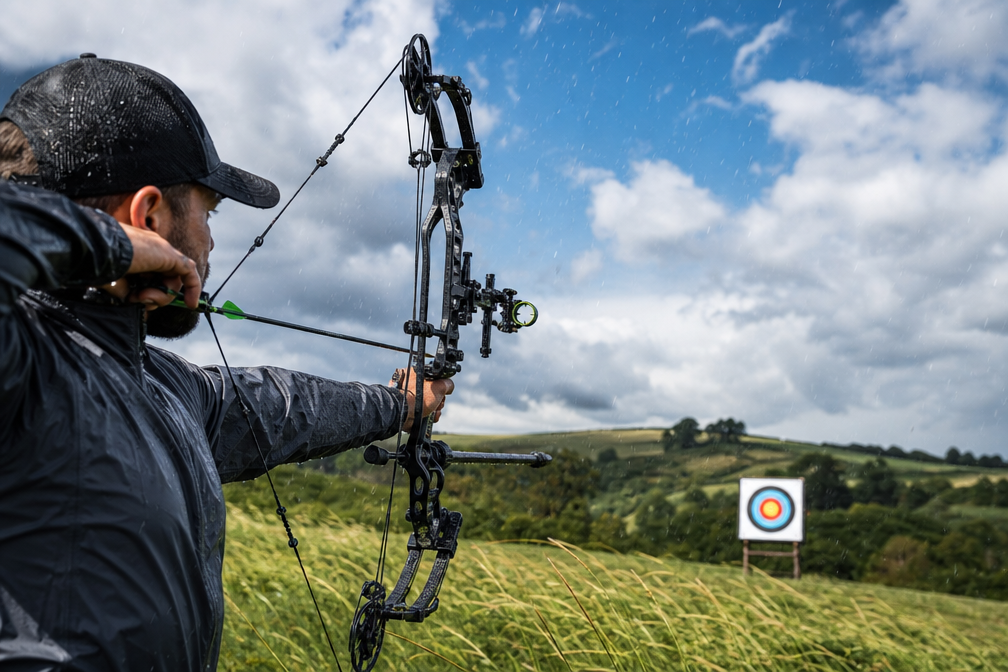
Weather changes how arrows fly by altering air density and creating wind drift - wind is the biggest factor, capable of pushing arrows several inches off target past 40 yards.
Affiliate Disclaimer: We are a participant in the Amazon Services LLC Associates Program, an affiliate advertising program designed to provide a means for sites to earn advertising fees by advertising and linking to Amazon.com. As an Amazon Associate I earn from qualifying purchases. We also participate in other affiliate programs.
Weather dramatically changes how arrows fly by altering air density, creating wind drift, and affecting equipment performance. Wind is the single biggest factor, capable of pushing arrows several inches off target at distances beyond 40 yards, while temperature and humidity change arrow speed by affecting air resistance. Rain adds weight to arrows and reduces visibility, compounding accuracy challenges that even experienced archers must compensate for through aim adjustments and technique modifications.

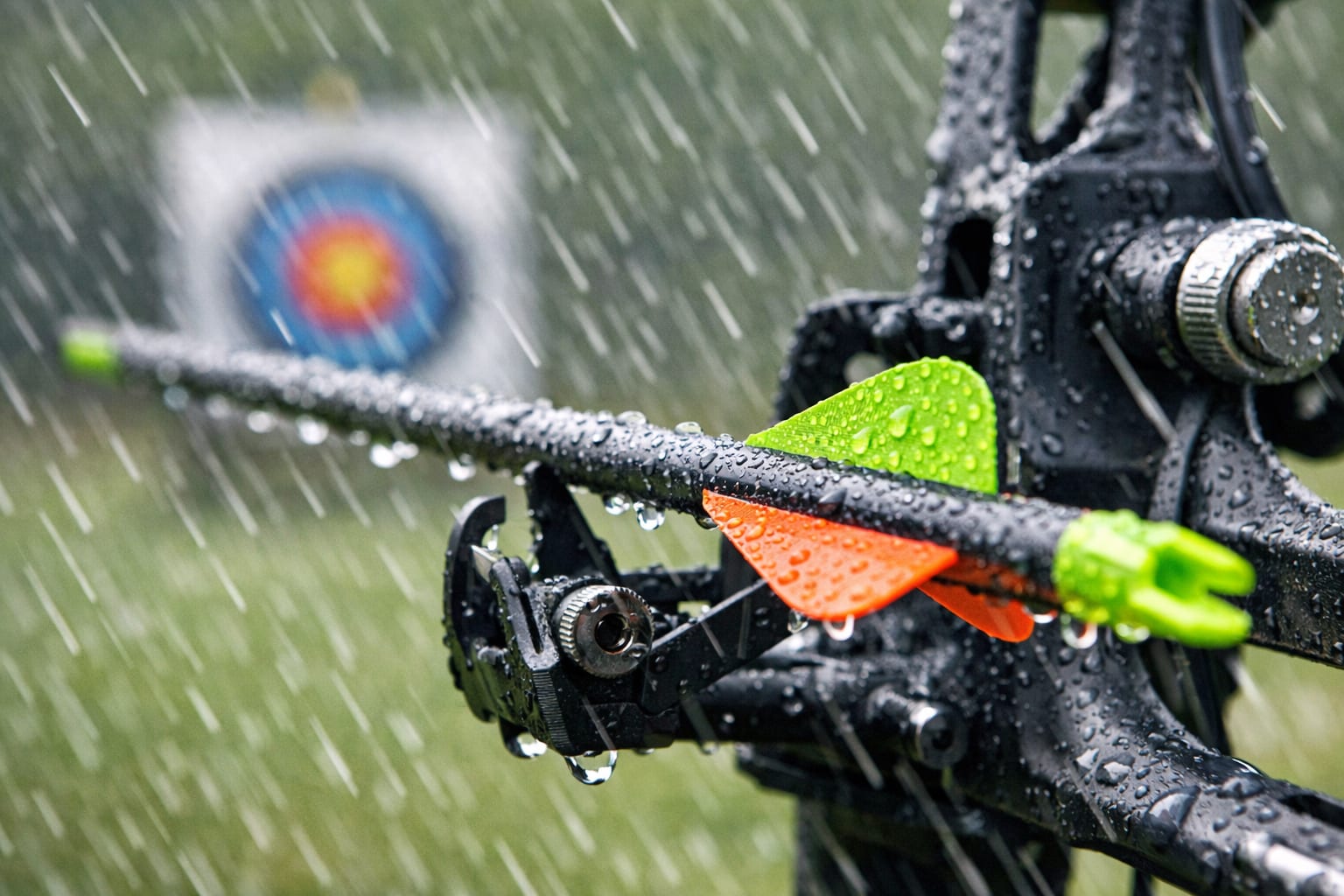
Wind is the most significant weather variable affecting arrow accuracy because it applies continuous lateral force throughout the arrow’s flight path. A 10 mph crosswind can deflect an arrow 4-6 inches at 40 yards and 10-15 inches at 60 yards, with the effect increasing exponentially as distance grows. The arrow’s profile, fletching size, and speed all determine how much wind drift occurs.
Wind affects arrows through three primary mechanisms:
The arrow’s speed matters significantly. Faster arrows (300+ fps) spend less time in flight and experience less total wind drift than slower arrows (250 fps), making bow setup and arrow tuning critical for windy conditions. Heavier arrows resist wind drift better than lighter ones due to their higher momentum, though they also fly slower and have more arc.
Common mistake: Many archers aim into the wind without accounting for the arrow’s changing velocity. The arrow slows throughout its flight, meaning wind has progressively more effect. Aim adjustments should be slightly more aggressive than simple linear calculations suggest, especially beyond 50 yards.
The worst conditions for archery combine strong gusty winds (15+ mph with variable direction), rain or snow, and temperature extremes below 35°F or above 95°F. Gusty winds are more challenging than steady winds because they change during the arrow’s flight, making consistent compensation impossible. Rain reduces visibility, adds weight to equipment, and creates unpredictable air currents, while temperature extremes affect both equipment performance and archer comfort.
Ranking of challenging weather conditions from worst to manageable:
Professional target archers generally avoid shooting when sustained winds exceed 12-15 mph or when gusts reach 20+ mph. Bowhunters face different constraints since they cannot control when game appears, making weather adaptation skills essential for hunting success. Learning to read wind indicators like grass movement, tree sway, and mirage effects helps predict conditions before each shot.
Edge case: Shooting in mountain terrain or near buildings creates localized wind patterns that differ dramatically from open-field conditions. Arrows may experience multiple wind direction changes in a single flight, making these environments particularly challenging even when overall wind speeds seem moderate.
Yes, rain measurably changes arrow flight by adding weight to the arrow and fletching, reducing visibility, and creating unpredictable air currents. A wet arrow can gain 10-20 grains of water weight depending on shaft material and fletching type, which lowers velocity by 2-4 fps and increases drop by 1-3 inches at 40 yards. Plastic vanes absorb less water than feather fletching, making them preferable for wet conditions.
Rain impacts arrow performance through:
The severity depends on rain intensity. Light drizzle has minimal effect on a few shots, but sustained rain over 15-20 minutes saturates equipment and creates cumulative problems. Arrows should be wiped down between shots when possible, and arrow inspection becomes critical since water can hide damage or cracks that compromise safety.
Practical tip: Sight in your bow during light rain if you plan to hunt or compete in wet conditions. The point of impact will shift down and potentially sideways compared to dry conditions, and pre-establishing wet-weather sight settings eliminates guesswork during actual shooting situations.
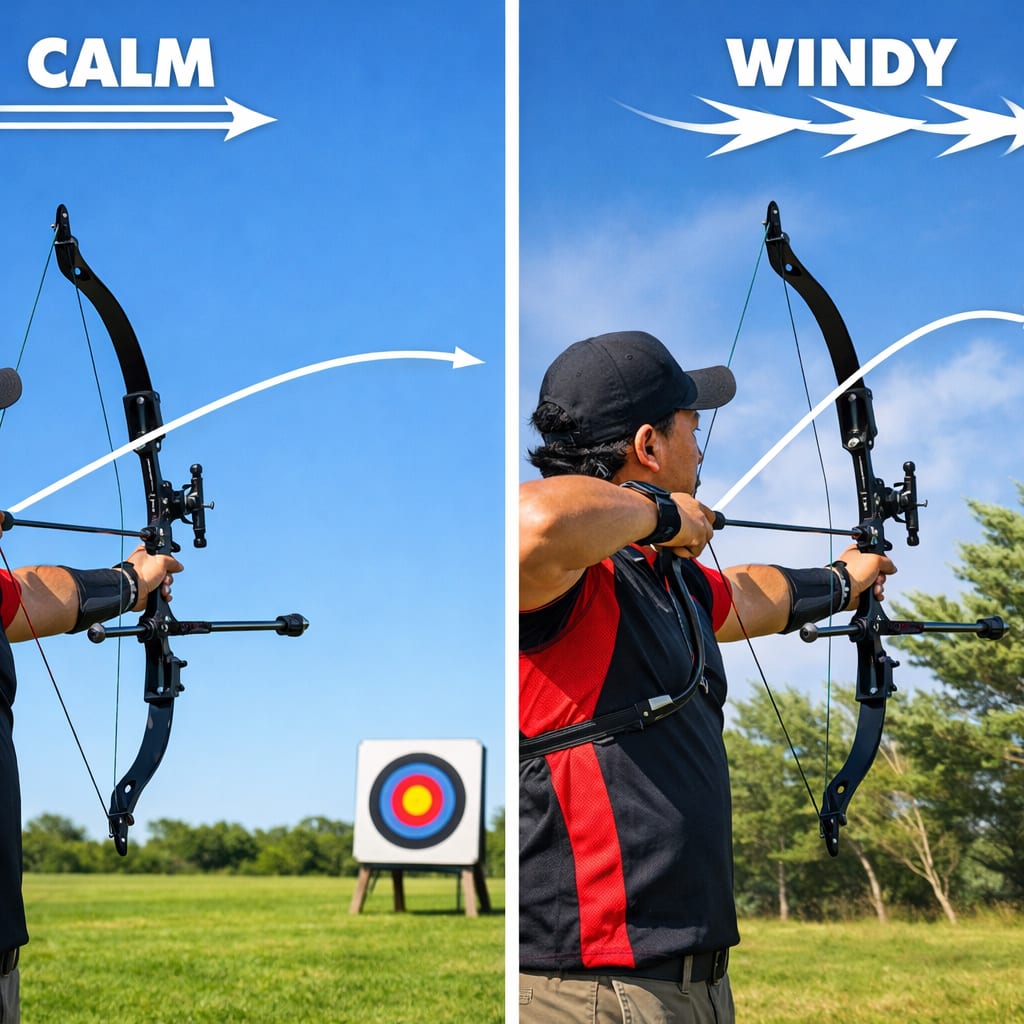
Adjust your aim into the wind by estimating 1-1.5 inches of compensation per 10 mph of crosswind at 20 yards, doubling to 3-4 inches at 40 yards, and increasing to 8-12 inches at 60 yards. The exact amount depends on arrow speed, weight, and fletching size, so establishing your specific bow’s wind drift through practice is essential. Most archers use visual reference points on or near the target rather than adjusting sights for each shot.
Step-by-step wind compensation process:
For bowhunting scenarios, wind compensation becomes more complex because you cannot always wait for ideal conditions. Limiting maximum shot distance in windy conditions is the most reliable strategy, if you normally shoot 50 yards in calm air, consider 35 yards your maximum in 10+ mph winds.
Choose this approach if: You shoot regularly at the same range with predictable wind patterns. Establish a personal wind chart showing hold-off amounts for your specific setup at various distances and wind speeds, then reference it during practice and competition.
Temperature affects arrow flight primarily through air density changes, with cold air being denser and creating more drag than warm air. An arrow shot in 30°F air will fly 2-4 fps slower than the same arrow in 80°F air, resulting in 1-2 inches more drop at 40 yards. Temperature also affects bow performance directly, with limbs and strings becoming stiffer in cold and more elastic in heat, changing draw weight by 1-3 pounds across a 50-degree temperature range.
Temperature impacts on archery equipment and performance:
| Temperature Range | Air Density Effect | Bow Performance | Arrow Speed Change | Practical Impact at 40 Yards |
|---|---|---|---|---|
| Below 32°F | High density, maximum drag | Stiff limbs, brittle strings | -3 to -5 fps | 2-3 inches low |
| 32-60°F | Moderate density | Normal performance | -1 to -2 fps | 1 inch low |
| 60-80°F | Baseline | Optimal | Baseline | Point of impact |
| Above 80°F | Low density, reduced drag | Softer limbs, stretched strings | +1 to +3 fps | 1-2 inches high |
The effect compounds with distance. At 60+ yards, temperature-related trajectory changes can reach 4-6 inches, enough to cause misses on small targets or vital zones. Serious target archers and bowhunters re-sight their bows when temperature changes exceed 20-30 degrees from their last practice session.
Material considerations: Carbon arrows maintain more consistent performance across temperatures than aluminum, which expands and contracts more noticeably. Synthetic bowstrings (BCY-X, 452X) handle temperature swings better than traditional materials, making them preferable for archers who shoot year-round in variable climates.
Common mistake: Archers often sight in their bow during comfortable afternoon temperatures (70-75°F) then hunt in cold morning conditions (35-45°F) without adjusting. This typically results in arrows hitting 2-4 inches low, often below the vital zone on deer-sized game. Always verify your sight settings in conditions matching your intended use.
Yes, accurate shooting in rain is possible but requires technique adjustments, equipment preparation, and acceptance of reduced precision compared to dry conditions. Experienced archers can maintain 4-6 inch groups at 40 yards in light to moderate rain, though this expands from the 2-3 inch groups achievable in ideal conditions. Success depends on using water-resistant equipment, adjusting for the added arrow weight, and maintaining focus despite discomfort.
Essential adaptations for rain shooting:
Professional target archers rarely compete in heavy rain because the accuracy loss makes meaningful competition impossible. However, light rain (under 0.1 inches per hour) is generally considered shootable for practice and some competitions. Archery safety becomes more critical in rain since wet equipment can slip or fail unexpectedly.
For bowhunters: Rain often creates ideal hunting conditions since game movement increases and human scent disperses better. Practicing in rain before the season builds confidence and establishes realistic maximum shot distances for wet conditions, typically 10-15 yards shorter than dry-weather limits.
Arrow drift is the lateral deviation from the intended flight path caused by crosswinds applying force to the arrow’s surface area throughout its flight. Wind pushes against the arrow shaft and fletching continuously, with the effect accumulating over the flight time. A 10 mph crosswind applies roughly 0.15-0.25 pounds of lateral force to a standard arrow, which seems small but acts over 0.3-0.5 seconds of flight time at typical archery distances, resulting in several inches of drift.
Physics of arrow drift:
The amount of drift depends on four primary factors working together. First, wind speed creates the force, drift increases linearly with wind speed, so 20 mph wind causes roughly double the drift of 10 mph. Second, arrow speed determines flight time, faster arrows spend less time exposed to wind and drift less. Third, arrow profile affects how much surface area catches wind, larger diameter shafts and bigger fletching increase drift. Fourth, arrow mass provides inertia to resist lateral force, heavier arrows drift less than lighter ones at the same speed.
The drift pattern is not linear across the arrow’s flight. Maximum drift occurs in the middle third of the trajectory where the arrow has slowed from initial velocity but still has significant remaining flight time. This is why wind compensation requires more than simple proportional aiming, the relationship between distance and drift is exponential, not linear.
Practical example: An arrow shot at 280 fps in a 12 mph crosswind at 50 yards will drift approximately 8-10 inches. The same arrow at 320 fps drifts only 6-7 inches because it reaches the target 0.1 seconds faster, giving wind less time to act. This explains why arrow flight optimization through bow tuning and proper arrow selection matters significantly for outdoor shooting.
Yes, professional archery competitions have specific weather thresholds that trigger delays, modifications, or cancellations to ensure fair competition and safety. Most outdoor target archery events postpone shooting when sustained winds exceed 12-15 mph or gusts reach 20+ mph, as these conditions make consistent scoring impossible and create unfair advantages based on when archers shoot. Rain delays occur when precipitation becomes heavy enough to obscure targets or create unsafe footing.
Typical competition weather protocols:
World Archery (the international governing body) provides guidelines but allows tournament directors discretion based on local conditions. Indoor competitions avoid most weather issues, which is why major championships increasingly use indoor venues or covered ranges. Field archery and 3D competitions generally continue in worse conditions than target events since the format already includes environmental challenges.
For bowhunters: Unlike competitive archers, hunters cannot postpone when game appears. This makes weather shooting skills essential for hunting success. Many experienced hunters specifically practice in poor conditions to build competence and confidence for real hunting scenarios where perfect weather is rare.
Humidity has minimal direct effect on arrow flight physics, changing air density by less than 1% even at extreme humidity differences. Contrary to common belief, humid air is actually slightly less dense than dry air at the same temperature and pressure because water molecules (molecular weight 18) displace heavier nitrogen and oxygen molecules (molecular weight 28-32). This means arrows fly marginally faster in humid conditions, but the difference is typically under 1 fps, too small to measure reliably or require compensation.
Humidity’s real impacts on archery:
The significant effects of humidity are indirect, affecting equipment rather than arrow flight. High humidity (above 70%) causes wooden bow components to swell, natural fiber strings to stretch and lose tension, and leather accessories to become soft and inconsistent. Modern synthetic materials largely eliminate these problems, which is why serious archers use synthetic strings, carbon or aluminum arrows, and composite bow limbs rather than traditional materials.
Humidity effect comparison:
For practical shooting, treat humidity as an equipment maintenance concern rather than a ballistic factor. Store bows in climate-controlled environments when possible, use synthetic strings and plastic vanes, and wipe down equipment after shooting in humid conditions to prevent long-term degradation.
Edge case: Extreme humidity combined with temperature changes can cause condensation on sight lenses and arrow shafts, creating visibility and handling problems. This occurs most often during early morning hunts when cold equipment meets warm, humid air. Allowing equipment to acclimate to ambient temperature before shooting prevents this issue.
Beginners should practice in mild wind conditions (5-8 mph) after establishing basic form consistency in calm air, as this builds essential compensation skills without overwhelming developing technique. Starting in calm conditions allows new archers to isolate form problems from environmental factors, but practicing exclusively in perfect weather creates unrealistic expectations and leaves archers unprepared for real-world shooting. Introduce wind gradually, starting at closer distances where compensation is minimal.
Progressive wind training for developing archers:
Choose calm conditions if: You are working on specific form corrections, testing new equipment, or shooting for score in practice. Wind adds variables that make it difficult to isolate what’s working and what needs adjustment.
Choose windy conditions if: You are preparing for hunting season, building mental toughness, or specifically practicing environmental adaptation skills. Real-world archery rarely offers perfect conditions, so wind practice is essential for field competence.
Common beginner mistake: Practicing only in perfect conditions creates “fair-weather archers” who struggle or refuse to shoot when conditions deteriorate. This severely limits hunting effectiveness and outdoor competition performance. Aim for at least 20-30% of practice time in less-than-ideal conditions once basic skills are established.
The biggest mistake archers make in bad weather is failing to adjust their expectations and technique for the conditions, instead trying to shoot with the same precision and approach that works in ideal weather. This leads to frustration, poor performance, and sometimes dangerous situations when archers take shots beyond their weather-adjusted capability. Other critical errors include inadequate equipment preparation, ignoring safety factors like arrow damage from cold, and not establishing weather-specific sight settings.
Top weather shooting mistakes and corrections:
Mistake: Taking the same maximum distance shots in wind as in calm air
Mistake: Using the same sight settings across major temperature changes
Mistake: Shooting feather-fletched arrows in rain
Mistake: Ignoring equipment stress from cold temperatures
Mistake: Fighting through discomfort instead of adapting
For hunting applications: The most dangerous mistake is taking marginal shots in bad weather that would be refused in good conditions. Wind drift, reduced visibility, and equipment performance issues all increase the risk of wounding rather than cleanly harvesting game. When conditions deteriorate, ethical shot distance decreases proportionally.
Mental game error: Many archers become frustrated when weather degrades their performance and either quit practicing or push harder trying to achieve calm-weather results. Instead, view weather practice as a different skill set, you’re training adaptability and mental toughness, not pure accuracy. Groups that would be unacceptable in calm air may represent excellent shooting in challenging conditions.
Yes, cold weather below 40°F increases brittleness in carbon arrows and significantly raises the risk of catastrophic failure on impact, especially with arrows that have existing micro-cracks or damage. Carbon fiber becomes less flexible and more prone to shattering rather than bending when temperatures drop, turning minor damage that would be safe in warm weather into a serious safety hazard. Aluminum arrows are less affected but can still develop stress fractures more easily in extreme cold.
Cold weather arrow safety considerations:
Carbon arrows experience material property changes as temperature drops. The epoxy resin binding carbon fibers becomes harder and less able to absorb impact energy, meaning arrows that would survive a target impact at 70°F may shatter at 30°F. This is particularly dangerous because carbon splinters can cause serious injuries if an arrow fails during the shot or upon impact.
Temperature-based arrow inspection protocol:
The risk compounds with arrow age and use. An arrow with 500+ shots that performs fine in summer may become unsafe in winter conditions. This is why understanding when to retire an arrow becomes even more critical for cold-weather shooting.
Practical safety rule: Never shoot arrows in freezing temperatures that have any visible damage, have been shot into hard targets (rocks, frozen ground), or are more than two seasons old. The cost of replacing arrows is trivial compared to the medical bills and permanent injury risk from a catastrophic arrow failure.
Aluminum arrow advantage: Aluminum maintains more consistent properties across temperature ranges and typically bends rather than shatters when it fails, making it a safer choice for extreme cold-weather shooting despite being less popular than carbon for most applications.
Compensate for wind when bowhunting by reducing maximum shot distance, using heavier arrows that resist drift better, and waiting for lulls in gusty conditions before releasing. Unlike target archery where you can adjust aim for consistent wind, hunting shots often occur in variable conditions where the wind may change during the arrow’s flight. The most reliable strategy is limiting distance, if you’re confident to 50 yards in calm air, consider 35 yards your maximum in 10 mph winds and 25 yards in 15+ mph conditions.
Bowhunting wind compensation strategy:
Wind reading for hunters: Learn to read natural wind indicators at the shooting location, not just where you’re standing. Grass movement, leaf flutter, and branch sway at the target distance show the wind the arrow will experience. Wind often differs significantly between your elevated stand position and ground level where the animal stands.
Ethical consideration: Wind increases the risk of marginal hits that wound rather than kill cleanly. When wind exceeds your practiced compensation ability, the ethical choice is not shooting. This is why serious bowhunters practice specifically in poor conditions, it expands the range of weather in which they can hunt effectively and ethically.
Equipment note: Mechanical broadheads typically drift more than fixed-blade broadheads in crosswinds due to their larger profile when deployed. However, the difference is usually only 1-2 inches at hunting distances and matters less than proper shot selection and distance discipline. Focus on proper shooting form and wind reading skills rather than obsessing over minor equipment differences.
How much does a 10 mph crosswind affect arrow flight at 40 yards?
A 10 mph crosswind typically causes 3-5 inches of lateral drift at 40 yards for a standard hunting arrow traveling 280 fps. Faster arrows (300+ fps) drift 2-4 inches, while slower arrows (250 fps) may drift 5-7 inches. The exact amount depends on arrow weight, diameter, and fletching size.
Can you shoot a bow accurately in 20 mph wind?
Shooting accurately in 20 mph wind is extremely difficult and generally not recommended for hunting or serious practice. Drift at 40 yards can exceed 10-12 inches, and gusty conditions make consistent compensation impossible. Most archers limit shooting to winds under 15 mph for any precision work.
Do arrows fly faster in hot or cold weather?
Arrows fly slightly faster in hot weather because warm air is less dense and creates less drag. The difference is typically 2-4 fps between 30°F and 80°F conditions, resulting in 1-2 inches less drop at 40 yards in warm weather. Bow performance also improves slightly in moderate heat.
Should I use heavier arrows in windy conditions?
Yes, heavier arrows resist wind drift better due to higher momentum, though they also fly slower and have more arc. For hunting in consistently windy areas, arrows weighing 450-500 grains offer a good balance of wind resistance and trajectory. The improved wind performance usually outweighs the slightly slower speed.
How do professional archers deal with wind during competitions?
Professional archers use detailed wind flags, establish personal wind charts showing hold-off amounts for their equipment, and carefully time their shots during lulls in gusty conditions. They also practice extensively in wind to develop intuitive compensation skills and mental toughness for challenging conditions.
Does rain damage carbon arrows?
Rain itself does not damage carbon arrows, but it adds weight that affects performance and can hide existing damage during inspection. Always dry arrows thoroughly after rain shooting and inspect carefully for cracks or delamination that may have been obscured by water. Wet arrows should be wiped down before storage.
What wind speed is too dangerous for archery?
Sustained winds above 20 mph or gusts exceeding 30 mph create dangerous conditions where arrows can become unpredictable and potentially strike unintended targets. Most ranges and competitions suspend shooting at these thresholds. Additionally, wind strong enough to affect your stance or balance makes safe shooting impossible.
How does altitude affect arrow flight compared to weather?
Altitude affects arrow flight through reduced air density, similar to temperature effects but more pronounced. Arrows fly 1-2% faster per 1,000 feet of elevation gain, resulting in flatter trajectories. An arrow sighted at sea level will hit 2-3 inches high at 40 yards when shot at 5,000 feet elevation without sight adjustment.
Can you practice archery in light snow?
Yes, light snow is shootable though it reduces visibility and adds minor weight to arrows similar to rain. Avoid shooting in heavy snow where you cannot clearly see the target or in conditions where snow accumulation on equipment affects performance. Plastic vanes handle snow better than feather fletching.
Do I need different sight settings for morning vs afternoon shooting?
Temperature differences between morning and afternoon may require sight adjustments if the change exceeds 20-30 degrees. Morning shots in cold air typically hit lower than afternoon shots in warm air by 1-2 inches at 40 yards. Serious target archers and hunters verify their zero in conditions matching their intended shooting time.
How does shooting from an elevated stand affect wind compensation?
Elevated stands place you in potentially different wind conditions than ground level, and the downward shot angle changes how wind affects the arrow. Wind at stand height may be stronger than at ground level, but the arrow spends less time in that wind zone. Generally, compensate based on the wind where the arrow spends most flight time, the middle of its trajectory.
What’s the best way to practice wind compensation skills?
Start at close range (20 yards) in light winds (5-8 mph) and shoot groups while noting drift direction and amount. Gradually increase distance and wind speed as you develop compensation intuition. Keep a wind journal recording conditions, distances, and hold-off amounts to build a personal reference chart for your specific equipment.
Understanding how weather affects arrow flight transforms archery from a fair-weather hobby into a year-round skill that works in real-world conditions. Wind, temperature, rain, and humidity each influence arrow performance through distinct mechanisms, wind creates lateral drift, temperature changes air density and equipment performance, rain adds weight and reduces visibility, while humidity primarily affects equipment rather than flight physics. The key to successful weather shooting is not fighting the conditions but adapting technique, equipment, and expectations to match them.
Take action on weather shooting skills:
Start by establishing your baseline performance in calm conditions, then systematically introduce environmental variables during practice sessions. Build a personal wind chart documenting how much your specific setup drifts at various distances and wind speeds. Re-verify your sight settings when temperature changes exceed 20 degrees from your last practice. Invest in weather-appropriate equipment like plastic vanes for rain and heavier arrows for wind resistance.
Most importantly, reduce your maximum shooting distance proportionally as conditions deteriorate, this single adjustment prevents more problems than any other compensation technique. Whether you’re a target archer seeking competitive success or a bowhunter pursuing ethical harvests, weather shooting competence separates capable archers from those limited to perfect conditions. The next time wind picks up or rain starts falling, head to the range instead of packing up. That’s where real archery skills develop.
For more guidance on optimizing your setup, explore our resources on arrow flight, bow tuning, and archery accuracy.