
Newsletter Subscribe
Enter your email address below and subscribe to our newsletter
All voices matter
All voices matter
 ByTravis
Most archers should build fundamentals at 20 yards before extending to longer distances - beginners start at 10-15 yards, intermediate shooters practice at their common distance plus 10-20 yards.
Affiliate Disclaimer: We are a participant in the Amazon Services LLC Associates Program, an affiliate advertising program designed to provide a means for sites to earn advertising fees by advertising and linking to Amazon.com. As an Amazon Associate I earn from qualifying purchases. We also participate in other affiliate programs.

Most archers should focus practice sessions at 20 yards to build fundamental form and consistency before extending to longer distances. Beginners benefit from starting at 10-15 yards to master basic technique, while intermediate shooters should practice at their most common shooting distances plus 10-20 yards beyond. The specific yardage depends on your discipline: target archers typically practice 18-70 meters, while bowhunters focus on 20-40 yards where most ethical shots occur.
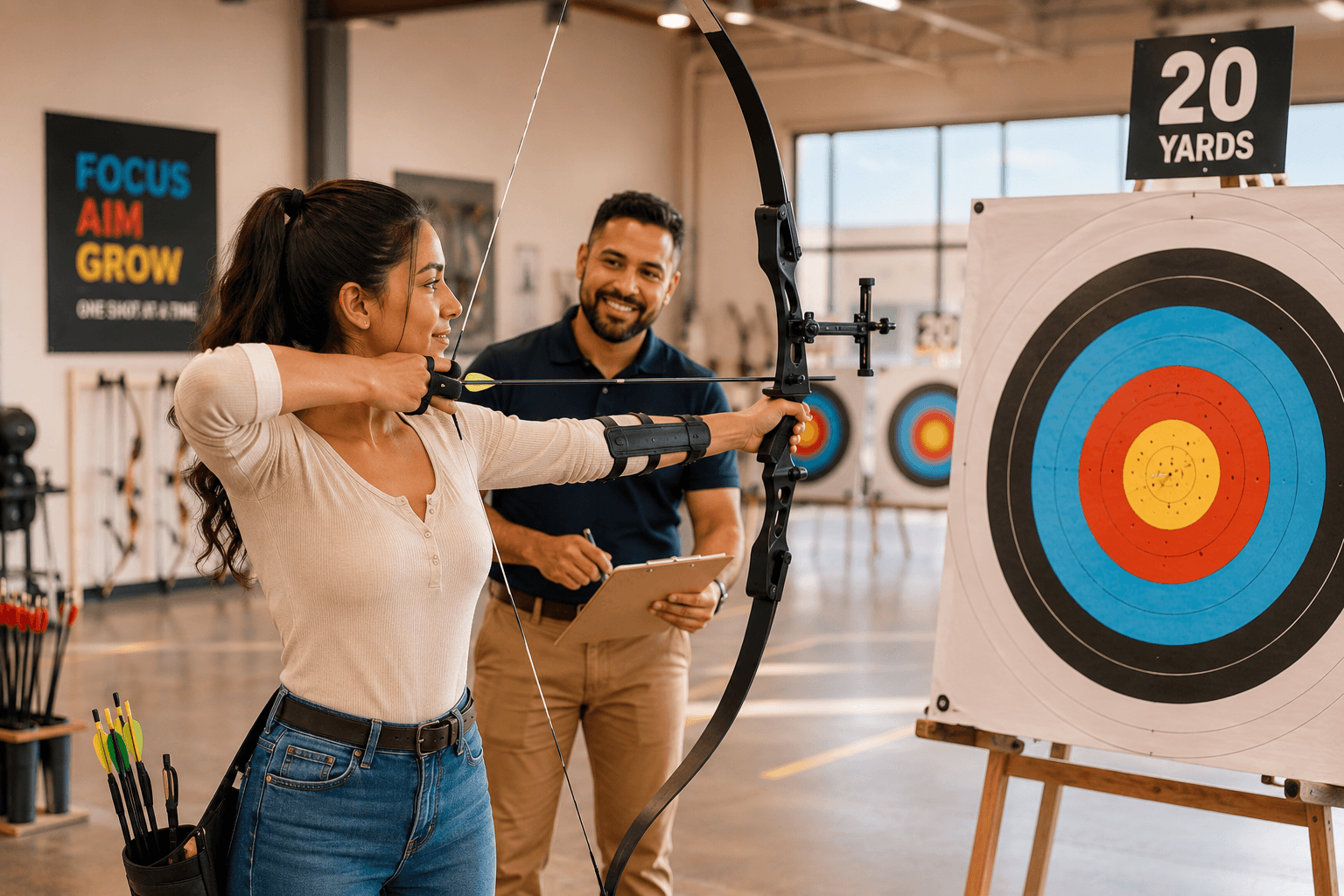
Beginners should start practicing at 10-15 yards and remain at this distance until they can consistently group arrows within a 6-inch circle. This close range allows new archers to focus entirely on form, anchor point, and release without the added complexity of elevation adjustments or wind compensation.
Starting too far back is the most common mistake among new archers. At 10-15 yards, you can clearly see form errors and make immediate corrections. The target appears large enough to build confidence while still requiring proper technique.
Progression timeline for beginners:
The 10-yard starting distance also helps prevent the development of target panic, a psychological condition where archers struggle to hold on target or control their release. Building confidence at close range creates a solid foundation for longer distances.
New archers should dedicate at least 70% of practice time to their current mastery distance. If you’re working on 15-yard consistency, spend 7 out of every 10 ends at that yardage before attempting longer shots.
Choose practice distances based on three factors: your intended use (hunting vs. target), your current skill level, and the distances where you need the most confidence. Most archers should build a practice routine around 3-5 core distances rather than attempting to practice every possible yardage.
Decision framework for selecting practice distances:
For bowhunters:
For target archers:
For recreational shooters:
Track where your arrows land over several practice sessions. If you consistently struggle at a specific distance, that becomes a priority practice yardage. Conversely, distances where you already shoot well need less frequent attention.
Consider your practice frequency when selecting distances. If you practice 2-3 times per week, focus on just 2-3 distances per session. Archers who practice daily can rotate through more yardages while maintaining proficiency.
The most important distance to practice is 20 yards for the majority of archers, regardless of discipline. This distance is close enough to reinforce proper form while far enough to reveal technique flaws, making it the ideal “diagnostic distance” for building and maintaining fundamental skills.
Twenty yards serves as the foundation distance because it requires correct execution without allowing compensation through raw strength or luck. At this range, form errors produce visible results on the target, but the distance remains forgiving enough to maintain confidence.
Why 20 yards matters across disciplines:
Professional coaches often use 20 yards as the “truth distance” during lessons. If an archer shoots well at 40 yards but poorly at 20, the issue is typically form-related rather than aiming or distance judgment.
Dedicate at least 50% of every practice session to 20-yard shooting, even when working on longer-distance skills. This maintains your foundation and prevents form degradation that can occur when focusing exclusively on challenging distances.
Archers should practice specific yardages with full, proper form rather than partial draws or modified technique. Every practice shot should replicate your complete shooting sequence from stance through follow-through, regardless of target distance.
The concept of “full swings” doesn’t directly translate to archery, but the principle applies: practice with your standard draw length, anchor point, and release every time. Modifying your form for different distances creates inconsistency and builds bad habits.
Practice approach for different distances:
Some archers mistakenly believe they should “take it easy” at close range or “try harder” at long range. Both approaches damage consistency. Your 10-yard shot should feel identical to your 40-yard shot, with only sight picture or gap changing.
Practice frequency matters more than distance variety. Shooting 50 arrows at 20 yards with perfect form beats shooting 50 arrows at random distances with inconsistent technique.
Competitive archers practice most frequently at their specific competition distances, with Olympic recurve archers focusing on 70 meters, compound target archers on 50 meters, and indoor competitors on 18 meters. Elite archers typically spend 60-70% of practice time at exact tournament distances.
Competition preparation requires distance-specific practice because each yardage presents unique challenges in sight picture, aiming precision, and mental focus. A 70-meter shot demands different visual processing than an 18-meter shot, even with identical form.
Competition distance breakdown by discipline:
Olympic Recurve:
Compound Target:
3D Archery:
Field Archery:
Professional archers also practice at distances 10-20% beyond their competition maximum to build confidence. A 70-meter competitor might practice at 80-90 meters occasionally, making the competition distance feel more manageable.
Tournament simulation matters as much as distance. Competitive archers practice their competition distances under time pressure, with scoring, and sometimes with distractions to replicate event conditions.
High handicappers should focus 80% of practice time on 15-20 yards until they achieve consistent 6-inch groups, then gradually extend to 25-30 yards. Attempting longer distances before mastering close-range consistency reinforces bad habits and slows skill development.
The term “high handicapper” in archery refers to archers who score below 250 on a 300-round or struggle with basic consistency. These shooters gain far more improvement from perfecting fundamentals at close range than from attempting impressive long-distance shots.
Priority practice structure for developing archers:
High handicappers often make the mistake of practicing at distances where they “want” to shoot rather than where they “should” shoot. If you can’t consistently hit a paper plate at 20 yards, practicing at 40 yards wastes time and builds frustration.
Common form issues become exaggerated at longer distances. Practicing at 15-20 yards allows you to identify and correct problems with grip pressure, anchor consistency, and release timing before they become ingrained habits.
Consider working with proper draw weight as well. Many high handicappers struggle because they’re shooting bows too heavy for their current strength and form development.
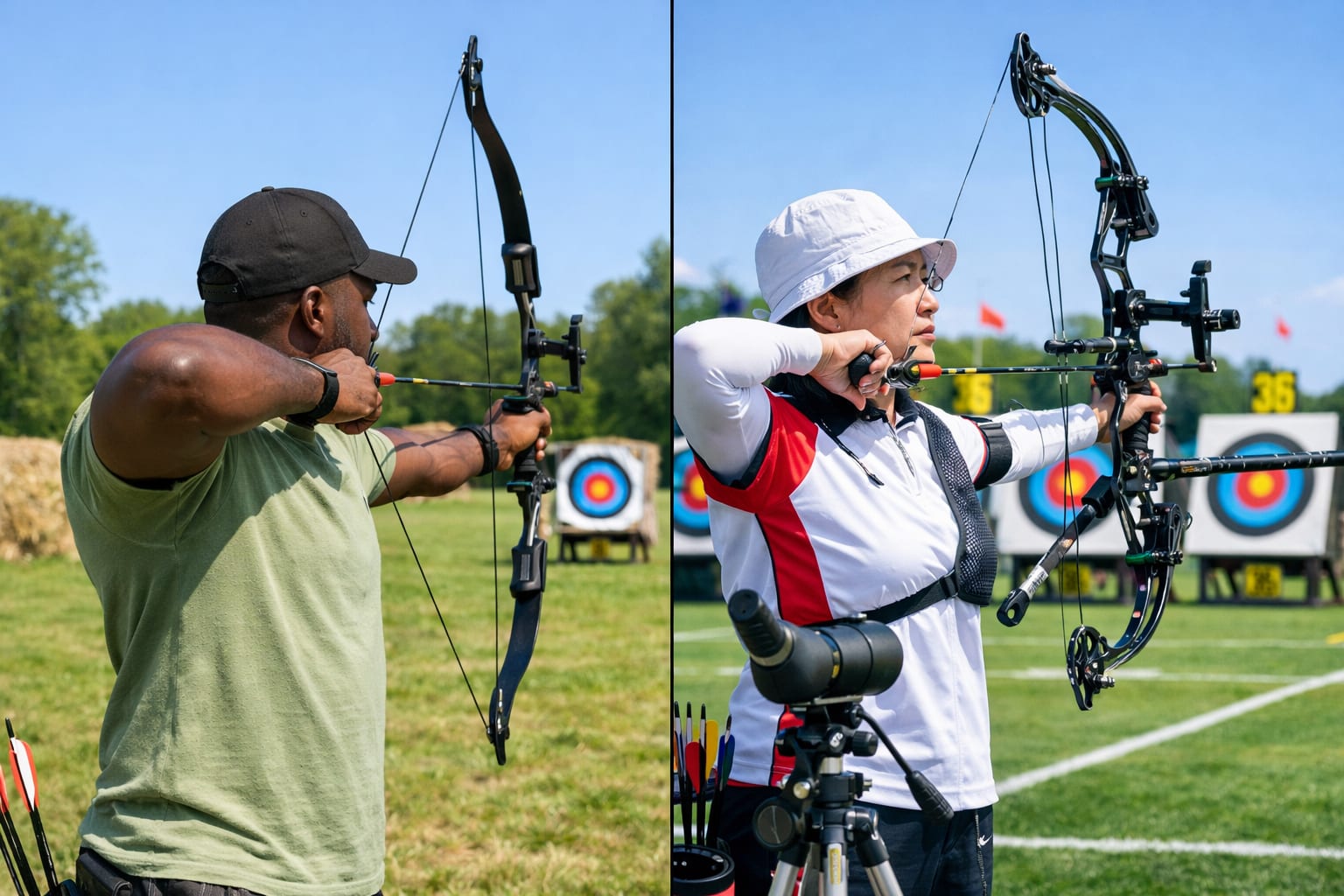
The most common mistake when choosing practice distances is practicing exclusively at ranges that feel comfortable rather than distances that challenge specific weaknesses. Archers often avoid the yardages where they struggle most, which prevents improvement in those exact areas.
Frequent distance selection errors:
Practicing too far too soon: New archers attempting 40+ yard shots before mastering 20-yard consistency develop compensatory habits that become difficult to break. The excitement of long-range shooting undermines fundamental skill building.
Random distance practice: Shooting a few arrows at 10 yards, then 30, then 20, then 40 without structure prevents the repetition needed to build muscle memory. Effective practice requires focused work at specific distances.
Ignoring close-range work: Experienced archers sometimes abandon 10-20 yard practice, viewing it as “too easy.” Close range reveals subtle form flaws that longer distances mask, making it essential for maintenance.
Practicing only competition distances: Target archers who shoot exclusively at 18 meters or 70 meters miss the diagnostic benefits of mid-range practice where form issues become obvious.
Neglecting realistic hunting distances: Bowhunters who practice primarily at 40+ yards prepare for shots they’ll rarely take ethically, while neglecting the 15-25 yard range where most opportunities occur.
Distance hopping during sessions: Changing distances every few arrows prevents proper warm-up and adjustment. Shoot at least 12-18 arrows at each distance before moving.
The solution is structured practice with specific goals. Dedicate each session to 2-3 distances maximum, spending at least 15-20 arrows at each before transitioning. Track your scores or group sizes to identify which distances need more attention.
You need to practice only 3-5 key distances rather than every 10-yard increment, focusing on the ranges where you’ll actually shoot and one distance beyond your typical maximum. Practicing every possible yardage spreads your training too thin and prevents mastery of critical distances.
The “every 10 yards” approach comes from a misunderstanding of how archery skills transfer. Once you’ve mastered proper form and sight adjustment at key distances, intermediate yardages become simple interpolation rather than separate skills requiring dedicated practice.
Efficient distance selection strategy:
For bowhunters:
For target archers:
For recreational shooters:
The gap between practiced distances can be larger than 10 yards without losing proficiency. An archer who shoots well at 20 and 40 yards will typically perform adequately at 25, 30, and 35 yards without specific practice at those increments.
Sight adjustment and gap shooting skills develop through understanding trajectory, not through memorizing every possible distance. Once you know your 20-yard and 40-yard sight settings or gaps, calculating 30 yards becomes straightforward.
In archery, the concept of “yardage gaps between clubs” translates to understanding the effective range of different arrow setups and practicing at distances that reveal performance differences. Most archers should practice with their hunting setup at 10-yard increments from 20-40 yards, and with their target setup at competition-specific distances.
Unlike golf where each club has a specific distance purpose, archery uses the same bow and arrow setup across all distances, with only sight adjustments changing. However, different arrow weights and broadhead choices do affect trajectory and require distance-specific practice.
Practice approach for different setups:
Hunting arrows with broadheads:
Target arrows with field points:
Heavy vs. light arrow setups:
The “gap” concept matters most when switching between practice arrows and hunting arrows. Many bowhunters practice primarily with field points, then wonder why broadheads impact differently. Dedicate at least 20% of pre-season practice to your actual hunting setup at realistic distances.
For archers who shoot both indoor and outdoor competitions with different arrow setups, maintain separate practice routines for each configuration at the relevant distances.
Practicing at 50 yards is too far for developing short-game archery skills; instead, bowhunters and recreational archers should focus on 10-30 yards where most real-world shooting occurs. The “short game” in archery refers to close-range precision, typically 20 yards and under, which requires different practice than long-range shooting.
Fifty yards exceeds the ethical shooting distance for most bowhunters and presents challenges (wind drift, trajectory estimation, target panic) that don’t translate to improving close-range performance. In fact, excessive long-range practice can harm short-game skills by encouraging aiming habits that don’t work at close distances.
Short-game practice structure:
For bowhunters (most important):
For target archers:
For 3D competitors:
The short game in archery emphasizes shot execution under realistic conditions rather than distance achievement. Practice realistic hunting scenarios at close range: shooting from awkward positions, with time pressure, at angled targets, and after physical exertion.
Close-range practice also reveals form flaws that longer distances hide. At 15 yards, even small errors in release or bow torque show clearly on the target, allowing immediate correction.
Dedicate at least 60% of practice time to distances under 30 yards if you’re a bowhunter. The confidence and precision you build at close range transfers upward to longer shots, but long-range practice doesn’t reliably improve short-range performance.
The distances that matter most for hunting success are 20-30 yards, where approximately 70% of ethical bowhunting shots occur. Bowhunters should practice primarily at 20 yards (50% of practice time), 30 yards (30% of practice time), and 40 yards (20% of practice time) to prepare for realistic field conditions.
Field data from successful bowhunts consistently shows that most game is taken at 25 yards or closer. Practicing extensively beyond 40 yards prepares you for shots you’re unlikely to take ethically and may never encounter in actual hunting situations.
Hunting distance priorities by game type:
Whitetail deer (most common):
Elk and larger game:
Turkey and small game:
Beyond practicing specific distances, bowhunters should incorporate realistic variables: shooting from elevated positions (tree stands), kneeling or sitting positions, through small shooting windows, and after the physical exertion of hiking or climbing.
Backyard practice at hunting distances helps build familiarity, but also practice at the range or in 3D courses where you can simulate field conditions more accurately.
The mental aspect of hunting distances matters as much as physical accuracy. Practice at 20-30 yards builds the confidence to pass on marginal 45-yard shots and wait for higher-percentage opportunities.
Practice distance directly affects form development because close ranges (10-20 yards) reveal subtle technique flaws while longer ranges (40+ yards) can mask problems through compensatory aiming. Archers who practice exclusively at long distances often develop inconsistent form that produces acceptable results through luck rather than proper technique.
At 10-15 yards, even minor issues with grip pressure, anchor point consistency, or release timing produce visible impacts on the target. The large target appearance and short arrow flight time eliminate distance estimation and trajectory as variables, isolating pure form execution.
How different distances reveal specific form issues:
10-15 yards (diagnostic distance):
20-30 yards (foundation distance):
40-50 yards (challenge distance):
60+ yards (advanced distance):
Professional coaches typically diagnose form problems at 15-20 yards, then verify corrections at longer distances. If an archer shoots poorly at 40 yards, the coach moves them to 15 yards to isolate the root cause rather than attempting fixes at the longer distance.
The progression should always be: master form at close range, verify at medium range, challenge at long range. Skipping the close-range foundation creates archers who can sometimes hit targets but don’t understand why they miss.
Regular close-range practice also prevents form degradation. Even experienced archers should dedicate 20-30% of every session to 15-20 yards to maintain fundamental technique.
A balanced practice routine dedicates 50-60% of time to your primary distance, 20-30% to a shorter diagnostic distance, and 10-20% to a longer challenge distance. This structure builds consistency while preventing stagnation and maintaining motivation through variety.
Sample practice session structures:
Bowhunter routine (90 arrows, 60 minutes):
Target archer routine (120 arrows, 90 minutes):
Recreational shooter routine (60 arrows, 45 minutes):
The specific distances matter less than the structure: start close for warm-up, spend most time at your priority distance, include some challenge work, and end with confidence-building shots.
Track your practice with a simple log noting distance, arrow count, and group size or score. This data reveals which distances need more attention and documents improvement over time.
Vary your practice routine every 4-6 weeks to prevent plateaus. If you’ve been focusing on 20 and 30 yards, shift to 25 and 35 yards for a month. The change stimulates adaptation while maintaining your core skills.
Consider incorporating specific practice drills even at familiar distances to maintain engagement and target specific skills like shot timing, aiming precision, or mental focus.
What is the best starting distance for someone who has never shot a bow?
Complete beginners should start at 5-10 yards for their first session to learn basic safety and bow operation, then move to 10-15 yards for regular practice once they understand the fundamentals. This extremely close range builds confidence and allows instructors to safely correct form without the frustration of missing the target entirely.
How long should I practice at each distance before moving farther?
Practice at each distance until you can consistently group arrows within a 6-inch circle for at least three consecutive ends (18 arrows total) before extending range. For most archers, this takes 3-6 practice sessions at each distance, though progression speed varies with practice frequency and natural aptitude.
Should I practice at longer distances than I’ll actually shoot?
Yes, occasionally practicing 10-20 yards beyond your typical maximum distance builds confidence and makes your normal range feel easier, but this should represent only 10-15% of total practice time. The majority of practice should occur at distances you’ll actually shoot in competition or hunting situations.
What distance should I practice at if I only have 30 minutes?
Focus exclusively on 20 yards if you have only 30 minutes, shooting 40-50 arrows with attention to consistent form rather than trying to cover multiple distances. This single-distance focus provides more skill development than rushing through several yardages.
Do indoor and outdoor practice require different distances?
Indoor practice typically occurs at shorter distances (18 meters/20 yards) due to range limitations, while outdoor practice allows longer distances, but the fundamental skills transfer between environments. If you compete in both, practice at the specific distances for each discipline.
How do I know if I’m ready to practice at longer distances?
You’re ready to extend distance when you can shoot a 6-inch group at your current distance for three consecutive ends and feel confident in your form consistency. Rushing to longer distances before achieving this consistency reinforces bad habits and slows overall progress.
Should I practice at the same distances every session?
Dedicate 60-70% of practice time to consistent core distances (typically 20 and 30 yards for most archers) while varying the remaining 30-40% to prevent boredom and address specific weaknesses. Complete consistency builds mastery, but some variety maintains motivation.
What’s the maximum distance I should practice at as a bowhunter?
Bowhunters should practice at a maximum of 10 yards beyond their ethical shooting limit, typically 40-50 yards for most hunters. Practicing beyond this range doesn’t improve hunting success and may encourage taking shots beyond your reliable accuracy range.
How does practice distance change with different bow types?
Compound bows allow accurate practice at longer distances due to let-off and sight systems, while traditional bows (recurve, longbow) typically require more close-range practice to develop instinctive aiming skills. The fundamental principle of mastering close range before extending distance applies to all bow types.
Should I practice at unmarked distances to prepare for hunting?
Yes, incorporate unmarked distance practice for 20-30% of your hunting preparation, but only after you’ve mastered known distances at 20, 30, and 40 yards. Unknown distance practice develops range estimation skills but shouldn’t replace fundamental accuracy work at known distances.
What distance reveals target panic most clearly?
Target panic typically becomes most obvious at 10-15 yards where the large target appearance triggers anxiety about holding and releasing. If you can shoot well at 30 yards but struggle at 10 yards, target panic is likely the issue rather than a form problem.
How often should I practice at my maximum distance?
Practice at your maximum distance only once per week or 10-15% of total practice time, dedicating most sessions to distances where you need consistency rather than attempting impressive long shots. Maximum distance work builds confidence but doesn’t develop the fundamental skills that improve overall performance.
Selecting the right practice distances is fundamental to archery development and long-term success. Most archers benefit from focusing 50-60% of practice time at 20 yards, where form issues become visible but the distance remains manageable enough to build confidence. Beginners should start at 10-15 yards and progress gradually, while experienced shooters should maintain regular close-range practice even as they develop long-range capabilities.
The key insight is that practice distance should match your actual shooting needs rather than your aspirations. Bowhunters gain more from mastering 20-30 yards than from attempting 60-yard shots they’ll never take ethically. Target archers should focus on competition distances plus diagnostic work at shorter ranges. High handicappers improve fastest by perfecting fundamentals at close range rather than struggling at distances beyond their current skill level.
Build a structured practice routine that includes warm-up at close range, focused work at your primary distance, and occasional challenge sessions at longer ranges. Track your progress at each distance to identify weaknesses and measure improvement. Remember that consistency at key distances beats occasional success at impressive ranges.
Start your next practice session with a clear distance plan: dedicate the first 15 minutes to 10-15 yards for form verification, spend 30-40 minutes at your primary distance (typically 20 yards), and finish with 10-15 minutes at a challenge distance. This structure builds the foundation for long-term accuracy and confidence at any range you’ll encounter in competition or the field.


