
Newsletter Subscribe
Enter your email address below and subscribe to our newsletter

All voices matter
All voices matter

 ByTravis
Walk-back tuning has you shoot from progressively longer distances to spot and correct horizontal arrow drift caused by sight or rest misalignment.
Affiliate Disclaimer: We are a participant in the Amazon Services LLC Associates Program, an affiliate advertising program designed to provide a means for sites to earn advertising fees by advertising and linking to Amazon.com. As an Amazon Associate I earn from qualifying purchases. We also participate in other affiliate programs.

Quick Answer: Walk-back tuning is a bow tuning method where archers shoot at targets from progressively increasing distances (typically 20, 30, 40, and 50 yards) to identify and correct horizontal arrow drift caused by improper sight alignment or rest positioning. By observing how arrow groups shift left or right as distance increases, archers can adjust their sight housing or rest to achieve perfect vertical alignment and consistent accuracy at all ranges.
Walk-back tuning works by exploiting the geometric relationship between sight alignment, arrow trajectory, and distance to reveal horizontal misalignment that isn’t obvious at close range. When your bow’s sight and arrow rest are perfectly aligned vertically, arrows will impact in a straight vertical line as distance increases, with only elevation changes due to arrow drop.
The physics behind this method is straightforward. Your sight pin sits several inches to the side of your arrow’s launch point. If the sight housing is canted even slightly left or right, or if your rest pushes arrows off-center, this angular error multiplies with distance. At 20 yards, a 1-degree misalignment might cause a half-inch deviation. At 50 yards, that same error produces a 3-4 inch miss.
The walk-back process reveals these issues through:
This method is more reliable than paper tuning alone because it tests your entire shooting system under real-world conditions, including your form, release, and equipment working together across practical hunting and competition distances.
Walk-back tuning in archery is a field-proven diagnostic technique that identifies and corrects horizontal alignment errors in your bow setup by shooting at targets placed at incrementally longer distances. Unlike other tuning methods that focus on arrow flight characteristics at a single distance, walk-back tuning evaluates your entire system’s performance across your effective shooting range.
This method is particularly valuable for archers who need consistent accuracy at varying distances, such as 3D competitors, field archers, and bowhunters who may not have time to range every shot. When properly executed, walk-back tuning ensures that your sight adjustments for elevation (up and down) are the only changes needed as distance varies, windage (left and right) remains constant.
Walk-back tuning is essential for:
The technique assumes you’ve already addressed fundamental setup issues like proper arrow spine, nocking point location, and basic center shot alignment. Walk-back tuning is the final refinement step that takes a good-shooting bow and makes it exceptional across all distances.
You should use walk-back tuning after completing basic bow setup and paper tuning, but before finalizing your sight tape or pin settings for multiple distances. This method is specifically designed to catch horizontal alignment errors that other tuning techniques miss or can’t accurately diagnose.
Use walk-back tuning when:
Skip walk-back tuning or delay it if:
Walk-back tuning complements rather than replaces other tuning methods. Think of paper tuning as diagnosing arrow flight off the bow, while walk-back tuning diagnoses your sight-to-rest relationship across practical shooting distances. Both are necessary for a fully optimized setup.
Walk-back tuning requires methodical execution and careful observation. Follow this proven process to achieve perfect vertical alignment across all distances.
Equipment and setup requirements:
The walk-back tuning process:
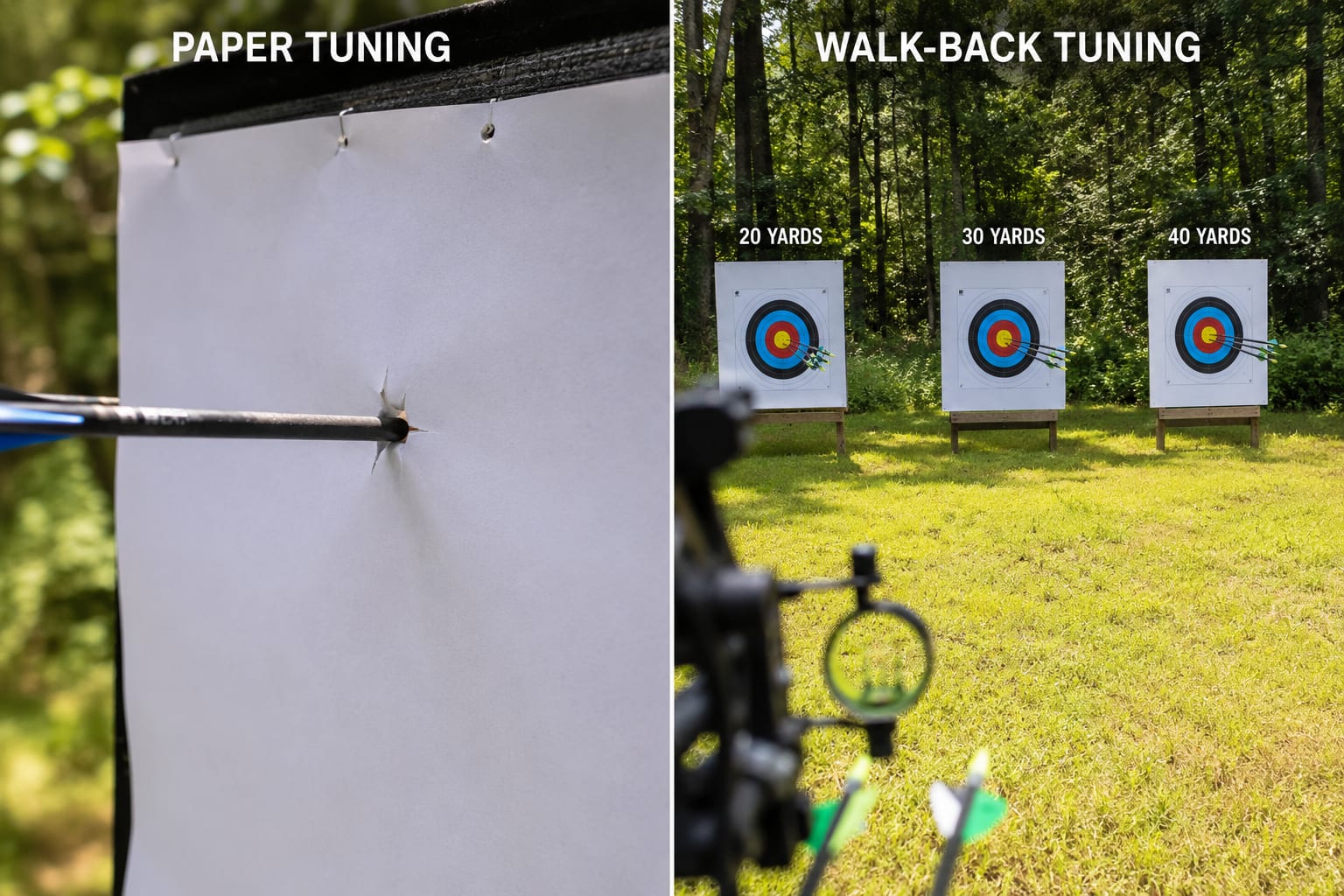
Establish your baseline at 20 yards – Shoot a 3-5 arrow group aiming at the center of your target. Mark the center point of this group. This is your reference point.
Move to 30 yards – Without adjusting your sight, aim at the same spot on the target and shoot another 3-5 arrow group. Note whether the group center is left, right, or vertically aligned with your 20-yard group.
Continue to 40 and 50 yards – Repeat the process at each distance, always aiming at the same point and observing the horizontal relationship between groups.
Analyze the pattern – Draw an imaginary line connecting the centers of all four groups. If the line is perfectly vertical, your bow is tuned. If the line angles left or right, adjustments are needed.
Make corrections based on drift direction:
Verify your adjustment – Shoot the entire sequence again from 20-50 yards to confirm the drift is corrected. You may need 2-3 iterations to achieve perfect vertical alignment.
Final confirmation – Once groups form a vertical line, shoot additional groups at each distance to verify consistency. Your windage should now be locked in for all distances.
Pro tip: Make adjustments to your sight housing rather than your rest if possible. Rest adjustments can affect arrow clearance and paper tune results, while sight adjustments only change your point of aim.
Even experienced archers make errors during walk-back tuning that lead to incorrect adjustments or frustration. Avoiding these pitfalls will save time and arrows.
The most frequent walk-back tuning mistakes:
Inconsistent shooting form – If your anchor point, grip pressure, or release execution varies between shots, you’ll see horizontal spread that has nothing to do with equipment alignment. Shoot at least 3-5 arrows per distance and look for the group center, not individual flyers. If your groups are larger than 4-6 inches at 40 yards, work on form consistency before tuning equipment.
Tuning in windy conditions – Even a 5-10 mph crosswind will push arrows horizontally and mask or exaggerate actual alignment issues. Always walk-back tune on calm days, preferably in the morning or evening when wind is minimal. If you must tune with some wind, shoot additional arrows and average the results.
Making large adjustments – Moving your sight or rest 1/8 inch at a time will overshoot the correction and create new problems. Start with 1/32 inch movements (or 1-2 clicks on micro-adjustable sights) and verify results before making additional changes.
Changing multiple variables simultaneously – Adjusting both your sight housing and rest position in the same tuning session makes it impossible to know which change fixed (or created) the problem. Pick one adjustment point and stick with it throughout the process.
Not marking group centers accurately – Eyeballing the center of a group leads to imprecise corrections. Use a ruler or measuring tape to find the mathematical center of your arrow impacts, or use a marker to draw crosshairs through the group.
Tuning with damaged or inconsistent arrows – Bent nocks, damaged fletching, or arrows with different spine ratings will produce erratic results. Verify all arrows are straight and identical before beginning walk-back tuning.
Stopping at 30 yards – Some archers shoot 20 and 30 yards, see good results, and assume they’re done. Alignment errors often don’t become obvious until 40-50 yards. Always complete the full distance progression to catch subtle issues.
Walk-back tuning serves a specific purpose in the bow tuning hierarchy and works best when combined with other methods rather than used in isolation.
Paper tuning focuses on arrow flight immediately off the bow by shooting through paper and analyzing the tear pattern. It diagnoses issues like nocking point height, rest position, and arrow spine. Paper tuning is essential for establishing basic arrow flight but can’t detect sight alignment issues because you’re shooting at close range (typically 6-8 feet) without using your sight.
Walk-back tuning picks up where paper tuning leaves off by testing your sight-to-rest relationship across practical shooting distances. It assumes arrow flight is already clean and focuses exclusively on horizontal alignment. You need both methods for a fully tuned bow.
Bare shaft tuning involves shooting arrows without fletching alongside fletched arrows to identify arrow spine and rest position issues. Bare shafts reveal problems that fletching can steer around. This method is excellent for diagnosing spine issues but doesn’t test sight alignment at distance.
French tuning (group tuning) involves shooting groups while systematically moving your rest in small increments to find the position that produces the tightest groups. This method is time-consuming but can reveal the optimal rest position for your specific shooting style. Walk-back tuning is faster and more specifically targets horizontal alignment.
| Tuning Method | What It Diagnoses | Best Used When | Time Required |
|---|---|---|---|
| Paper Tuning | Arrow flight off the bow, nocking point, basic rest position | Initial setup, after component changes | 15-30 minutes |
| Walk-Back Tuning | Sight-to-rest horizontal alignment across distances | After paper tuning, before finalizing sight settings | 30-60 minutes |
| Bare Shaft Tuning | Arrow spine matching, rest position fine-tuning | Diagnosing spine issues, optimizing arrow selection | 45-90 minutes |
| French Tuning | Optimal rest position for tightest groups | Final optimization for competition setups | 2-3 hours |
The optimal tuning sequence: Start with paper tuning to establish clean arrow flight, then perform walk-back tuning to perfect sight alignment, and finally use group tuning or bare shaft tuning if you’re chasing the last few percentage points of accuracy for competition.
Walk-back tuning works effectively with compound bows, recurve bows with sights, and traditional bows equipped with adjustable aiming systems. The fundamental principle, that horizontal misalignment magnifies with distance, applies to any bow where you can adjust sight position or rest location.
Compound bows are ideal candidates for walk-back tuning because they typically feature micro-adjustable sights and rests that allow precise corrections. The method works with both multi-pin hunting sights and single-pin target sights. Compound shooters benefit most from walk-back tuning because the bow’s mechanical advantage and let-off allow consistent form, making equipment issues easier to isolate.
Recurve bows with sights also respond well to walk-back tuning, particularly for Olympic recurve setups used in target archery. The process is identical to compound bow tuning, though recurve shooters may need more arrows per group due to the additional form variables inherent in shooting without let-off.
Traditional bows and barebow recurves present challenges because most don’t use sights. However, archers who use fixed crawl techniques (where finger position on the string changes with distance) or string walking can still benefit from walk-back tuning to optimize rest position. The method reveals whether arrows are launching left or right of the intended line, even without a sight.
Crossbows can be walk-back tuned using the same principles, though the shorter power stroke and higher arrow speeds mean alignment errors may be less pronounced. Crossbow shooters should extend the maximum distance to 60-70 yards to make drift patterns more visible.
Choose walk-back tuning if:
Skip walk-back tuning if:
Walk-back tuning benefits both hunting and target archery, but the implementation and priorities differ based on your shooting discipline and accuracy requirements.
For bowhunters, walk-back tuning ensures reliable accuracy across the 20-50 yard range where most ethical shot opportunities occur. Hunting situations rarely allow time to range a target and adjust a single-pin sight, so having a bow that shoots true at any distance within your effective range is critical. Walk-back tuning eliminates the horizontal drift that causes marginal hits on vitals.
Hunters should prioritize walk-back tuning after setting up a new bow or when switching between hunting bow configurations (like adding a heavier stabilizer or changing arrow weight). The method is particularly valuable for Western hunters taking longer shots at elk or mule deer in open terrain, where a 40-yard shot might present itself without warning.
For target archers, walk-back tuning is essential for field archery, 3D competitions, and outdoor target rounds where distances vary. Field archers shooting unmarked distances rely on walk-back tuning to ensure their sight tape or multi-pin setup is accurate across the entire course. A bow that’s off by 2 inches horizontally at 50 yards can cost multiple points per round.
Olympic recurve and compound target archers shooting known distances at 50, 60, and 70 meters still benefit from walk-back tuning during initial setup, even though they’ll fine-tune each distance individually. The method ensures the foundation is correct before making distance-specific adjustments.
Key differences in application:
Both disciplines benefit from the confidence that comes with knowing your bow is mechanically sound across all distances. When you miss, you know it’s a form or execution issue, not an equipment problem.
Sometimes walk-back tuning reveals problems that aren’t easily fixed with simple sight or rest adjustments. Understanding these edge cases helps you diagnose and resolve complex tuning issues.
Problem: Groups drift in a curve rather than a straight line
This pattern suggests multiple issues are present simultaneously. The most common cause is inconsistent shooting form combined with a minor equipment misalignment. Shoot additional arrows at each distance to verify the pattern is consistent, not just random scatter. If the curve persists, return to paper tuning to check for basic arrow flight issues, then verify your arrows are properly spined for your draw weight and draw length.
Problem: Drift direction changes between distance intervals
If groups drift right from 20-30 yards but then drift left from 30-40 yards, you likely have a form inconsistency that changes with distance. Many archers unconsciously adjust their anchor point or grip pressure at longer distances. Video your shooting form at each distance to identify changes in posture, head position, or release execution.
Problem: Vertical spread increases dramatically with distance
While walk-back tuning focuses on horizontal alignment, excessive vertical spread indicates arrow flight or spine issues. Check for damaged fletching, bent arrows, or inconsistent release execution. Bare shaft tuning can help diagnose spine problems that cause vertical dispersion.
Problem: Adjustments don’t produce expected results
If moving your sight right causes groups to move left (or vice versa), you’re either adjusting the wrong component or misreading the drift direction. Remember: for right-handed shooters, moving the sight housing right moves impact right; moving the rest right moves impact left. Double-check which component you’re adjusting and verify you’re making changes in the correct direction.
Problem: Perfect tune at 20-40 yards but drift appears at 50 yards
This suggests your arrows are marginally under-spined or your rest position is slightly off. The additional arrow flex at longer distances reveals issues that aren’t apparent at closer ranges. Consider increasing arrow spine stiffness or making a small rest adjustment (1/64 inch) and retesting.
Problem: Tune changes day-to-day or after transport
If your walk-back tune doesn’t hold, check for loose sight mounting screws, rest mounting bolts, or limb bolts. Vibration during transport can cause micro-movements in components. Apply thread-locking compound to critical fasteners and verify all mounting hardware is properly torqued.
Walk-back tuning requires a moderate time investment but delivers accuracy improvements that persist for months or even years with proper equipment maintenance. Understanding the time and resource requirements helps you plan effective tuning sessions.
Time requirements for a complete walk-back tuning session:
Experienced archers who have walk-back tuned multiple bows can often complete the process in 30-40 minutes, while beginners should budget 90 minutes for their first attempt. The time investment is front-loaded, once your bow is properly tuned, you won’t need to repeat the process unless you change major components.
Arrow consumption: Expect to shoot 30-50 arrows during a complete walk-back tuning session, including verification groups. This is modest compared to other tuning methods like French tuning, which can require 100+ arrows.
Frequency of re-tuning: Most archers only need to walk-back tune once per season or after significant equipment changes. Unlike sight adjustments for individual distances, which you might tweak regularly, walk-back tuning establishes a baseline that remains stable. Re-tune if you:
Cost considerations: Walk-back tuning itself is free, you’re just shooting arrows you already own at targets you already have access to. The only potential costs are range fees (if you don’t have access to a private range with 50+ yards of space) and arrow replacement if you damage shafts during the process.
Compared to paying a professional bow technician $50-100 for tuning services, learning to walk-back tune yourself saves money and gives you the knowledge to maintain your equipment independently. The skill transfers to every bow you’ll own in the future.
Walk-back tuning is most valuable for intermediate to advanced archers who have mastered basic shooting fundamentals and want to optimize their equipment for multi-distance accuracy. The method assumes you can shoot consistent groups and distinguish between form errors and equipment issues.
Ideal candidates for walk-back tuning:
Who should delay or skip walk-back tuning:
If you’re just getting started with archery, focus on developing consistent form and learning to shoot tight groups at 20 yards before investing time in advanced tuning methods. Walk-back tuning amplifies the accuracy of a well-executed shot but can’t compensate for fundamental form problems.
The skill progression for most archers looks like:
Once you reach the point where your groups are limited by equipment rather than form, walk-back tuning becomes one of the highest-value skills you can learn. The method is straightforward enough that most archers can master it in a single session, and the accuracy improvements are immediately noticeable.
While walk-back tuning is highly effective for correcting horizontal alignment, several alternative methods can achieve similar results or address different aspects of bow optimization. Understanding these alternatives helps you choose the right approach for your specific situation.
Laser bore sighting uses a laser mounted in place of an arrow to verify that your sight and rest are aligned on the same vertical plane. This method is fast and doesn’t require shooting arrows, but it can’t account for arrow paradox (the way arrows flex around the riser during launch) or real-world shooting form variables. Laser alignment is best used as a starting point before confirming with walk-back tuning.
Sight tape verification shooting involves shooting groups at every distance on your sight tape (or at each pin setting) and adjusting windage individually for each distance. This method works but is time-consuming and doesn’t address the root cause of horizontal drift. You’re compensating for misalignment rather than correcting it. Walk-back tuning is more efficient because it fixes the underlying issue.
Professional bow tuning services offered by archery pro shops can save time if you’re uncomfortable making adjustments yourself. Experienced technicians can walk-back tune your bow in 30-45 minutes and often catch issues you might miss. Expect to pay $50-100 for comprehensive tuning services. This is a good option for beginners who want to learn by watching a professional work.
Broadhead tuning is essential for bowhunters and involves shooting fixed-blade broadheads alongside field points to verify they impact the same location. While not a replacement for walk-back tuning, broadhead tuning should be performed after walk-back tuning is complete. The larger surface area of broadheads can reveal rest position issues that field points don’t show.
Yoke tuning (for compound bows with split-yoke cam systems) addresses cam lean and timing issues that can cause horizontal drift. If your walk-back tuning reveals severe drift that can’t be corrected with sight or rest adjustments, yoke tuning may be necessary to level the cams before proceeding with walk-back tuning.
Choosing the right method:
Most serious archers use walk-back tuning as the foundation of their setup process, supplemented by other methods as needed for specific situations. The combination of paper tuning (for arrow flight), walk-back tuning (for sight alignment), and broadhead tuning (for hunting setups) covers 95% of tuning needs for recreational and competitive archers.
How often should I perform walk-back tuning on my bow?
Walk-back tune your bow once per season or after changing major components like your sight, rest, arrows, or stabilizer system. The tune remains stable for months if your equipment is properly maintained and mounting hardware stays tight. Re-tune if you notice consistent horizontal drift that wasn’t present before.
Can I walk-back tune with a multi-pin sight?
Yes, walk-back tuning works perfectly with multi-pin sights. Use your 20-yard pin for all distances during the tuning process, aiming at the same spot on each target. Once tuning is complete, set your remaining pins for their respective distances. The horizontal alignment will be correct for all pins.
What if I don’t have access to 50 yards for walk-back tuning?
You can walk-back tune at shorter distances (10, 20, 30 yards) but the drift patterns will be less pronounced, making adjustments less precise. If space is limited, extend to the maximum distance available and shoot additional arrows per group to better identify the center point. Even 30 yards of range is sufficient to catch major alignment issues.
Does walk-back tuning work for left-handed archers?
Walk-back tuning works identically for left-handed archers, but the adjustment directions are reversed. If groups drift right as distance increases, move your sight housing right or move your rest left (opposite of right-handed shooters). The underlying principle remains the same regardless of handedness.
Should I walk-back tune before or after setting my sight tape?
Always walk-back tune before finalizing your sight tape or pin settings. Walk-back tuning establishes correct horizontal alignment, which is the foundation for accurate elevation adjustments. If you set your sight tape first and then walk-back tune, you’ll need to re-shoot your sight tape after making alignment corrections.
Can walk-back tuning fix arrow flight problems?
Walk-back tuning specifically addresses sight-to-rest horizontal alignment and won’t fix fundamental arrow flight issues like poor arrow spine, incorrect nocking point height, or rest clearance problems. Complete paper tuning and bare shaft tuning first to establish clean arrow flight, then use walk-back tuning to perfect sight alignment.
What’s the minimum group size I need before walk-back tuning?
Your groups should be 6 inches or smaller at 30 yards before walk-back tuning will be effective. Larger groups indicate form inconsistency or fundamental equipment issues that will mask alignment problems. Work on shooting fundamentals and basic bow setup until you can shoot consistent groups, then proceed with walk-back tuning.
Do I need to walk-back tune separately for field points and broadheads?
Walk-back tune with field points first to establish correct sight alignment. After walk-back tuning is complete, perform separate broadhead tuning to verify fixed-blade heads impact the same location as field points. You may need minor rest adjustments for broadheads, but the walk-back tune provides the foundation.
Can environmental conditions affect walk-back tuning results?
Wind is the primary environmental factor that affects walk-back tuning. Even moderate crosswinds (5-10 mph) can push arrows horizontally and mask or exaggerate actual alignment issues. Always walk-back tune on calm days, preferably in the morning or evening. Temperature and humidity have minimal impact on the tuning process itself.
Will walk-back tuning help with vertical stringing?
Walk-back tuning specifically addresses horizontal alignment and won’t directly fix vertical stringing (arrows spreading up and down). Vertical issues typically stem from inconsistent release execution, arrow spine problems, or nocking point height issues. Address these through form work, bare shaft tuning, or paper tuning rather than walk-back tuning.
How precise do my adjustments need to be during walk-back tuning?
Start with small adjustments of 1/32 inch or 1-2 clicks on micro-adjustable sights. Most bows achieve perfect alignment with total adjustments of 1/16 inch or less. Making large adjustments (1/8 inch or more) typically overshoots the correction and creates new problems. Patience and small incremental changes produce the best results.
Can I walk-back tune a bow without a micro-adjustable sight?
Walk-back tuning is more challenging with fixed-position sights but still possible by adjusting rest position instead of sight position. Make small rest adjustments (1/32 inch) and verify results through the full distance progression. Consider upgrading to a micro-adjustable sight if you plan to tune regularly, as the precision makes the process much easier.
Walk-back tuning is an essential skill for any archer who shoots at multiple distances and wants to eliminate horizontal drift from their setup. By revealing sight-to-rest alignment issues that other tuning methods miss, walk-back tuning ensures your bow shoots true from 20 to 50+ yards with only elevation adjustments needed as distance changes.
The process is straightforward: shoot groups at progressively longer distances, observe horizontal drift patterns, and make small adjustments to sight or rest position until all groups form a vertical line. Most archers can complete walk-back tuning in under an hour with 30-50 arrows, and the results remain stable for months with proper equipment maintenance.
Your next steps to implement walk-back tuning:
Walk-back tuning transforms a good-shooting bow into an exceptional one, giving you confidence that equipment alignment is perfect across your entire effective range. When you miss, you’ll know it’s an execution issue, not a tuning problem. Master this technique and you’ll shoot more accurately, consistently, and confidently at any distance within your capabilities.
For more guidance on optimizing your archery setup, explore our resources on archery equipment and compound bow selection.


