
Newsletter Subscribe
Enter your email address below and subscribe to our newsletter

All voices matter
All voices matter

 ByTravis
Learn the critical signs of bow string wear, when to replace your string, and how to inspect for damage. Expert guide to bow string safety and maintenance.
Affiliate Disclaimer: We are a participant in the Amazon Services LLC Associates Program, an affiliate advertising program designed to provide a means for sites to earn advertising fees by advertising and linking to Amazon.com. As an Amazon Associate I earn from qualifying purchases. We also participate in other affiliate programs.
A worn bow string can fail catastrophically at full draw, sending the bow’s stored energy into your face or arm instead of the arrow. Knowing how to tell if your bow string is worn out isn’t just about maintaining accuracy, it’s about preventing serious injury and equipment damage that can happen in a split second.

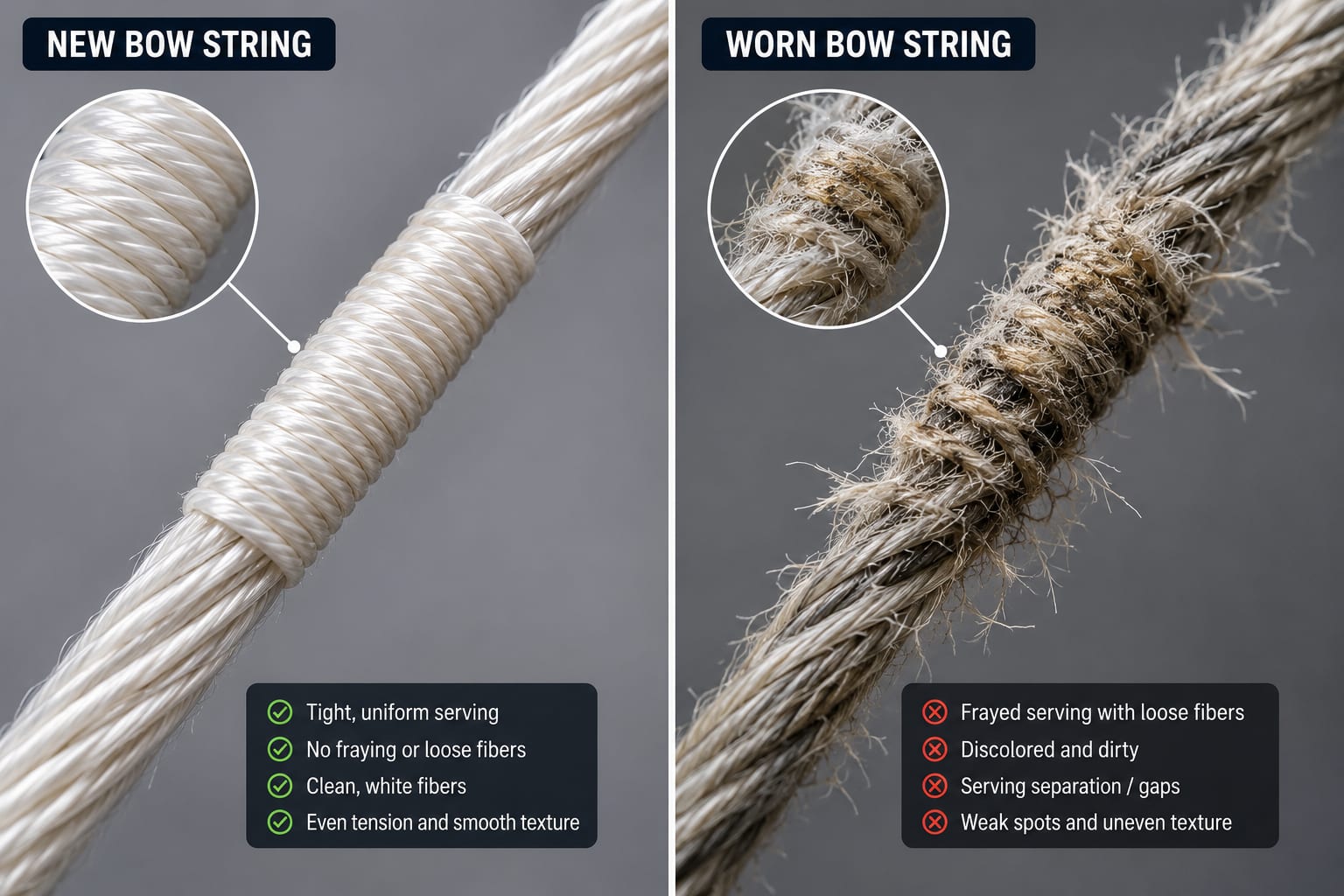
A worn bow string displays several distinct warning signs that range from minor cosmetic issues to critical structural failures. The most common indicators include fuzzy or frayed fibers protruding from the string body, discoloration from white or the original color to brown or gray, separation of the serving (the tightly wound thread at the nocking point and cam loops), visible broken strands within the string bundle, and a dry, brittle texture that lacks the smooth, slightly waxy feel of a healthy string.
Visual inspection reveals:
Tactile inspection shows:
The most dangerous sign is broken strands within the string bundle. If you can see even one or two broken fibers when you gently spread the string, replacement is mandatory. Modern bow strings are engineered with specific strand counts, and losing even a few strands compromises the entire string’s integrity under the extreme forces generated during a shot.
Bow strings on compound bows typically last 2-3 years with regular recreational use (shooting 2-3 times per week), while competitive archers who shoot daily may need replacement every 12-18 months. Recurve bow strings generally last longer, 3-5 years for recreational shooters, because they experience less stress from cams and operate at lower overall tensions.
Several factors significantly impact string lifespan:
Usage intensity:
Environmental conditions:
Bow specifications:
Maintenance quality:
A common mistake is assuming that low shot count automatically means the string is fine. A bow string that’s been sitting in a hot garage for three years, even with only 100 shots on it, has likely suffered UV and heat damage that compromises its structural integrity. Time degrades strings even without use.
For those just starting with archery equipment, establishing a replacement schedule based on shooting frequency rather than waiting for visible damage provides the safest approach.
Fraying and general wear represent different stages and types of string degradation, though both indicate the string is approaching the end of its service life. Fraying is localized fiber damage where individual strands break and stick out from the string body, creating a fuzzy appearance in specific areas. General wear is systemic degradation affecting the entire string through discoloration, loss of protective wax coating, compression, and overall fiber weakening.
Fraying characteristics:
General wear characteristics:
The critical distinction: fraying is a structural failure in progress, while general wear is aging. You can shoot with a generally worn but not frayed string for a limited time if you increase inspection frequency and plan replacement soon. You should never shoot with significant fraying, especially near the cam loops or serving areas.
A string can be generally worn but not frayed (common with well-maintained strings in controlled environments), or it can show fraying with minimal general wear (typical when mechanical issues like rough cam grooves damage an otherwise healthy string). The worst-case scenario combines both: an old, worn string that develops fraying becomes a catastrophic failure waiting to happen.
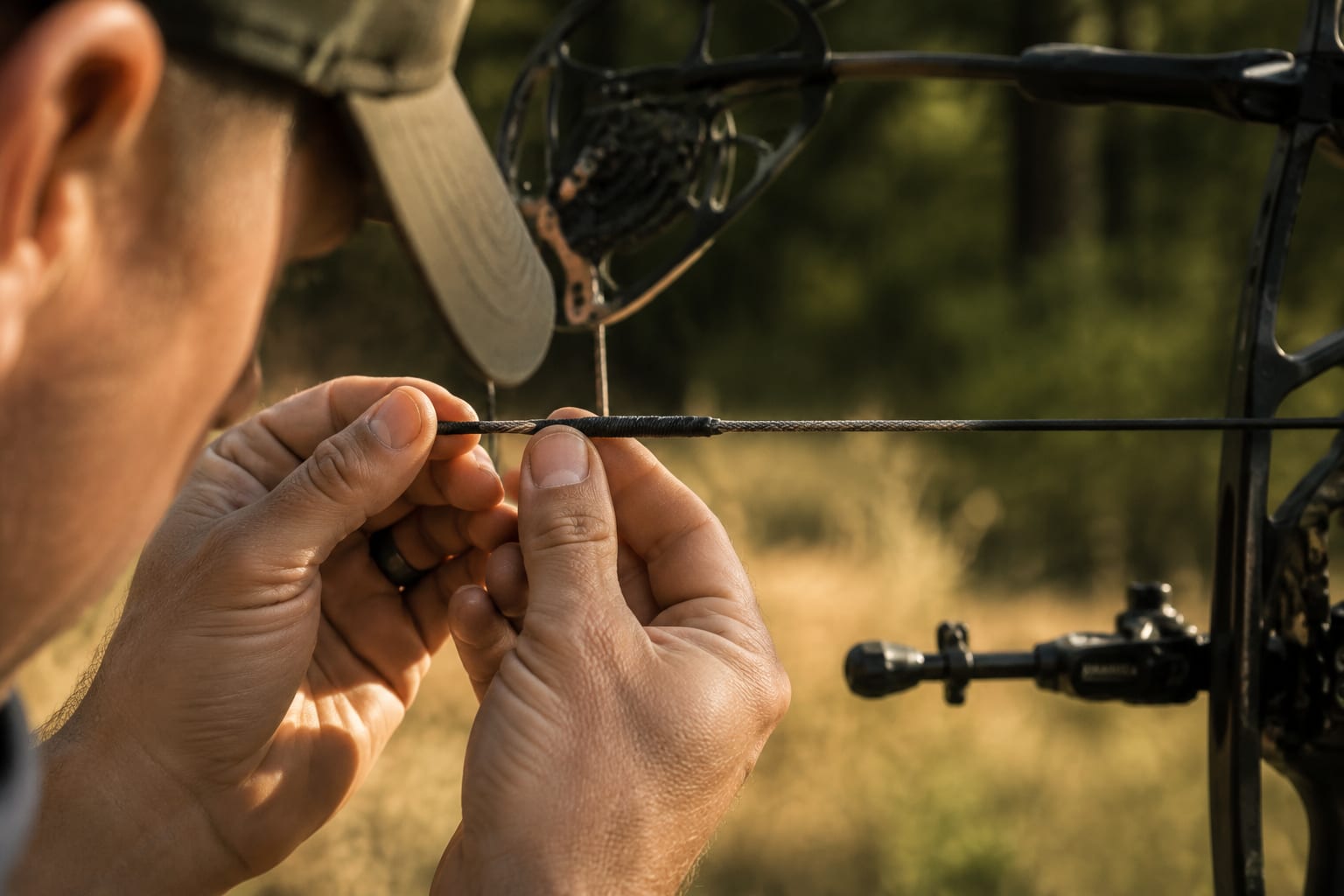
You can continue shooting with a bow string showing minor general wear, slight discoloration, mild dryness, or minimal fuzz, as long as there are no broken strands, no serving separation, and no fraying in critical stress areas. However, you should increase inspection frequency to before every shooting session, apply fresh wax immediately, and schedule replacement within 4-6 weeks.
Safe to shoot (with increased monitoring):
Unsafe to shoot (replace immediately):
The risk calculation changes based on your bow’s draw weight and your shooting context. A compound bow at 70 lbs stores significantly more energy than a 40 lb bow, making string failure more dangerous. Similarly, shooting in a controlled range environment with proper safety equipment differs from hunting situations where a string failure could mean a lost opportunity or dangerous equipment malfunction in the field.
Common mistake: Archers often rationalize continuing to shoot with questionable strings because “it’s only been X months” or “I’ve only shot Y arrows.” String condition matters more than time or shot count. A string exposed to harsh conditions for six months may be more dangerous than a well-maintained string shot heavily for two years.
If you’re questioning whether your string is safe, that uncertainty itself is a strong indicator you should replace it. The cost of a new string ($30-75 for materials, or $75-150 installed) is trivial compared to the cost of a destroyed bow, medical bills from injury, or the loss of a hunting opportunity due to equipment failure.
Shooting with a damaged bow string can result in catastrophic string failure at full draw or during release, causing the bow’s stored energy to discharge uncontrollably into the bow’s limbs, cams, and potentially the archer. The most common consequences include severe facial injuries from the string or cable striking the face, forearm lacerations from the released string, damaged or destroyed bow components (cracked limbs, bent cams, damaged risers), and complete loss of arrow control with the projectile going wildly off-target.
Injury risks include:
Equipment damage includes:
Performance consequences:
The physics involved are sobering. A 70 lb compound bow at 29-inch draw stores approximately 90-100 foot-pounds of energy. When a string fails, that energy releases in milliseconds with no controlled direction. The string itself can accelerate to over 300 feet per second, and the limbs can recoil violently enough to self-destruct.
Real-world scenario: An archer drawing a bow with a frayed string near the cam groove experiences string failure at full draw. The string separates at the fray point, causing the cam to spin freely. The bottom limb, no longer under balanced tension, kicks forward violently while the top limb recoils backward. The loose string end whips across the archer’s face, and the arrow falls harmlessly off the rest. The archer suffers facial lacerations requiring stitches, the bow’s bottom limb cracks at the pocket, and the cam bearing is destroyed. Total cost: medical bills plus a destroyed $800 bow, all to avoid a $100 string replacement.
Inspect your bow string before every shooting session with a quick visual and tactile check, and perform a detailed inspection monthly or every 500 shots, whichever comes first. Competitive archers shooting daily should conduct detailed inspections weekly, while hunters preparing for season should inspect thoroughly before and after each hunt, plus monthly during the off-season.
Pre-shooting quick inspection (2-3 minutes):
Detailed monthly inspection (10-15 minutes):
Increase inspection frequency when:
Common inspection mistakes:
For archery equipment maintenance, consistency matters more than intensity. A quick 2-minute check before every session catches problems early, while skipping inspections for months then doing one detailed check often misses the critical window when damage first appears.
Set phone reminders for monthly detailed inspections, and make the pre-shooting quick check as automatic as putting on your arm guard. The few minutes invested in inspection can prevent injuries and equipment damage that cost thousands of dollars and months of recovery time.
Bow string wax significantly slows wear and extends string life by 40-50%, but it cannot prevent wear entirely or reverse existing damage. Wax works by coating the string fibers to reduce friction between individual strands, repelling moisture that degrades synthetic materials, and protecting against UV damage, but it cannot repair broken fibers, restore compressed string structure, or prevent mechanical abrasion from rough cam surfaces or cable guards.
What wax does effectively:
What wax cannot do:
Proper waxing technique:
Waxing frequency by conditions:
The biggest misconception about string wax is that it’s a repair solution. Archers often discover a dry, slightly fuzzy string and think, “I’ll just wax it and it’ll be fine.” While waxing will improve the string’s condition temporarily, it doesn’t address the underlying fiber damage that caused the fuzziness. Think of wax as preventive maintenance, not corrective maintenance.
Decision rule: If your string looks and feels good, wax it regularly to keep it that way. If your string shows damage (fraying, broken strands, serving separation), wax won’t fix it, you need replacement. Wax extends the life of healthy strings; it doesn’t resurrect dying ones.
Compound bow strings wear faster and differently than recurve bow strings due to the mechanical stress from cams, higher string angles at full draw, and friction points at cable guards and cam grooves. Compound strings typically show wear concentrated at specific high-stress points (cam loops, cable guard contact areas, and serving sections), while recurve strings experience more uniform wear along their entire length with particular stress at the nocking point and string loops.
Compound bow string wear patterns:
Recurve bow string wear patterns:
Why compound strings wear faster:
The cam system creates multiple friction points and sharp bending angles that don’t exist on recurve bows. When you draw a compound bow, the string must bend sharply around the cam groove, creating extreme localized stress. The let-off characteristic of compounds means the string holds peak weight through a longer portion of the draw cycle, increasing total stress time. Additionally, the cables running through the cable guard create a friction point that constantly rubs against the string during the draw cycle.
Recurve strings experience a simpler stress pattern. The string bends smoothly around the limb tips without sharp angles or mechanical friction points. The stress is distributed more evenly along the string’s length, and there are no cables or cam grooves to create localized wear spots.
Inspection differences:
Replacement timing:
For those working with different bow types, understanding these wear pattern differences helps establish appropriate inspection and replacement schedules.
Bow strings typically show visible wear before cables because strings experience more bending cycles, sharper angles around the cams, and direct contact with the arrow and release aid, while cables run in straighter paths with less acute bending. However, cables often fail more catastrophically when they do break because cable failure causes immediate and total loss of cam synchronization, potentially destroying the bow.
Why strings usually wear first:
Why cables can be more dangerous:
Inspection priorities:
For strings, focus on:
For cables, focus on:
Replacement strategy:
Many bow shops and manufacturers recommend replacing strings and cables as a set, even if only one shows significant wear. The reasoning: if the string has 2,000 shots on it and shows wear, the cables have the same 2,000 shots and similar (though less visible) wear. Replacing only the string means you’ll likely need cable replacement within a few months anyway, and you’ll pay for labor twice.
Cost comparison:
Decision rule: If your string shows significant wear and your cables are more than 18 months old or have more than 1,500 shots, replace both together. If your string shows minor wear and your cables are less than a year old, you can replace the string alone and monitor the cables closely.
The exception: if you find a broken cable strand or cable serving separation, replace the entire set immediately regardless of string condition. Cable failure is too dangerous to risk.
The most common mistake when checking bow string condition is relying solely on visual inspection without tactile examination, missing critical damage that’s only detectable by touch. Many archers also fail to inspect the cam loop areas thoroughly because they’re difficult to access, ignore minor serving separation thinking it’s cosmetic, and continue shooting after finding questionable damage because the string “still looks mostly okay.”
Critical inspection mistakes:
1. Visual-only inspection
2. Ignoring cam loop areas
3. Dismissing minor serving separation
4. Poor lighting during inspection
5. Inconsistent inspection schedule
6. Not documenting findings
7. Continuing to shoot with questionable strings
8. Confusing wax buildup with healthy string
9. Not checking string length and timing
10. Ignoring environmental exposure
For archery training purposes, developing proper inspection habits early prevents the dangerous practice of shooting with compromised equipment.
Yes, a bow string can break while shooting, either at full draw or during release, and this catastrophic failure happens most commonly with strings showing visible wear, fraying, or broken strands that the archer ignored or failed to detect. String breaks occur in milliseconds and release the bow’s stored energy uncontrollably, typically causing equipment damage and often resulting in archer injury.
When strings break:
Warning signs before breakage:
Most string breaks aren’t truly sudden, they’re the final failure of a string that showed warning signs the archer missed or ignored:
Immediate actions if a string breaks:
Prevention:
Risk factors that increase break probability:
The physics of string failure are violent. A 70 lb compound bow at 80% let-off still holds 14 lbs at full draw, but the string itself is under the full 70 lbs of tension. When the string breaks, that energy releases instantly. The limbs recoil, the cams spin freely, and the broken string ends whip at extremely high velocity.
Real consequence: String breaks have caused fractured eye sockets, broken noses, deep facial lacerations requiring reconstructive surgery, broken bow arms, and destroyed bows. The cost of prevention (a $100 string replacement every 2-3 years) is trivial compared to the cost of failure (thousands in medical bills plus equipment replacement).
You need a professional to replace a compound bow string unless you own a bow press and have training in bow tuning, as compound bows require specialized equipment to safely remove limb tension and proper expertise to restore cam timing and tune after string installation. Recurve bow strings can be replaced by most archers at home with basic tools and knowledge, as they simply loop over the limb tips without requiring a press or complex timing procedures.
Compound bow string replacement:
Why professional service is recommended:
Professional service includes:
Cost: $75-150 for string replacement including labor, or $125-225 for complete string and cable set replacement with tuning
DIY compound string replacement:
If you have a bow press and experience, you can replace strings yourself:
Recurve bow string replacement:
Why DIY is feasible:
DIY recurve string replacement steps:
Cost: $15-30 for a quality recurve string, or $50-100 for professional installation if you prefer
Decision factors:
Choose professional service if:
Choose DIY if:
For those getting started with archery, learning basic bow maintenance is valuable, but string replacement on compound bows is best left to professionals until you’ve gained significant experience and invested in proper equipment.
Replacing a bow string costs $70-150 for professional installation on a compound bow (including materials and labor), or $125-225 for a complete string and cable set replacement with tuning. DIY string replacement costs $30-75 for materials if you own a bow press, while recurve bow string replacement costs $15-30 for materials or $50-100 for professional installation.
Compound bow string replacement costs:
Professional service (recommended):
DIY costs (requires bow press and experience):
Recurve bow string replacement costs:
Professional service:
DIY costs:
Factors affecting cost:
String material:
String type:
Service level:
Additional costs to consider:
Cost-saving strategies:
Cost comparison over time:
For a recreational archer shooting 2-3 times per week:
The math clearly favors regular preventive replacement over waiting for failure. Even at professional service rates, string replacement costs less than 10% of most bow values and prevents catastrophic failures that destroy equipment and cause injuries.
You can buy replacement bow strings online from specialized archery retailers like Lancaster Archery Supply, 60X Custom Strings, and Americas Best Bowstrings, which offer both stock replacement strings and custom strings built to your bow’s specifications. Major outdoor retailers like Cabela’s and Bass Pro Shops also carry strings, though with more limited selection, while manufacturer-direct options from companies like Mathews, Hoyt, and PSE provide OEM strings guaranteed to fit specific bow models.
Recommended online retailers:
Specialty archery suppliers (best selection and expertise):
Major outdoor retailers (convenient, limited selection):
Manufacturer direct (guaranteed fit):
What to know before ordering:
Required information:
Stock vs. custom strings:
Stock strings:
Custom strings:
Ordering tips:
Red flags when buying online:
Cost expectations:
For most archers, ordering from established specialty retailers like Lancaster Archery Supply or reputable custom string makers like 60X provides the best balance of quality, selection, and customer service. While manufacturer-direct OEM strings guarantee fit, they’re often more expensive and offer fewer customization options than quality aftermarket strings.
How can you tell if a bow string is bad?
A bow string is bad if it shows broken strands, severe fraying with fuzzy fibers protruding, serving separation exposing underlying string, discoloration from white to brown or gray, dry brittle texture, or any visible structural damage. Run your fingers along the entire string, rough spots, inconsistent thickness, or stiff sections indicate the string needs replacement.
What does a worn out bow string look like?
A worn out bow string appears discolored (gray, brown, or yellow instead of white), shows fuzzy fibers sticking out perpendicular to the string body, has separated or loose serving at the nocking point or cam loops, displays flattened sections instead of a round cross-section, and feels dry and rough instead of smooth and slightly waxy.
How many years does a bow string last?
Bow strings last 2-3 years for compound bows with regular recreational use (2-3 times weekly), 18-24 months for frequent shooters (daily practice), or 3-5 years for occasional use. Recurve bow strings typically last 3-5 years for recreational shooters. Environmental factors like UV exposure, heat, and humidity can reduce lifespan by 30-40% regardless of shot count.
Can you over wax a bow string?
Yes, you can over wax a bow string, causing excess wax buildup that attracts dirt and debris, creates a sticky surface that interferes with arrow release, and masks underlying string damage during inspection. Apply only a thin coat of wax every 2-3 weeks, work it into the fibers thoroughly, and remove any excess, the string should feel slightly tacky, not gummy or heavily coated.
Should I replace my bow string if it’s fuzzy?
Replace your bow string if the fuzziness includes broken strands, appears near cam loops or serving areas, or involves multiple fibers protruding in the same location. Minor fuzziness (1-3 stray fibers) in non-critical areas away from cams and serving can be monitored with increased inspection frequency, but any significant fuzzing indicates the string is approaching failure and should be replaced within 2-4 weeks.
What happens if you don’t wax your bow string?
An unwaxed bow string degrades 40-50% faster than a properly maintained string, becoming dry and brittle as the protective coating wears away. The individual fibers experience increased friction against each other, leading to premature fraying and breakage. Moisture penetrates the string more easily, UV damage accelerates, and the string loses flexibility, ultimately failing much sooner than its expected lifespan.
How tight should a bow string be?
Bow string tightness is measured by brace height (the distance from the grip to the string at rest), which varies by bow model but typically ranges from 6-8 inches for compound bows and 7-9 inches for recurve bows. Check your bow’s manufacturer specifications for the correct brace height, too tight (high brace height) reduces power and speed, while too loose (low brace height) causes poor arrow flight and increased hand shock.
Can a bow string be too old even with low shot count?
Yes, a bow string can be too old even with minimal use because UV exposure, heat, humidity, and time degrade synthetic fibers regardless of shot count. A string stored in a hot garage or vehicle for three years with only 100 shots has likely suffered more damage than a well-maintained string shot 2,000 times in two years. Replace strings based on both age (2-3 years maximum) and condition, not shot count alone.
Do bow cables wear out faster than strings?
Bow cables typically wear slower than strings because they experience less bending stress and fewer acute angles, but cable wear is harder to see and inspect. Cables run in straighter paths and don’t contact the arrow or release aid, reducing mechanical wear. However, when cables do fail, the consequences are often more catastrophic because cable failure causes immediate cam desynchronization and can destroy the bow.
What’s the difference between serving separation and string fraying?
Serving separation occurs when the tightly wound thread (serving) that protects the string at the nocking point or cam loops loosens, unravels, or shows gaps, exposing the underlying string fibers. String fraying is damage to the string fibers themselves, with individual strands breaking and protruding from the string body. Both require replacement, but serving separation can sometimes be repaired by a professional if caught early, while string fraying always requires complete string replacement.
Should I replace strings and cables at the same time?
Replace strings and cables together if both have similar age (18+ months) or shot count (1,500+ shots), even if only one shows visible wear. This approach saves labor costs by avoiding two separate service visits and ensures matched wear levels. However, if your string fails after only 6 months due to a defect or damage while the cables are still new, you can replace the string alone and monitor the cables closely.
Can I use any bow string on my compound bow?
No, you cannot use any bow string on your compound bow, strings must match your specific bow model’s length, strand count, and material specifications. Using an incorrect string length changes brace height and cam timing, causing poor performance and potential equipment damage. Always order strings specifically made for your bow’s make, model, and year, or have a professional measure and build a custom string to your bow’s exact specifications.
Knowing how to tell if your bow string is worn out protects you from dangerous equipment failures and maintains your bow’s performance. The key indicators, fraying, broken strands, serving separation, discoloration, and dry texture, are easy to spot with regular inspection before every shooting session and detailed monthly checks.
Take action now:
The cost of prevention, a $100-150 string replacement every few years, is trivial compared to the consequences of failure: destroyed equipment worth hundreds or thousands of dollars, serious injuries requiring medical treatment, and lost opportunities in competition or the field.
Don’t wait for catastrophic failure. If your string shows any of the warning signs discussed in this guide, or if it’s approaching the typical replacement interval for your shooting frequency, schedule replacement with a qualified bow shop or order a new string today. Your safety and your bow’s performance depend on maintaining this critical component.
For more guidance on archery equipment maintenance and selection, explore our comprehensive resources designed to help you shoot safely and accurately.


