
Newsletter Subscribe
Enter your email address below and subscribe to our newsletter
All voices matter
All voices matter

 ByTravis
Not exactly - broadheads create more wind resistance and can expose tuning issues that field points mask, but proper bow tuning minimizes the difference.
Affiliate Disclaimer: We are a participant in the Amazon Services LLC Associates Program, an affiliate advertising program designed to provide a means for sites to earn advertising fees by advertising and linking to Amazon.com. As an Amazon Associate I earn from qualifying purchases. We also participate in other affiliate programs.
Quick Answer: Broadheads typically do not fly exactly like field points due to differences in aerodynamics, weight distribution, and surface area. Fixed-blade broadheads especially create more wind resistance and can expose tuning issues that field points mask. With proper bow tuning and arrow setup, you can minimize these differences to achieve near-identical point of impact at hunting distances.
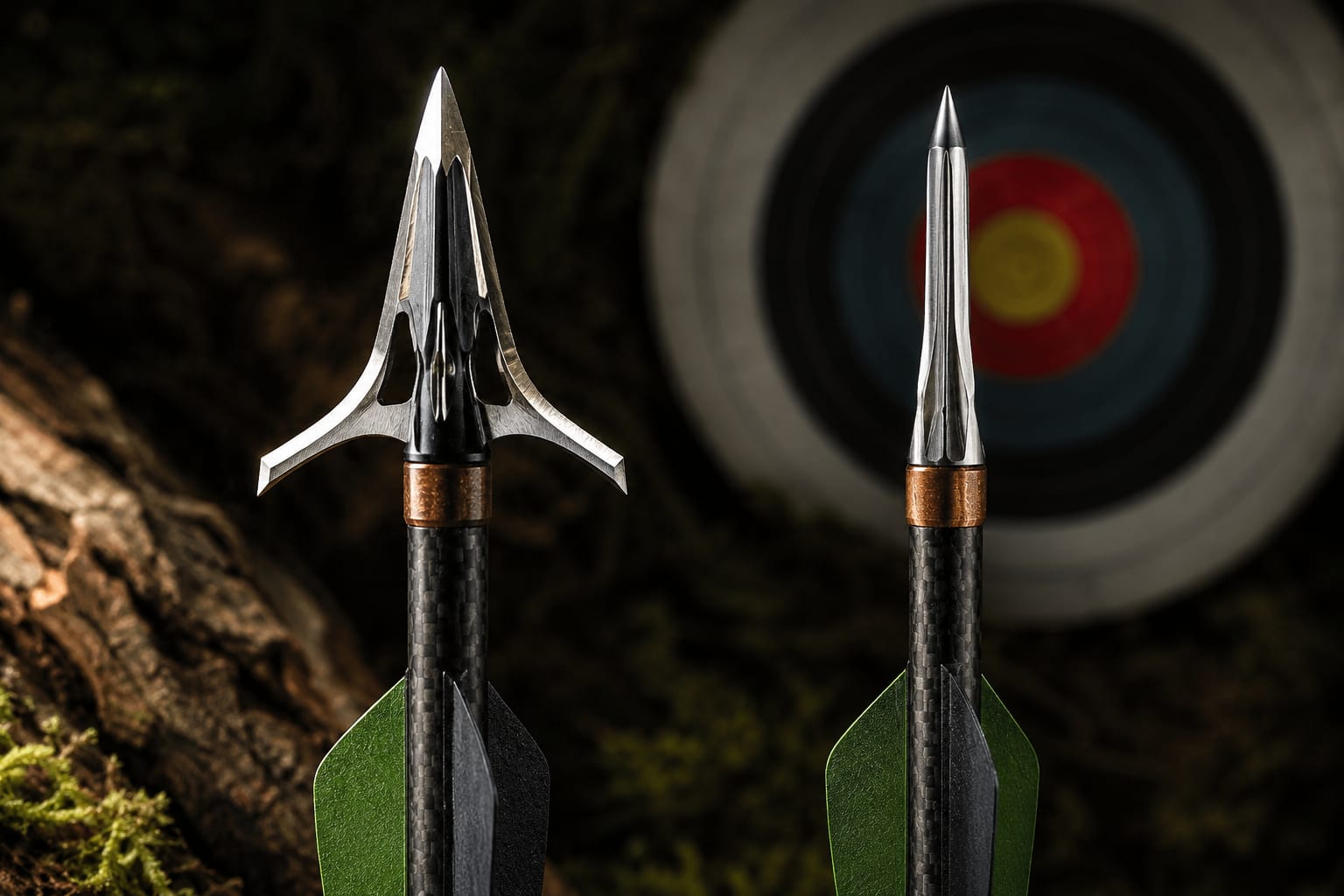
Broadheads and field points serve completely different purposes and have distinct physical characteristics that affect arrow flight. Field points are simple, bullet-shaped tips designed purely for target practice, with a streamlined profile that minimizes air resistance. Broadheads are hunting tips with exposed cutting blades designed to create lethal wounds on game animals.
The key physical differences include:
These differences mean that broadheads act like small wings or rudders on your arrow. Any imperfection in arrow flight, bow tune, or release becomes magnified. Field points are forgiving and will fly reasonably well even with tuning issues, but broadheads will expose every flaw in your setup.
Common mistake: Assuming that because your field points group tightly, your broadheads will automatically do the same. Broadheads require dedicated tuning and verification.

Broadheads typically impact lower than field points because of increased drag during flight, which slows the arrow and causes it to drop more over distance. The exposed blades on broadheads create air resistance that acts as a brake, reducing arrow velocity by 3-8 feet per second compared to field points with identical arrow setups.
Additional factors that cause low impacts include:
The amount of difference varies based on broadhead design, arrow speed, and shooting distance. At 20 yards, you might see only 1-2 inches of difference, but at 40 yards, this can expand to 4-8 inches or more with poorly tuned equipment.
Choose fixed-blade broadheads if you want maximum penetration and reliability, but be prepared for more tuning work. Choose mechanical broadheads if you want flight characteristics closer to field points with less tuning required.
Proper bow tuning is the single most important factor in achieving consistent broadhead flight. Start by ensuring your bow is paper-tuned correctly, then verify and refine with actual broadhead shooting. A well-tuned bow will produce broadhead impacts within 1-2 inches of field point impacts at 30 yards.
Step-by-step tuning process:
Paper tune first: Shoot through paper at 6-8 feet to verify clean arrow flight. You want a bullet hole or small tear, not large tears indicating poor nock travel.
Check center shot: Ensure your arrow rest positions the arrow so it aligns with the center of the bow’s riser or slightly outside center for most setups.
Verify arrow spine: Use a spine chart for your bow’s draw weight and arrow length. Broadheads require arrows on the stiffer side of the recommended range.
Adjust rest position: If broadheads hit left or right of field points, move your rest in small increments (1/32 inch) in the direction of the broadhead impact.
Fine-tune with cam timing: For compound bows, ensure both cams hit the stops simultaneously. Uneven cam timing causes nock travel issues that broadheads expose.
Test at multiple distances: Shoot both field points and broadheads at 20, 30, and 40 yards to verify consistent grouping.
Make final sight adjustments: Once groups align horizontally, adjust your sight to account for any vertical difference.
Common mistake: Making multiple adjustments at once. Change one variable at a time and test thoroughly before making additional changes.
Edge case: If your broadheads group well but consistently hit in a different location than field points despite tuning, you may need to create a separate sight tape or pin setting specifically for broadheads.
Mechanical broadheads fly significantly closer to field points than fixed-blade broadheads because their blades remain folded during flight, creating a more streamlined profile similar to a field point. The blades only deploy upon impact, so during the critical flight phase, mechanical broadheads experience much less drag and wind resistance.
Most archers find that mechanical broadheads impact within 1-3 inches of field points at 30-40 yards with minimal tuning, while fixed-blade broadheads may require extensive tuning to achieve similar results. This makes mechanical broadheads an attractive option for bowhunters who want to minimize practice time or who struggle with bow tuning.
Trade-offs to consider:
Choose mechanical broadheads if you shoot longer distances (40+ yards), have difficulty tuning your bow, or prioritize ease of use. Choose fixed-blade broadheads if you hunt larger game requiring maximum penetration, shoot in cold weather where mechanical parts might freeze, or want the simplest, most reliable design.

The broadheads that fly most like field points share common design characteristics: compact profiles, precise manufacturing tolerances, and balanced weight distribution. While “best” depends on your specific bow setup and hunting needs, certain designs consistently perform well across different setups.
Top-performing broadhead designs for field-point-like flight:
Mechanical broadheads:
Fixed-blade broadheads:
Manufacturing quality matters: Precisely machined broadheads with tight tolerances fly more consistently than cheaper alternatives. Check for blade alignment by spinning the broadhead on a flat surface or using a broadhead spinner. Any wobble indicates poor alignment that will affect flight.
Common mistake: Buying broadheads based solely on cutting diameter or price without considering how they match your arrow setup and bow tune. A perfectly manufactured broadhead that’s wrong for your arrow spine will still fly poorly.
With a properly tuned bow and matched arrow setup, you should expect broadheads to impact within 2-3 inches of field points at 30 yards, and within 4-6 inches at 40 yards. Mechanical broadheads typically stay within 1-2 inches at these distances, while fixed-blade broadheads may show slightly more variation.
Realistic expectations by distance:
If your broadheads are impacting more than 6 inches away from field points at 30 yards, your bow needs tuning or your arrows are mismatched to your setup. This level of difference indicates a fundamental problem, not normal variation.
Factors that increase difference:
Decision rule: If you plan to shoot beyond 40 yards at game, you must practice extensively with your actual hunting broadheads, not just field points. The difference becomes too significant to estimate.
Yes, you will almost certainly need to adjust your sight when switching from field points to broadheads, even with a well-tuned bow. The aerodynamic differences between the two tip types mean they will impact at slightly different points, particularly at longer distances. Most archers need to move their sight pins down (aiming higher) to compensate for broadheads hitting lower.
The amount of adjustment varies based on several factors:
Practical approach: After tuning your bow so broadheads and field points group in the same horizontal plane, shoot both at your maximum hunting distance. Measure the vertical difference and adjust your sight accordingly. Some archers create a separate sight tape for broadheads, while others simply remember the difference and hold accordingly.
Common mistake: Adjusting your sight based on shooting at 20 yards only. The difference becomes more pronounced at longer distances, so verify at your maximum expected hunting range.
Edge case: If you hunt from a treestand, remember that downward angles affect broadheads differently than field points. Practice from an elevated position with your hunting broadheads to verify your sight settings.
Paper tuning always comes first because it establishes the foundation of proper arrow flight from your bow. Paper tuning verifies that your arrow leaves the bow cleanly with minimal nock travel deviation, which is essential before you can effectively tune for broadheads. Only after achieving a clean paper tear should you move to broadhead-specific tuning.
Correct tuning sequence:
This sequence works because paper tuning addresses fundamental bow setup issues (rest position, nock point, cam timing), while broadhead tuning addresses the specific aerodynamic challenges that broadheads introduce. Trying to tune with broadheads first is like trying to adjust a rifle scope before bore-sighting, you’re working without a proper baseline.
Common mistake: Skipping paper tuning entirely and going straight to shooting broadheads. This approach makes it nearly impossible to diagnose problems because you can’t separate bow tuning issues from broadhead-specific issues.
Alternative approach: Some experienced archers use bare-shaft tuning instead of paper tuning. This involves shooting arrows without fletching to verify proper spine and rest position. Both methods work, but paper tuning is generally easier for most archers.
Broadheads that fly sideways or wobble in flight indicate serious problems with arrow spine, broadhead alignment, or bow tuning. The most common cause is incorrect arrow spine, arrows that are too weak or too stiff for your bow’s draw weight and draw length will flex excessively, causing broadheads to plane off course. Broadheads amplify this flex because their blades act like rudders, steering the arrow in the direction of the flex.
Primary causes of broadhead wobble:
Diagnostic steps:
Quick fix: If you see wobble during the spin test, try rotating the broadhead 120 degrees and retesting. Sometimes the broadhead’s weight distribution can offset minor arrow imperfections. If wobble persists, replace the arrow or broadhead.
Expensive broadheads are generally more accurate than cheap ones because of tighter manufacturing tolerances, better materials, and more precise blade alignment. Premium broadheads are machined to exact specifications with blades that align within 0.001 inches, while budget broadheads may have variations of 0.005 inches or more. This difference directly affects flight consistency and accuracy.
However, the price-accuracy relationship isn’t linear. A mid-priced broadhead from a reputable manufacturer will often perform nearly as well as the most expensive option, while the cheapest broadheads typically show significant quality issues. The biggest accuracy gains come from moving from poor-quality to good-quality broadheads, not from good to premium.
What you get with premium broadheads:
What causes accuracy problems in cheap broadheads:
Decision rule: If you’re a serious bowhunter shooting at game beyond 30 yards, invest in quality broadheads. The cost difference (typically $30-50 per pack) is minimal compared to the value of a clean, ethical harvest. For casual target shooting or practice, mid-priced options offer good value.
Common mistake: Buying the cheapest broadheads available and then spending hours trying to tune your bow to compensate for poor manufacturing quality. Your time is worth more than the money saved.
Beginners should practice primarily with field points and only switch to broadheads for final verification and pre-season practice. Field points are significantly cheaper, don’t dull with use, and allow you to focus on developing proper shooting form without worrying about destroying expensive broadheads. Once you can consistently group field points within 4-6 inches at 30 yards, then introduce broadheads for tuning and verification.
Recommended practice approach for beginners:
This approach balances skill development with equipment verification while managing costs. A dozen quality broadheads can cost $40-60, and they dull quickly with repeated shooting into targets. Field points cost $5-10 for a dozen and last indefinitely.
What beginners should practice with broadheads:
Common mistake: Never practicing with broadheads until opening day of hunting season. Even a well-tuned bow should be verified with actual broadheads before hunting to ensure nothing has changed.
Safety note: Always use a broadhead-rated target when shooting broadheads. Regular foam targets won’t stop broadheads safely, and broadheads can pass through and create dangerous situations.
The transition from field points to broadheads reveals equipment and technique flaws that field points mask. The most common mistake is assuming your bow is properly tuned just because field points group well. Broadheads are far less forgiving and will expose issues with arrow spine, rest position, and nock travel that don’t significantly affect field point accuracy.
Critical mistakes to avoid:
Not verifying arrow spine: Field points will fly reasonably well with slightly incorrect spine, but broadheads won’t. Always verify your arrow spine matches your bow’s specifications when using broadheads.
Mixing broadhead types: Using different broadhead models or weights in the same quiver creates inconsistency. All your hunting arrows should have identical broadheads.
Failing to use a broadhead wrench: Hand-tightening broadheads doesn’t provide consistent torque. Use a proper wrench to tighten to manufacturer specifications (typically 30-40 inch-pounds).
Not checking broadhead alignment: Assuming broadheads are straight out of the package. Always spin-test each broadhead before hunting to verify alignment.
Ignoring fletching contact: Broadheads are wider than field points and may contact your rest or cables if clearance is tight. Check for fletching or broadhead contact marks on your rest.
Practicing only at one distance: Shooting only at 20 yards doesn’t reveal how broadheads perform at longer distances where aerodynamic differences become significant.
Using damaged broadheads: Reusing broadheads that hit bone or hard targets without inspecting for bent blades or damaged tips. Even minor damage affects flight.
Not creating a dedicated sight setting: Assuming you can hold over or under to compensate for broadhead differences rather than properly adjusting your sight.
Edge case: If you shoot a fast bow (300+ fps) with mechanical broadheads, you might get away with less-than-perfect tuning at short distances. However, this doesn’t mean your bow is properly tuned, it just means speed is compensating for tuning issues.
You don’t necessarily need a stiffer arrow spine specifically for broadheads, but broadheads do require arrows on the stiffer end of the recommended spine range for your bow setup. If your arrows are borderline too weak for your draw weight and draw length with field points, switching to broadheads will likely expose this as a problem. Broadheads amplify any arrow flex during launch, making proper spine selection more critical.
The relationship between broadheads and spine works like this: when you release an arrow, it flexes around the bow’s riser (archer’s paradox). Field points are streamlined and don’t significantly affect this flex. Broadheads, however, have blades that catch air during this flex phase, causing the arrow to plane or steer off course if the spine isn’t correct.
When you need stiffer arrows for broadheads:
When your current spine is probably fine:
Testing your spine: If you’re unsure whether your spine is correct for broadheads, shoot a bare shaft (arrow with no fletching) alongside fletched arrows at 15-20 yards. If the bare shaft impacts in the same location as fletched arrows, your spine is correct. If it impacts left or right, you need spine adjustment.
Common mistake: Buying stiffer arrows without first verifying that spine is actually the problem. Many broadhead flight issues are caused by poor bow tuning, not incorrect spine. Only change spine after you’ve eliminated tuning issues.
Can I use the same sight settings for broadheads and field points?
No, you’ll typically need different sight settings because broadheads hit lower than field points due to increased drag. Most archers adjust their sight pins down (aiming higher) by 1-4 inches at 30-40 yards when switching to broadheads.
How many broadheads should I shoot to verify my bow is tuned?
Shoot at least 6-9 arrows (two groups of 3) with broadheads at 30 yards to verify consistent grouping and point of impact relative to field points. This gives you enough data to confirm your tune without dulling too many broadheads.
Will broadheads damage my target?
Yes, broadheads will damage regular foam targets and can pass through them dangerously. Always use a target specifically rated for broadheads, which typically have denser foam or layered construction designed to stop and hold broadheads safely.
Can I sharpen and reuse broadheads after practice?
Fixed-blade broadheads with replaceable blades can be reused after replacing the blades. Mechanical broadheads can often be reused if the mechanism still functions properly. However, any broadhead that hit bone, concrete, or hard objects should be inspected carefully or replaced.
Do heavier broadheads fly better than lighter ones?
Heavier broadheads (125-150 grains) generally fly more consistently than lighter ones (75-100 grains) because they have more forward-of-center weight, which stabilizes flight. However, they also fly slower and drop more, requiring more precise range estimation.
How often should I check my broadhead alignment?
Check broadhead alignment every time you install a new broadhead and periodically throughout the season. Any impact with a hard object can bend blades or damage alignment, so inspect after each practice session or hunt.
Can I mix fixed-blade and mechanical broadheads in my quiver?
No, you should never mix broadhead types in your hunting quiver. Different designs fly differently and impact at different points, making it impossible to aim consistently. Choose one type and use it exclusively.
What’s the minimum distance I should practice with broadheads?
Practice with broadheads at your maximum expected hunting distance, typically 30-40 yards for most bowhunters. Also practice at closer distances (15-25 yards) to verify consistency across your entire hunting range.
Do broadheads fly differently in cold weather?
Mechanical broadheads can be affected by cold weather if lubricants thicken or if ice forms on the mechanism. Fixed-blade broadheads are unaffected by temperature. Cold air is also denser, which slightly increases drag on all broadheads.
Should I practice with my actual hunting broadheads?
Shoot 2-3 arrows with your actual hunting broadheads shortly before hunting season to verify they’re sharp and fly correctly, but do most practice with dedicated practice broadheads or field points to preserve your hunting broadheads’ sharpness.
Can bow speed compensate for poor broadhead tune?
Faster bows (280+ fps) do minimize some broadhead flight issues by reducing the time aerodynamic forces act on the arrow, but speed cannot fully compensate for poor tuning. A properly tuned slower bow will outperform a poorly tuned fast bow with broadheads.
How do I know if my broadhead is hitting sideways?
Broadheads hitting sideways leave elongated or angled cuts in targets rather than clean, round holes. You may also see the arrow wobbling in flight or hear a whistling sound. These indicate serious tuning or alignment problems that must be corrected.
Broadheads do not fly exactly like field points, but with proper bow tuning, correct arrow spine, and quality broadheads, you can achieve point-of-impact differences small enough for ethical, accurate hunting. The key is understanding that broadheads expose equipment and tuning flaws that field points mask, making proper setup essential rather than optional.
Start by ensuring your bow is paper-tuned correctly, then verify your arrow spine matches your bow’s specifications for the broadhead weight you plan to use. Mechanical broadheads offer the closest flight characteristics to field points with minimal tuning, while fixed-blade broadheads require more attention but provide maximum reliability and penetration.
Action steps for success:
Remember that even perfectly tuned equipment will show some difference between broadheads and field points, especially at longer distances. The goal isn’t perfect identical flight, it’s achieving consistent, predictable accuracy within the vital zone of your target game at your maximum hunting distance. With attention to detail and proper preparation, your broadheads will fly accurately and give you confidence for ethical, successful hunts in 2026 and beyond.


