
Newsletter Subscribe
Enter your email address below and subscribe to our newsletter
All voices matter
All voices matter

 ByTravis
Fixed-blade broadheads offer superior penetration and durability but need more tuning, while mechanical broadheads fly like field points with less forgiveness on impact - here's the honest tradeoff.
Affiliate Disclaimer: We are a participant in the Amazon Services LLC Associates Program, an affiliate advertising program designed to provide a means for sites to earn advertising fees by advertising and linking to Amazon.com. As an Amazon Associate I earn from qualifying purchases. We also participate in other affiliate programs.
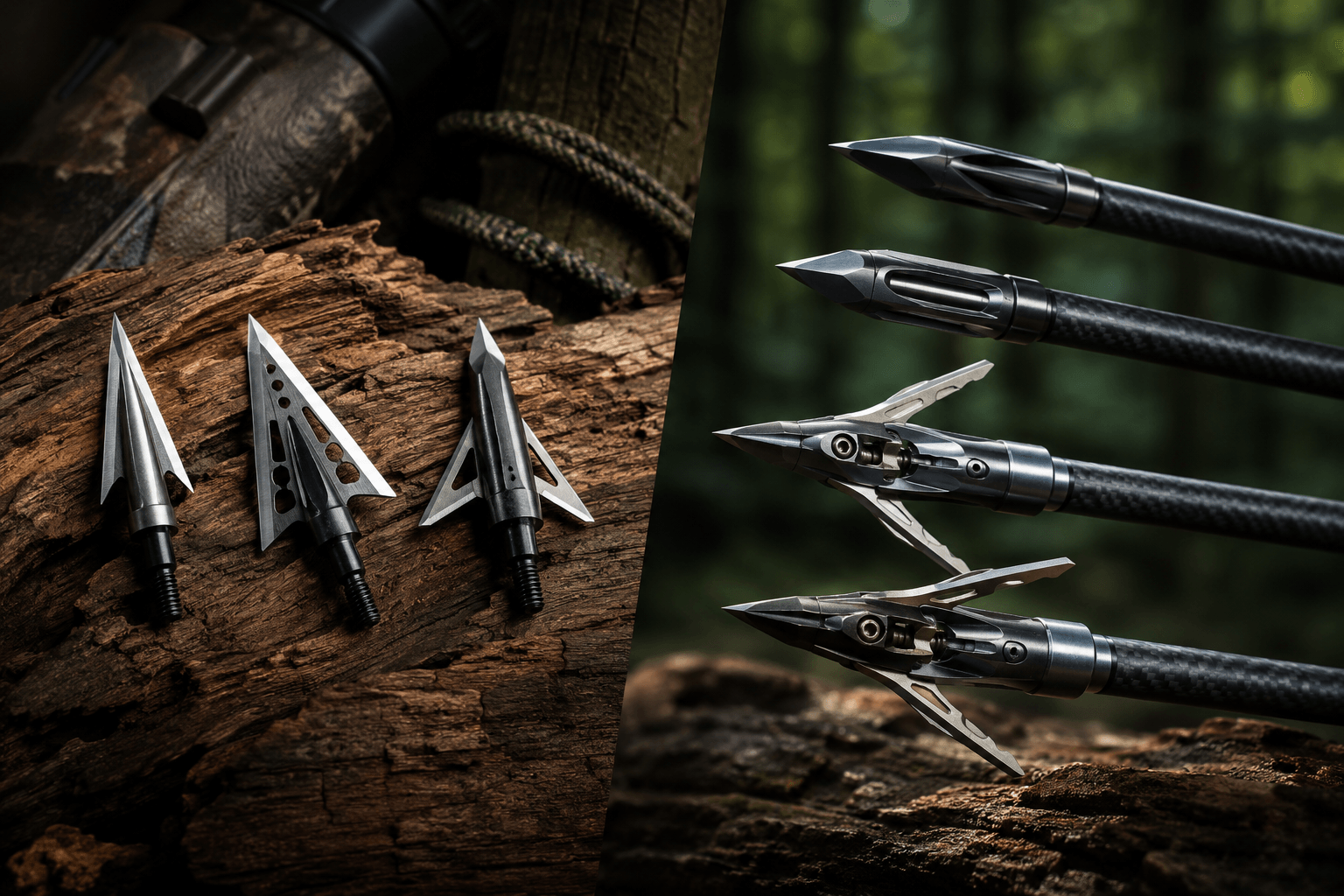
Fixed vs Mechanical Broadheads: The Honest Tradeoffs comes down to reliability versus flight performance. Fixed-blade broadheads offer superior penetration, durability, and dependability in all conditions but require more tuning and can be less forgiving in flight. Mechanical broadheads fly like field points with minimal tuning and create larger wound channels, but they’re more prone to mechanical failure, cost more, and may not penetrate as deeply on heavy bone or at lower draw weights.
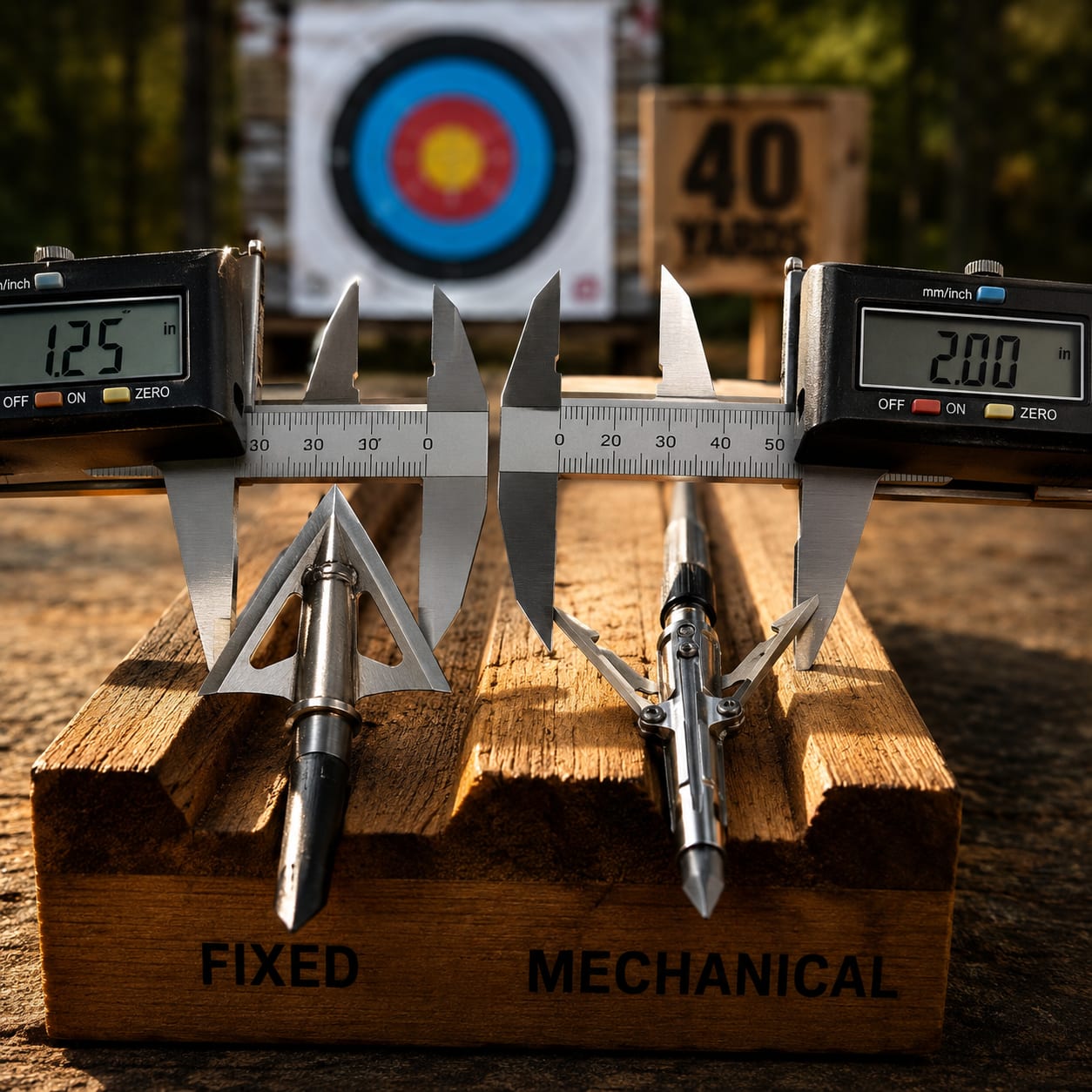
Fixed-blade broadheads feature blades that are permanently exposed and locked in place, either welded to the ferrule or secured with screws, while mechanical broadheads have blades that remain closed during flight and deploy upon impact using rubber bands, O-rings, or mechanical clips. This fundamental design difference affects everything from flight characteristics to terminal performance.
Fixed blades come in two main configurations: cut-on-contact designs where the blade edge meets the target first, and chisel-point designs with a hardened tip before the blades. Most modern fixed blades use 2, 3, or 4 blades with cutting diameters ranging from 7/8 inch to 1-3/8 inches.
Mechanical broadheads fall into two categories: rear-deploying models where blades fold back from the ferrule and swing forward on impact, and front-deploying (or over-the-top) designs where blades are positioned forward and swing backward. Cutting diameters when deployed typically range from 1.5 inches to over 2 inches.
The structural differences create distinct tradeoffs:
Mechanical broadheads are generally more accurate at distances beyond 30 yards because their closed profile creates less wind drift and flies nearly identical to field points. Fixed-blade broadheads require more precise arrow tuning and are more susceptible to wind planing, but when properly tuned, the accuracy difference becomes negligible for most hunting distances under 40 yards.
The accuracy advantage of mechanicals stems from aerodynamics. An exposed fixed blade acts like a rudder, amplifying any slight imperfections in arrow spine, rest timing, or fletching contact. Even a perfectly tuned arrow with fixed blades will experience more wind drift than a mechanical at 50+ yards.
Real-world accuracy factors:
For beginners, mechanicals offer a significant advantage because they’re forgiving of minor tuning issues. An arrow that groups well with field points will usually group similarly with mechanical broadheads. Fixed blades demand that your arrow flight is already dialed in perfectly.
Choose mechanicals for accuracy if:
Choose fixed blades despite the accuracy challenge if:
Mechanical broadheads typically penetrate 10-30% less than comparable fixed-blade broadheads due to the energy required to deploy the blades, increased friction from larger cutting diameters, and sometimes thinner blade construction. The penetration gap widens significantly on quartering shots, heavy bone contact, or when shooting lower draw weights below 55 pounds.
The physics are straightforward: deploying mechanical blades requires force, which subtracts from forward momentum. A 2-inch mechanical broadhead also creates substantially more tissue resistance than a 1-inch fixed blade, further slowing penetration.
Penetration factors that matter:
In controlled testing, fixed blades consistently pass through both shoulders of whitetail-sized game more reliably than mechanicals. On elk, moose, or other large game, the penetration advantage of fixed blades becomes critical for reaching vital organs on less-than-perfect shot angles.
However, mechanicals create larger wound channels, which can compensate for reduced penetration on broadside shots. A mechanical that penetrates 16 inches with a 2-inch cut may cause faster blood loss than a fixed blade that penetrates 20 inches with a 1-inch cut.
When penetration differences matter most:
Beginner bowhunters should start with quality mechanical broadheads because they fly like field points, require minimal bow tuning, and build confidence through consistent accuracy. Recommended models for 2026 include the Rage Hypodermic, Swhacker 2-inch, and Grim Reaper Razortip, all of which offer reliable deployment and are forgiving of minor form issues.
Mechanicals remove the frustration of trying to get broadheads to group with field points when you’re still learning proper arrow setup. This lets beginners focus on shooting form, woodsmanship, and hunting skills rather than spending weeks paper-tuning and bare-shaft testing.
Why mechanicals work for beginners:
That said, beginners should transition to fixed blades once they’ve developed solid shooting form and learned proper bow tuning. Fixed blades teach important lessons about arrow flight and force you to perfect your setup.
Beginner-friendly fixed-blade options:
Progression path for new bowhunters:
The worst mistake beginners make is buying cheap broadheads of either type. A $20 three-pack of off-brand mechanicals with poor quality control will fail and create bad habits. Invest in proven brands even as a beginner.
Mechanical broadheads fail primarily due to premature deployment during flight, failure to deploy on impact, or blade breakage when hitting bone. Common causes include debris jamming the mechanism, O-rings or rubber bands degrading in cold weather, improper assembly, contact with the arrow rest or cables during the shot, and manufacturing defects in cheaper models.
Most common failure modes:
Temperature plays a significant role. Rubber bands and O-rings lose elasticity below 40°F, making both premature deployment and non-deployment more likely. Some manufacturers now use stainless steel clips instead of rubber components to address this issue.
How to minimize mechanical failures:
Quality matters enormously. Premium mechanicals from Rage, Swhacker, or Grim Reaper have failure rates under 5% when properly maintained. Budget mechanicals can fail 20-30% of the time due to poor tolerances, weak materials, and inconsistent quality control.
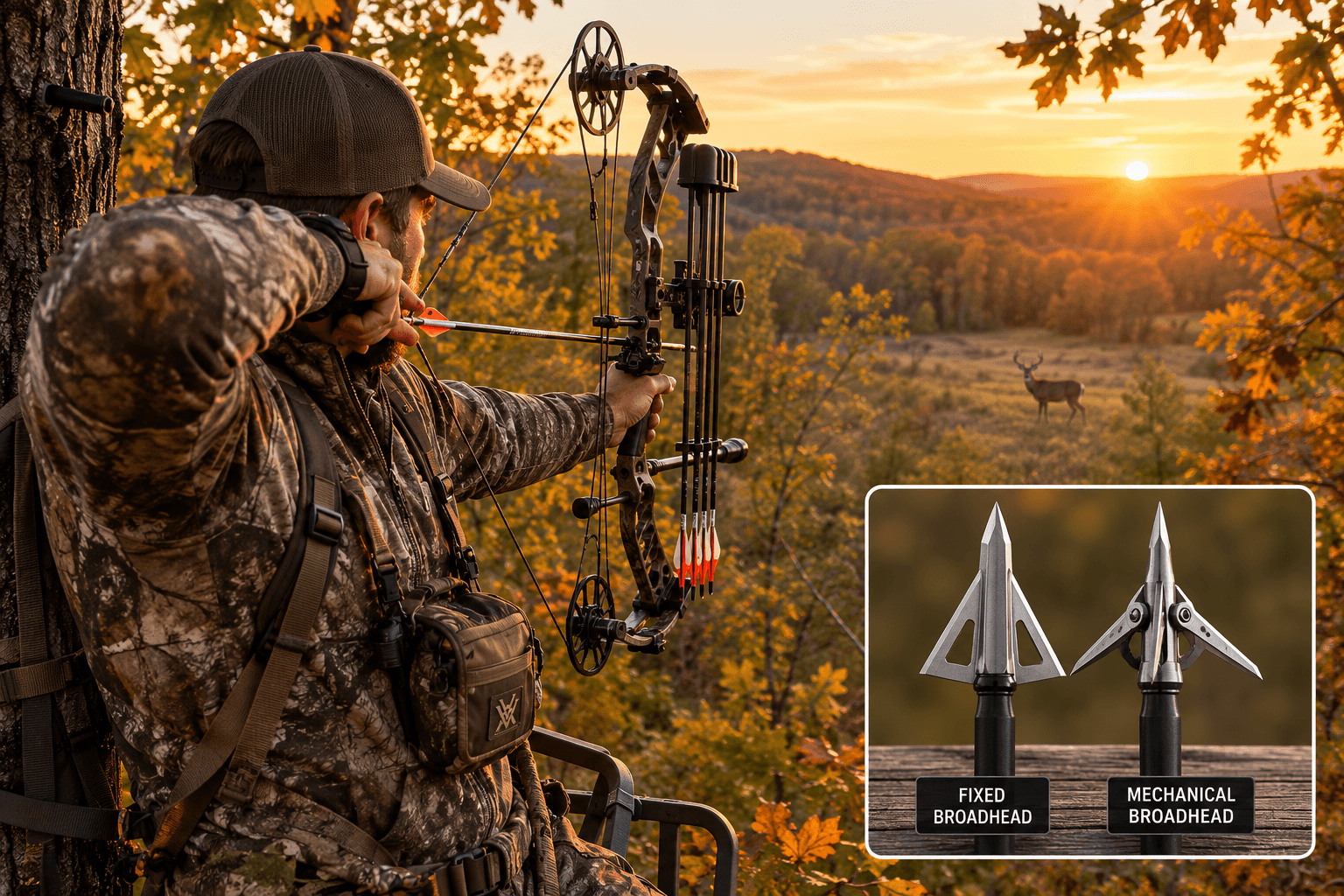
Fixed-blade broadheads are the better choice for elk hunting because they provide superior penetration through heavy bone and muscle, maintain reliability in cold mountain weather, and eliminate mechanical failure risk on a once-in-a-lifetime hunt. Elk require penetration depths of 18-24 inches to reach vitals on quartering shots, which fixed blades achieve more consistently than mechanicals, especially with draw weights under 65 pounds.
Elk anatomy presents challenges that favor fixed blades: massive shoulder bones, thick hide, dense muscle, and the likelihood of less-than-perfect shot angles in mountain terrain. A mechanical that works perfectly on whitetails may fail to reach an elk’s vitals on a quartering-away shot.
Why fixed blades excel on elk:
Many western guides and outfitters require or strongly recommend fixed blades for elk. The consequences of a mechanical failure on an elk hunt (expensive tag, limited time, difficult recovery terrain) make the reliability of fixed blades worth any minor accuracy tradeoff.
Recommended fixed blades for elk (2026):
If you insist on using mechanicals for elk, follow these guidelines:
The honest tradeoff: mechanicals may give you slightly better accuracy at 50 yards, but fixed blades dramatically increase your odds of recovery on the imperfect shots that happen in real elk hunting.
Quality broadheads cost between $35 and $60 for a three-pack in 2026, with fixed-blade models typically ranging from $35-$45 and mechanical broadheads from $40-$60. Premium models with advanced materials or proprietary designs can reach $70-$80 per three-pack, while budget options under $30 often sacrifice quality control, durability, and consistent performance.
Price breakdown by category:
Fixed-blade broadheads:
Mechanical broadheads:
The price difference reflects several factors: mechanicals include complex deployment mechanisms and often come with replacement blades, while premium fixed blades use better steel alloys and tighter manufacturing tolerances.
Cost considerations beyond initial purchase:
Is premium worth it? For most hunters, mid-range broadheads ($35-$50) offer the best value. Premium models provide marginal improvements in materials and tolerances that matter most to serious elk hunters or those shooting heavy poundage. Budget broadheads under $30 are false economy because inconsistent quality leads to wounded game and lost animals.
Smart buying strategy:
You can use mechanical broadheads with a crossbow, but you must choose models specifically rated for crossbow speeds (typically 350-450+ fps) because standard mechanical broadheads designed for vertical bows may deploy prematurely or fail structurally at higher velocities. Most major manufacturers now offer crossbow-specific versions with reinforced ferrules and stronger retention systems.
Crossbows generate significantly higher kinetic energy than compound bows, which creates unique challenges for mechanical broadheads. The extreme acceleration can cause weaker retention systems to fail, and the higher impact velocity increases stress on blade hinges and ferrules.
Crossbow-rated mechanical features:
Recommended mechanical broadheads for crossbows (2026):
Many crossbow hunters prefer fixed blades because they eliminate deployment concerns entirely and crossbows provide enough kinetic energy to drive fixed blades through game easily. The accuracy advantage of mechanicals matters less with crossbows since they’re inherently more accurate than vertical bows.
When to choose fixed vs mechanical for crossbows:
Never use a standard vertical-bow mechanical on a crossbow without verifying it’s rated for crossbow speeds. The failure rate can exceed 50% with non-rated models.
You typically need to retune your bow when switching from mechanical to fixed-blade broadheads because fixed blades expose more surface area to wind resistance and amplify any imperfections in arrow flight. Switching from fixed to mechanical usually requires minimal or no retuning since mechanicals are more forgiving. The extent of retuning depends on your current arrow flight quality and the specific broadhead designs involved.
A bow that shoots mechanicals perfectly may show significant broadhead planing (arrows flying left or right) when you switch to fixed blades. This happens because the exposed blades act like fletching, steering the arrow in the direction of any wobble or imperfect release.
What retuning typically involves:
Scenarios requiring significant retuning:
Scenarios requiring minimal retuning:
Time investment for retuning:
The honest tradeoff: mechanicals let you avoid retuning hassles, but learning to tune for fixed blades makes you a better archer and ensures your setup is truly optimized. Many serious bowhunters maintain two arrow sets, one with mechanicals for long-range practice and one with fixed blades for hunting.
The most common mistake when choosing broadheads is selecting based on marketing claims or peer pressure rather than matching the broadhead type to your specific draw weight, game species, typical shot distance, and hunting conditions. Other critical errors include buying cheap broadheads to save money, failing to practice with actual hunting broadheads, and not considering arrow weight and total kinetic energy in the decision.
Top mistakes hunters make:
1. Choosing mechanicals with insufficient draw weight
Mechanicals need 50+ pounds to deploy and penetrate reliably. Hunters shooting 45-pound bows often experience non-deployment or shallow penetration.
2. Using fixed blades without proper tuning
Buying fixed blades but never paper-tuning leads to poor accuracy and blaming the broadhead instead of arrow flight.
3. Selecting cutting diameter without considering game size
A 2.5-inch mechanical creates massive wound channels on whitetails but may not reach vitals on elk.
4. Ignoring arrow weight and FOC
Lightweight arrows (under 400 grains) don’t carry enough momentum for mechanicals to penetrate heavy game.
5. Buying based on brand loyalty alone
Assuming the broadhead that worked for your friend will work for your completely different setup.
6. Not practicing with hunting broadheads
Shooting field points all summer, then hunting with broadheads you’ve never shot creates surprises.
7. Choosing based on wound channel photos
Marketing photos of massive wound channels don’t show the penetration depth or failure rate.
8. Mixing broadhead weights
Using different weight broadheads in the same quiver changes point of impact and creates confusion.
Decision framework to avoid mistakes:
Start with these questions:
Then choose the broadhead that matches most of your answers, not the one with the coolest marketing video.
Fixed broadheads are significantly better for low poundage bows (under 50 pounds) because they require no energy for blade deployment, penetrate more efficiently with limited kinetic energy, and eliminate the risk of mechanical non-deployment that increases dramatically below 45 pounds of draw weight. Hunters shooting 40-50 pound bows should use cut-on-contact fixed blades with 2-3 blades and modest cutting diameters (1 inch or less) for reliable performance.
Low poundage bows generate less kinetic energy, making every bit of efficiency critical. Mechanical broadheads waste precious energy deploying blades and create more friction during penetration, which can mean the difference between a pass-through and a shallow wound.
Why fixed blades work better at low poundage:
Best fixed-blade characteristics for low poundage:
Recommended models for low poundage bows:
If you’re shooting under 45 pounds, also consider these setup optimizations:
Some mechanical manufacturers claim their models work at 40+ pounds, but real-world performance shows inconsistent deployment and inadequate penetration on anything larger than whitetails. The honest tradeoff: fixed blades give up some accuracy at distance, but accuracy doesn’t matter if your broadhead doesn’t penetrate.
Mechanical broadheads fly better at long distances beyond 40 yards because their closed profile minimizes wind drift, maintains arrow velocity better, and creates less aerodynamic drag than exposed fixed blades. At 50+ yards, mechanicals can show 3-6 inches less wind drift in moderate crosswinds and maintain tighter groups because they fly nearly identical to field points throughout the entire trajectory.
The physics are straightforward: exposed blades on fixed broadheads create drag and act as rudders that amplify any arrow wobble or wind influence. The longer the arrow is in flight, the more these factors compound.
Long-distance performance factors:
Wind drift comparison (40 yards, 10 mph crosswind):
Velocity retention:
Mechanicals maintain 2-4% more velocity at 50 yards compared to fixed blades due to reduced drag.
Group size at distance:
However, long-distance shooting introduces ethical concerns. Even with superior accuracy, mechanical broadheads lose kinetic energy over distance, which can compromise penetration. Most bowhunting organizations recommend maximum shot distances of 40 yards regardless of broadhead type.
When long-distance accuracy matters most:
Improving fixed-blade accuracy at distance:
The honest tradeoff: mechanicals give you better accuracy at 50 yards, but you shouldn’t be shooting game at 50 yards unless you’re an expert archer with perfect conditions. For most hunters, the accuracy advantage of mechanicals matters more at 35-40 yards, where both broadhead types remain ethical with proper shot placement.
Mechanical broadheads can work in cold weather, but their reliability decreases significantly below 40°F because rubber O-rings and retention bands lose elasticity, increasing both premature deployment and non-deployment failures. Hunters pursuing late-season game in cold conditions should either choose mechanical models with steel clip retention systems or switch to fixed-blade broadheads to eliminate temperature-related failure risks.
Cold weather affects mechanical broadheads in multiple ways:
Rubber component failures:
Temperature thresholds:
Cold-weather mechanical solutions:
1. Steel clip retention systems
Models like the Sevr and some Rage designs use stainless steel clips instead of rubber, maintaining reliability to 0°F.
2. Hybrid designs
Some mechanicals use minimal moving parts and metal retention that’s less temperature-sensitive.
3. Proper storage
Keep broadheads in an inside pocket or heated area until immediately before the shot.
4. Fresh components
Replace all O-rings and bands before cold-weather hunts, even if they look fine.
Cold-weather broadhead recommendations:
Many experienced cold-weather hunters simply won’t risk mechanicals below freezing. A late-season buck or bull represents too much investment (time, money, effort) to risk on a temperature-sensitive mechanism. Fixed blades work identically at -20°F as they do at 80°F.
The honest tradeoff: mechanicals might work fine in cold weather with proper precautions, but “might” isn’t good enough when you’ve spent days in a tree stand waiting for a mature animal. Fixed blades eliminate the variable entirely.
You should not use mechanical broadheads when hunting large, heavy-boned game like elk or moose with draw weights under 60 pounds, when shooting in cold weather below 32°F with rubber-retention models, when taking quartering shots that require maximum penetration, when hunting with lightweight arrows under 400 grains, or when hunting in thick brush where premature deployment is likely. Fixed-blade broadheads are the better choice in all these scenarios.
Specific situations to avoid mechanicals:
1. Large game with moderate draw weight
Elk, moose, bear, or wild hogs require penetration that mechanicals can’t reliably deliver unless you’re shooting 65+ pounds with heavy arrows.
2. Quartering shots
Any shot angle steeper than 20 degrees off broadside requires the extra penetration of fixed blades to reach vitals.
3. Backup bow or loaner equipment
If you’re using unfamiliar equipment or a backup bow, fixed blades are more forgiving and reliable.
4. Hunting thick cover
Brush, branches, or tall grass can cause premature deployment before the arrow reaches the target.
5. Low-confidence shooting situations
If you’re not confident in perfect shot placement, fixed blades give you better margin for error on penetration.
6. Budget constraints
If you can’t afford quality mechanicals ($40+ per three-pack), cheap mechanicals fail too often to be ethical.
7. Limited practice opportunity
If you haven’t practiced extensively with your specific mechanical broadheads, don’t hunt with them.
8. Crossbow hunting without crossbow-rated heads
Standard mechanicals fail at crossbow velocities.
Situations where mechanicals remain viable:
The decision isn’t about which broadhead is “better” in absolute terms, it’s about matching the tool to the specific hunting situation. Mechanicals excel in certain conditions and fail in others. Fixed blades are more universally reliable but require more skill to shoot accurately.
Risk assessment framework:
Can you mix fixed and mechanical broadheads in the same quiver?
You can carry both types in the same quiver, but they will have different points of impact, so you must know which arrow you’re shooting and adjust your aim accordingly. Most hunters who carry both mark their arrows clearly and practice with each type separately to know the exact point-of-impact difference at various distances.
How often should you replace mechanical broadhead O-rings?
Replace O-rings and retention bands annually before hunting season, or immediately if hunting in cold weather below 40°F, after any practice shots, or if you notice any cracking, stretching, or loss of tension. Most mechanical failures trace back to degraded retention components.
Do you need different arrow spine for fixed vs mechanical broadheads?
You typically don’t need different arrow spine when switching between fixed and mechanical broadheads of the same weight, but fixed blades are more sensitive to incorrect spine and will reveal spine problems that mechanicals mask. If your arrows fly well with mechanicals but plane badly with fixed blades, your spine may be slightly off.
Can you sharpen mechanical broadhead blades?
Most mechanical broadhead blades are designed as disposable replacements and use thin steel that’s difficult to sharpen effectively, though some premium models with thicker blades can be resharpened carefully with a fine stone. Replacement blade packs typically cost $15-25 and are more reliable than attempting to sharpen thin mechanical blades.
Will mechanical broadheads deploy if you hit a rib?
Quality mechanical broadheads will deploy when hitting ribs on broadside shots, but the blade deployment may be incomplete or asymmetrical, potentially reducing cutting diameter and wound channel effectiveness. This is one reason why broadside shots behind the shoulder (avoiding ribs entirely) are always preferred.
How do you test mechanical broadheads before hunting?
Test mechanical broadheads by shooting at least 3-6 arrows into a broadhead target (not foam) to verify they deploy consistently, group with your sight settings, and don’t show premature deployment. Inspect each broadhead after shooting for damage, then replace O-rings and bands before hunting with fresh components.
Are 2-blade or 3-blade fixed broadheads better?
Two-blade fixed broadheads typically penetrate deeper due to less surface area and are easier to sharpen, while 3-blade designs create larger wound channels and are more forgiving of slight shot placement errors. For elk and large game, 2-blade designs excel; for whitetails, 3-blade designs provide better blood trails.
Can you use the same broadheads for compound bows and recurve bows?
You can use the same broadhead models for both compound and recurve bows, but recurve shooters typically need to be more selective about fixed-blade designs because lower arrow speeds and different arrow flight characteristics make recurves more sensitive to broadhead planing. Most recurve hunters prefer cut-on-contact fixed blades with modest cutting diameters.
Do mechanical broadheads need special arrow rests?
Mechanical broadheads work with any quality arrow rest, but drop-away rests provide the most reliable clearance and eliminate any possibility of the closed blades contacting the rest during the shot. Whisker biscuit and containment rests can work but require careful setup to ensure the mechanical blades clear completely.
How much does broadhead weight affect arrow drop?
Changing broadhead weight by 25 grains (for example, from 100 to 125 grains) typically changes point of impact by 2-4 inches at 30 yards and 4-8 inches at 40 yards, requiring sight adjustment. Heavier broadheads drop more but carry more momentum for better penetration, making 125-grain the most popular weight for hunting.
Should you practice with the same broadheads you hunt with?
You should shoot at least 3-6 arrows with your actual hunting broadheads to verify point of impact and build confidence, then use practice broadheads (cheaper versions with the same weight and flight characteristics) for additional practice to save money. Never hunt with broadheads you haven’t shot at least once.
Can mechanical broadheads be reused after a miss?
Mechanical broadheads can be reused after a clean miss if you inspect them carefully for damage, replace O-rings and retention bands, verify the blades deploy smoothly, and confirm the ferrule isn’t bent or cracked. However, many hunters replace mechanicals after any shot because the cost of a wounded animal far exceeds the cost of a new broadhead.
Fixed vs Mechanical Broadheads: The Honest Tradeoffs ultimately comes down to matching your equipment and hunting situation to the right tool. Mechanical broadheads offer superior accuracy at distance and require less tuning, making them ideal for whitetail hunting in moderate conditions with adequate draw weight. Fixed-blade broadheads provide unmatched reliability, deeper penetration, and consistent performance in all weather conditions, making them the better choice for large game, cold weather, low poundage setups, and any situation where dependability matters more than precision.
The best approach for serious bowhunters is to own both types and choose based on specific hunts. Use mechanicals for open-country whitetails at 30-40 yards where their accuracy advantage matters. Switch to fixed blades for elk, late-season hunts, thick cover, or any time you need maximum penetration and zero risk of mechanical failure.
Action steps for choosing your broadheads:
The broadhead debate will continue as long as bowhunting exists, but the honest answer is that both designs work when matched correctly to the hunting situation. Success comes not from choosing the “best” broadhead in absolute terms, but from understanding the tradeoffs and selecting the design that maximizes your odds of ethical, effective kills in your specific hunting conditions.


