
Newsletter Subscribe
Enter your email address below and subscribe to our newsletter
All voices matter
All voices matter

 ByTravis
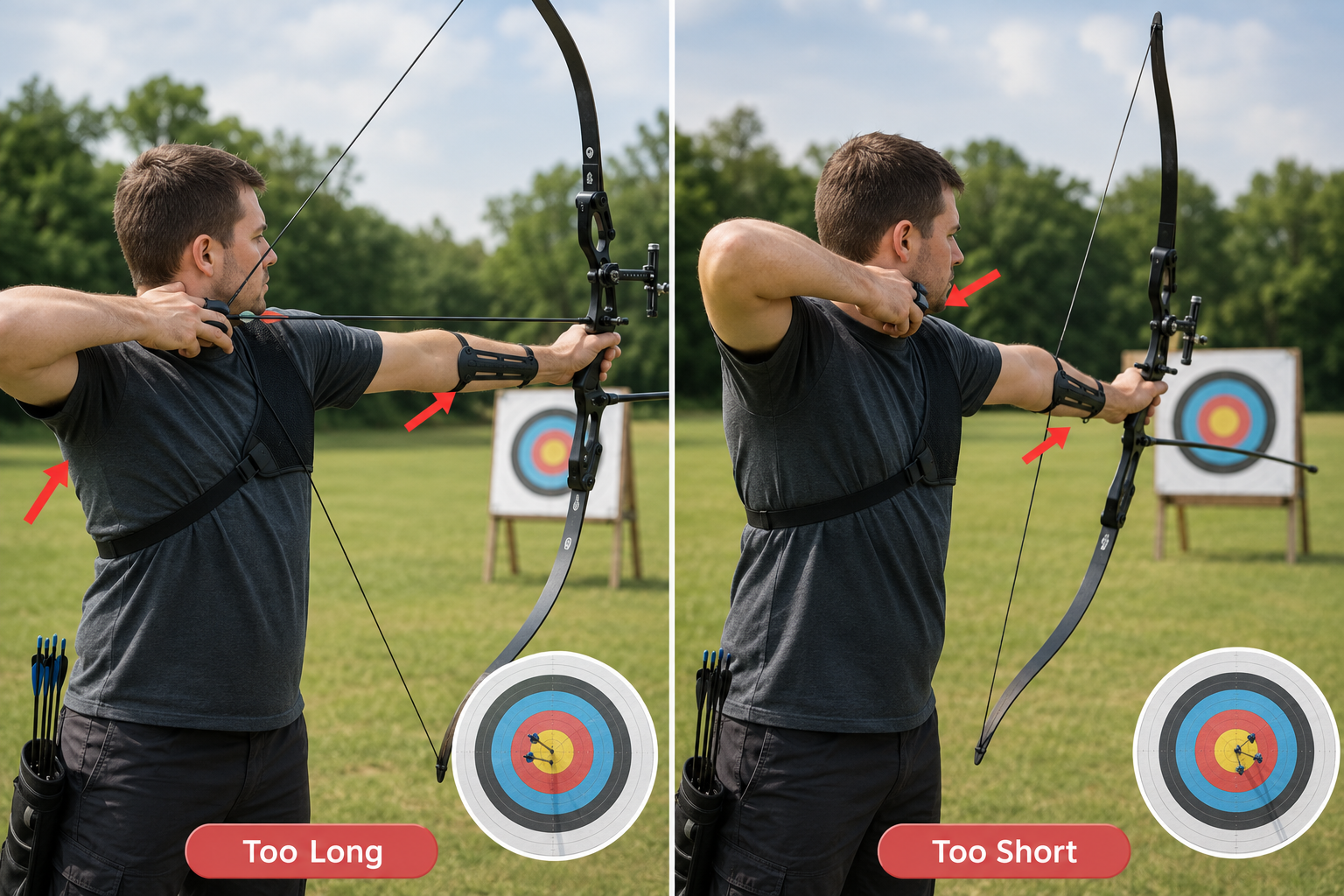
An incorrect draw length causes poor accuracy, inconsistent groups, and physical strain - too long forces you to overextend, too short cramps your anchor point and torques the bow arm.
Affiliate Disclaimer: We are a participant in the Amazon Services LLC Associates Program, an affiliate advertising program designed to provide a means for sites to earn advertising fees by advertising and linking to Amazon.com. As an Amazon Associate I earn from qualifying purchases. We also participate in other affiliate programs.

When your draw length is incorrect, you’ll experience poor accuracy, inconsistent shot groups, and physical discomfort that can lead to shoulder, neck, or back pain. A draw length that’s too long forces you to overextend and collapse your back shoulder, while a draw length that’s too short causes cramped anchor points and torqued bow arms. Both scenarios compromise your shooting form, reduce power transfer, and can cause long-term injury if not corrected.
Draw length is the distance from the nocking point on the bowstring to the throat of the grip (pivot point) plus 1.75 inches when the bow is at full draw. This measurement, standardized by the Archery Trade Association (ATA), determines how far you pull the bowstring back before releasing an arrow.
For compound bows specifically, draw length is a fixed setting that defines the point at which the bow reaches full draw and the let-off engages. Unlike traditional bows where you can vary your draw, compound bows are designed to perform optimally at one specific draw length.
Why draw length matters:
Most adult male archers fall between 28-30 inches, while adult females typically range from 26-28 inches. However, individual measurements vary based on arm length, shoulder width, and shooting style, so these are only rough guidelines.
A draw length that’s too long forces you into an overextended position that compromises both form and safety. The most obvious sign is that you cannot comfortably reach your anchor point without overextending your draw arm or collapsing your back shoulder forward.
Common symptoms of excessive draw length:
Choose a shorter draw length if: you’re a beginner still developing form, you have shorter arms relative to your height, or you experience any shoulder discomfort during or after shooting sessions.
Many archers, especially those who are self-taught, set their draw length too long because it feels like they’re getting more power. In reality, the collapsed form and poor alignment cost far more in accuracy and consistency than any perceived power gain.
When your draw length is too short, you’ll feel cramped at full draw with insufficient room to establish a solid anchor point. This compressed position prevents proper skeletal alignment and forces you to muscle the bow rather than using bone-on-bone support.
Key indicators your draw length needs to be longer:
A draw length that’s too short is actually less common than one that’s too long, because most archers naturally want to pull the bow farther. However, it can happen when someone borrows a bow set up for a smaller archer or when a bow shop makes a measurement error.
Edge case to consider: Some competitive target archers intentionally shoot slightly shorter draw lengths (0.25-0.5 inches under their measured length) for increased control and consistency, but this is an advanced technique that requires proper coaching.
Accurate draw length measurement is essential before purchasing or adjusting a bow. The two most reliable methods are the wingspan method and the wall-touch method, both of which can be performed at home or at a pro shop.
Wingspan method (most common):
Wall-touch method (more precise):
Professional measurement considerations:
For beginners, it’s worth paying for a professional measurement at an archery pro shop. The $20-30 investment prevents costly mistakes and potential injury from shooting an improperly fitted bow.
Yes, incorrect draw length is one of the leading causes of shoulder pain and injury among archers. A draw length that’s too long forces your back shoulder into an unstable, rotated position that places excessive stress on the rotator cuff and surrounding muscles.
When you shoot with a draw length that’s too long, your release-side shoulder rolls forward and upward instead of staying back and down in a strong, stable position. This collapsed shoulder position creates several problems:
A draw length that’s too short can also cause shoulder problems, though typically different ones. The cramped position forces you to muscle the bow with your front shoulder rather than using skeletal alignment, leading to front shoulder strain and fatigue.
Common mistake: Many archers try to “shoot through” shoulder pain, assuming it will improve with conditioning. In reality, shooting with incorrect draw length causes cumulative damage that worsens over time and can lead to chronic conditions requiring months of rest and physical therapy.
If you experience shoulder pain during or after shooting, stop immediately and have your draw length checked by a professional before continuing. Early correction prevents long-term injury.
A draw length that’s too long is generally worse than one that’s too short because it creates more severe form problems and higher injury risk. However, both scenarios significantly compromise your shooting and should be corrected.
Why too long is typically worse:
Problems with too short:
The tolerance question: Most archers can tolerate being 0.25-0.5 inches off their ideal draw length without major issues, but anything beyond that range creates noticeable problems. If you must err in one direction, being slightly short (0.25 inches) is generally safer than being too long.
Decision rule: If you’re between two draw length settings on a bow and unsure which to choose, select the shorter option. You can always add a D-loop twist or adjust your anchor point slightly to effectively lengthen your draw, but you cannot easily shorten a draw length that’s too long without changing cam modules.
Adjusting draw length on a compound bow typically costs between $20 and $50 at a professional archery shop, depending on the bow model and type of adjustment required. Many modern compound bows offer some degree of draw length adjustability without requiring new parts.
Cost breakdown by adjustment type:
| Adjustment Method | Typical Cost | Time Required |
|---|---|---|
| Rotating existing cam modules | $20-30 | 15-30 minutes |
| Installing new cam modules | $40-60 (plus parts) | 30-45 minutes |
| Adjusting draw stop position | $15-25 | 10-20 minutes |
| Complete bow re-tune after adjustment | $50-80 | 1-2 hours |
What’s included in professional adjustment:
DIY considerations: If you’re mechanically inclined and have the right tools (bow press, Allen wrenches, serving material), you can adjust draw length yourself on many bows. However, improper adjustment can damage your bow or create dangerous shooting conditions, so professional service is recommended unless you have experience.
Common mistake: Buying a bow with non-adjustable cams to save money, then discovering you need a different draw length. Always verify the adjustment range before purchasing, and consider bows with modular cam systems that offer 2-4 inches of adjustment range.
Some bow manufacturers offer wide-range adjustable bows (like the Bowtech Solution or Diamond Infinite Edge series) that adjust across 10+ inches of draw length without changing modules, making them ideal for growing youth archers or families sharing equipment.

Incorrect draw length dramatically affects accuracy because it prevents you from achieving consistent anchor points, proper alignment, and repeatable shot execution. Even small deviations of 0.5-1 inch can open up your groups significantly at longer distances.
How wrong draw length ruins accuracy:
Real-world impact: An archer shooting with 1 inch of extra draw length might see their 20-yard groups open from 2 inches to 4-5 inches. At 40 yards, this error compounds to 8-10 inch groups or worse. The effect becomes more pronounced as distance increases.
For beginners specifically: Starting with incorrect draw length ingrains bad habits that are extremely difficult to correct later. New archers should prioritize getting proper draw length before worrying about expensive accessories or advanced techniques.
Choose exact draw length if: you’re serious about accuracy, competing in tournaments, or hunting where ethical shot placement is critical. The small investment in proper fitting pays enormous dividends in performance.
Fixing draw length on a compound bow requires either rotating or replacing the cam modules, adjusting the draw stop position, or in some cases, changing the entire cam system. The specific method depends on your bow’s make and model.
Step-by-step adjustment process:
Common adjustment systems:
When to seek professional help: If you’ve never worked on a bow before, don’t have a bow press, or aren’t confident in your mechanical abilities, take your bow to a pro shop. Improper adjustment can damage your bow, void warranties, or create dangerous shooting conditions.
Verification step: After any draw length adjustment, have someone video your shooting form from the side. Check for proper shoulder position, bow arm extension, and anchor point consistency to confirm the new setting is correct.
Shooting with incorrect draw length for extended periods causes chronic injuries, ingrained bad habits, and potentially permanent changes to your shooting form that are extremely difficult to correct. The cumulative damage from thousands of shots with poor alignment takes a serious toll on your body.
Long-term physical consequences:
Form and performance impacts:
Recovery timeline: If you’ve shot with wrong draw length for years and then correct it, expect 3-6 months of retraining to develop proper form and muscle memory. Physical therapy may be needed for 2-4 months to address shoulder injuries and muscle imbalances.
Prevention strategy: Get your draw length checked annually, especially if you’re a growing youth archer or if you’ve made significant changes to your fitness or flexibility. Bodies change over time, and draw length may need adjustment accordingly.
Beginners need reasonably accurate draw length within ±0.5 inches to develop proper form and avoid injury, though they don’t need the precision that competitive archers require. Starting with approximately correct draw length is far more important than expensive accessories or advanced equipment.
Why beginners need good draw length:
Acceptable tolerance for beginners: New archers can typically function well within 0.5 inches of their ideal draw length. This small margin allows for form development and minor adjustments as they learn proper technique. Beyond 0.5 inches, problems become significant enough to hinder learning.
Common beginner mistake: Buying a used bow or borrowing equipment without verifying draw length fit. While this saves money initially, it often leads to frustration, poor performance, and potential injury that costs more in the long run.
Decision rule for beginners: If you’re just starting archery, invest in professional measurement and fitting before buying equipment. The $20-30 for proper measurement is the best money you’ll spend in archery. If you must choose between a more expensive bow with wrong draw length or a budget bow with correct draw length, always choose the properly fitted option.
Youth archers specifically: Growing children should use adjustable-draw-length bows that can grow with them. Buying a fixed-draw-length bow for a child almost guarantees it will be outgrown within 1-2 years.
The most common draw length mistake is relying on height-based charts rather than actual arm length measurements. Many archers also confuse their comfortable pulling distance with their proper draw length, leading to setups that feel powerful but compromise form and accuracy.
Frequent setup errors:
The “macho draw length” problem: Many male archers, especially beginners, set their draw length too long because it feels more powerful or because they think longer is better. This ego-driven decision causes poor form, reduced accuracy, and increased injury risk.
Measurement timing mistake: Getting measured while cold or fatigued produces different results than measuring after warming up. For best results, measure after light stretching but before fatigue sets in.
Equipment interaction errors: Some archers set draw length without considering how it interacts with their release aid, D-loop length, or anchor point preference. These factors can effectively change your draw length by 0.25-0.5 inches.
Correction approach: If you suspect your draw length is wrong, video yourself shooting from the side. Look for collapsed shoulders, bent bow arm, string contact, or cramped anchor points. These visual cues often reveal problems that feel normal because you’ve adapted to them.
Wrong draw length itself doesn’t typically damage your bow, but the compensating behaviors and poor form it causes can lead to equipment problems over time. The bow is designed to function at any draw length within its adjustment range, but shooting with improper form creates abnormal stresses.
Indirect damage from wrong draw length:
The exception – extreme cases: If you force a bow to a draw length significantly outside its designed range by improperly modifying components, you can damage cams, stress limbs beyond their design limits, or create dangerous situations where strings or cables fail.
String contact damage: The most common bow damage from wrong draw length occurs when the string slaps the bow arm or chest protector, which can fray the string, damage the serving, or even break strands over time. This is a clear sign your draw length is too long.
Warranty considerations: Some manufacturers void warranties if you modify draw length outside specified parameters or if damage results from improper setup. Always follow manufacturer guidelines and use authorized parts when adjusting draw length.
Prevention tip: After any draw length adjustment, have your bow professionally inspected and tuned. This ensures all components are properly aligned and functioning correctly, preventing damage from poor setup.
How do I know if my draw length is correct?
Your draw length is correct when you can comfortably reach a consistent anchor point with your back shoulder down and back, your bow arm fully extended but not locked, and your peep sight naturally aligns with your eye without head movement. Video yourself from the side to verify proper form.
Can I adjust draw length myself or do I need a pro shop?
You can adjust draw length yourself if you have a bow press, proper tools, and mechanical experience, but professional adjustment is recommended for beginners. Improper adjustment can damage your bow or create dangerous conditions. Pro shop adjustment costs $20-50 and includes re-tuning.
How much does draw length affect arrow speed?
Draw length affects arrow speed by approximately 10 feet per second per inch of draw length change. A longer draw length stores more energy and produces faster arrow speeds, but this benefit is completely negated by the poor form and reduced accuracy that comes from incorrect draw length.
Will my draw length change as I get stronger?
Your draw length should not change significantly as you get stronger because it’s based on your skeletal structure (arm length), not muscle strength. However, improved flexibility or significant changes in shoulder mobility might alter your optimal draw length by 0.25-0.5 inches.
What’s the difference between draw length and draw weight?
Draw length is the distance you pull the bowstring back (measured in inches), while draw weight is the force required to pull the bow to full draw (measured in pounds). Both must be properly set for your body, but they’re independent measurements that don’t directly affect each other.
Can wrong draw length cause target panic?
Yes, wrong draw length can contribute to target panic because the uncomfortable or unstable position at full draw creates anxiety and rushing. When you cannot achieve a solid, comfortable anchor point due to incorrect draw length, your brain develops anticipation and flinching behaviors.
How often should I check my draw length?
Check your draw length annually or whenever you experience discomfort, accuracy problems, or form issues. Youth archers should check every 6 months during growth spurts. Also recheck if you make significant changes to your release aid, anchor point, or shooting style.
Is it better to start with draw length too short or too long?
It’s better to start slightly short (0.25 inches under) than too long if you must choose. A draw length that’s too short is uncomfortable but safer, while one that’s too long causes form collapse and injury risk. You can always add D-loop twists to effectively lengthen a short draw.
Can I use the same draw length for hunting and target archery?
Most archers use the same draw length for both hunting and target archery, but some prefer 0.25 inches shorter for hunting to accommodate bulky clothing and shooting from awkward positions. The difference is personal preference rather than a requirement.
What happens if I buy a bow with non-adjustable draw length?
If you buy a bow with fixed draw length that doesn’t match your measurements, you’ll need to replace the entire cam system ($150-300) or sell the bow and buy a properly fitted one. Always verify draw length adjustability and range before purchasing any bow.
Does release aid type affect draw length?
Yes, release aid type can effectively change your draw length by 0.25-0.5 inches. Wrist-strap releases typically require slightly longer draw length than handheld thumb or hinge releases because of how they position your hand relative to your anchor point.
Can physical therapy help with injuries from wrong draw length?
Yes, physical therapy can address shoulder injuries, muscle imbalances, and postural problems caused by shooting with wrong draw length. Treatment typically takes 2-4 months and focuses on rotator cuff strengthening, scapular stabilization, and correcting muscle imbalances. However, you must also correct your draw length or the injuries will return.
Understanding what happens if your draw length is wrong is essential for every archer, from beginners just starting out to experienced shooters troubleshooting accuracy problems. Incorrect draw length creates a cascade of issues including poor accuracy, physical discomfort, potential injury, and ingrained bad habits that are difficult to correct.
The good news is that fixing draw length problems is straightforward and affordable. Professional measurement costs $20-30, and adjustment typically runs $20-50 at a pro shop. This small investment prevents months or years of frustration, poor performance, and potential injury.
Take action now:
Remember that proper draw length is the foundation of good archery form. No amount of expensive accessories, practice time, or coaching can compensate for a fundamentally incorrect bow fit. Prioritize getting this basic setup element right, and everything else in your archery journey becomes easier and more enjoyable.


