
Newsletter Subscribe
Enter your email address below and subscribe to our newsletter
All voices matter
All voices matter

 ByTravis
Shooting from an elevated tree stand means aiming for the true horizontal distance, not the angled line-of-sight distance - most hunters should aim slightly lower than instinct suggests.
Affiliate Disclaimer: We are a participant in the Amazon Services LLC Associates Program, an affiliate advertising program designed to provide a means for sites to earn advertising fees by advertising and linking to Amazon.com. As an Amazon Associate I earn from qualifying purchases. We also participate in other affiliate programs.

Quick Answer: Shooting from a tree stand requires aiming for the true horizontal distance rather than the actual line-of-sight distance because gravity affects arrows based on horizontal travel, not the angled path. Most bowhunters should aim slightly lower than their instinct suggests when shooting downward from an elevated stand, and the higher the stand, the more critical proper angle compensation becomes for accurate shot placement.
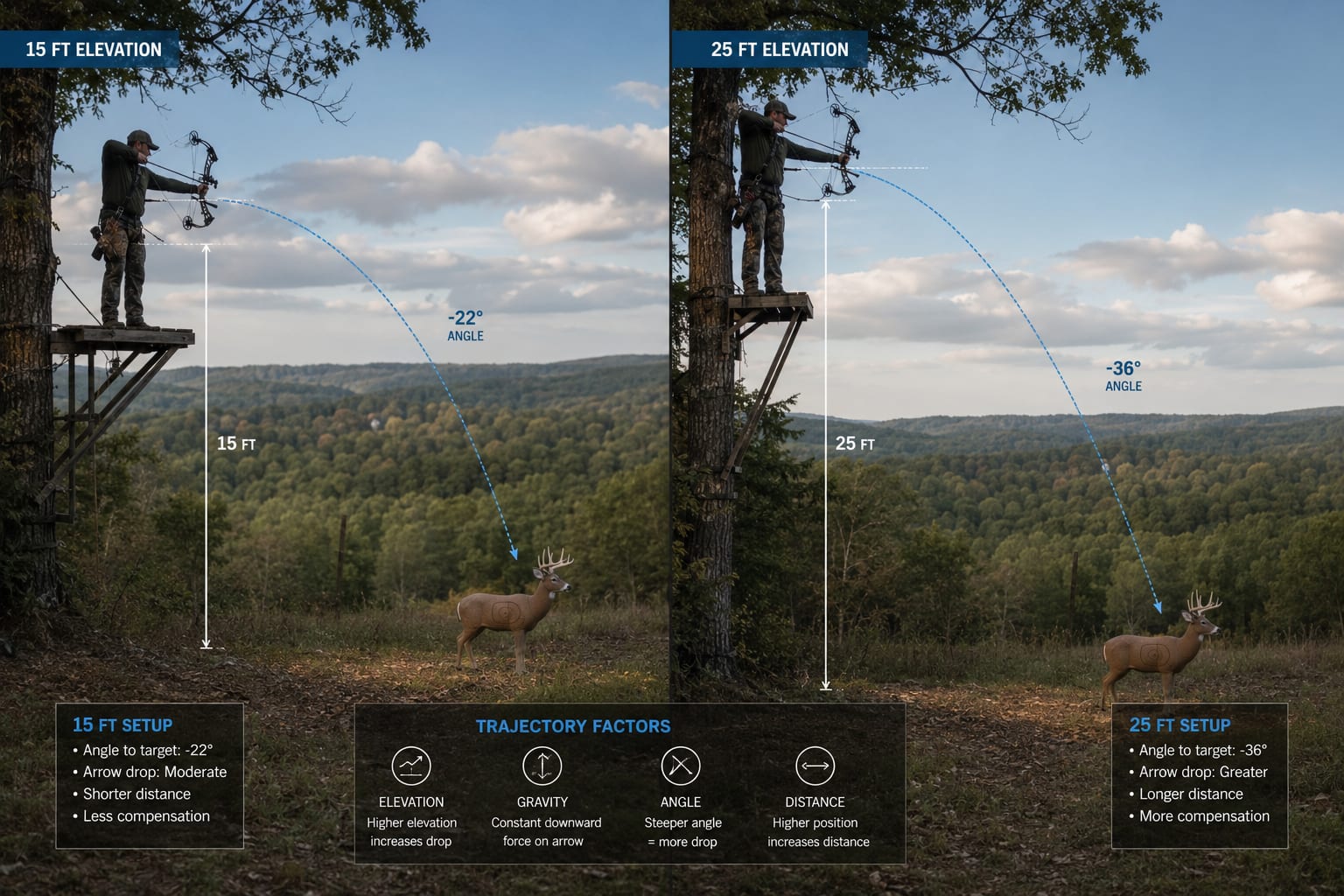
Shooting angle from a tree stand reduces the effective horizontal distance your arrow travels, which means gravity has less time to pull the arrow downward compared to a flat shot at the same measured distance. When you shoot at a downward angle, the arrow’s flight path is shorter in the horizontal plane where gravity does its work, resulting in less drop and a higher point of impact than you might expect.
The physics behind this effect is straightforward. Gravity pulls arrows straight down toward the earth, not along your line of sight. When you measure a 20-yard angled shot from your tree stand, that 20 yards represents the hypotenuse of a right triangle. The horizontal leg of that triangle (the distance gravity actually affects your arrow) might only be 17-18 yards depending on your stand height and the animal’s distance from your tree base.
Key factors that determine how much angle affects your shot:
A common mistake is assuming that because the arrow is traveling downward, it will drop more. The opposite is true. The arrow drops less because the horizontal distance (where gravity matters) is shorter than your line-of-sight measurement. Choose to compensate for angle whenever your shot exceeds a 20-degree downward angle, which typically occurs at distances under 25 yards from a 20-foot stand.
You should aim low when shooting from an elevated tree stand, meaning you should use the shorter horizontal distance for your sight pin selection rather than the longer line-of-sight distance. This translates to aiming with a closer-distance pin than your rangefinder’s unadjusted reading would suggest, which effectively lowers your point of aim and prevents shooting over the animal’s back.
The confusion about aiming high or low stems from misunderstanding what “aiming low” means in practice. You are not aiming at a lower spot on the deer’s body. You are still aiming at the vital zone (heart and lungs), but you are using a sight pin calibrated for a shorter distance. For example, if your rangefinder shows 22 yards line-of-sight from your stand, but the true horizontal distance is 19 yards, you should aim using your 20-yard pin instead of your 22-yard pin.
Practical aiming adjustments for common scenarios:
The steeper the angle, the more you compensate. If you forget this principle and aim high (using a farther pin), you will shoot over the deer’s back. This is the number one reason bowhunters miss from tree stands. Always remember: shorter horizontal distance means less drop, which means you need to aim as if the target is closer than it appears.
Shooting from 25 feet high versus 15 feet high creates steeper shot angles at any given horizontal distance, requiring more aggressive distance compensation and making accurate shot placement more challenging. A 25-foot stand produces approximately 5-7 degrees steeper angles than a 15-foot stand at typical hunting distances of 15-25 yards, which translates to an additional 1-2 yards of compensation needed.
At 15 feet, most bowhunters can maintain effective accuracy out to 25-30 yards with manageable angle compensation. The shooting angles remain within the comfort zone where muscle memory from practice translates well to hunting situations. At 25 feet, the steeper angles create several challenges: reduced vital zone presentation (you see more back and less broadside), increased difficulty judging exact distance, and a narrower margin for error in shot execution.
Comparison of practical shooting differences:
| Factor | 15-Foot Stand | 25-Foot Stand |
|---|---|---|
| Angle at 20 yards | Approximately 20 degrees | Approximately 27 degrees |
| Distance compensation needed | 1-2 yards | 3-4 yards |
| Vital zone visibility | Good broadside view | More top-down view |
| Effective range for most hunters | 25-30 yards | 20-25 yards |
| Setup/takedown difficulty | Moderate | Challenging |
| Detection risk by game | Lower | Lowest |
The advantage of a 25-foot stand is better scent dispersion and reduced visibility to game animals. However, these benefits come at the cost of more difficult shooting. For most bowhunters, especially those with moderate experience, a 15-18 foot stand height offers the best compromise. Choose a 25-foot stand only if you practice extensively at steep angles and hunt areas where deer frequently look up due to hunting pressure, or if terrain features make lower stands impractical.
The best rangefinders for tree stand hunting feature true horizontal distance (THD) or angle range compensation (ARC) technology that automatically calculates and displays the shooting distance you should use for aiming, eliminating manual math in critical moments. Quality models from manufacturers like Vortex, Leupold, Bushnell, and Sig Sauer offer reliable angle compensation in the price range of $200-$500, with accuracy within one yard at hunting distances.
Modern angle-compensating rangefinders use internal inclinometers to measure the shot angle, then apply trigonometric calculations to display the horizontal distance. When you range a deer at 23 yards from your tree stand, the display might show “23Y” for line-of-sight and “20Y” for the compensated horizontal distance. You then aim using your 20-yard pin, and the angle compensation is handled automatically.
Key features to prioritize for tree stand hunting:
Popular models for 2026 include the Vortex Ranger 1800, Leupold RX-2800 TBR/W, and Sig Sauer Kilo BDX series. The Bushnell Prime 1300 offers excellent value for budget-conscious hunters. Avoid older non-compensating models or smartphone apps that require manual angle calculations, as these introduce delays and potential errors during critical shot opportunities. If you hunt exclusively from the same stand height, you can memorize compensation amounts, but a rangefinder with built-in angle compensation provides versatility and confidence across varying setups.

Shooting over a deer from a tree stand almost always results from using the line-of-sight distance for aiming instead of the shorter true horizontal distance, causing the arrow to impact 3-6 inches high at typical hunting ranges. This error occurs because hunters instinctively aim using the distance their rangefinder displays without compensating for the downward angle, or they forget to activate their rangefinder’s angle compensation mode.
The second most common cause is target panic or poor shot execution under pressure, where the hunter’s anchor point shifts or they punch the release, driving the arrow high. However, when multiple shots from the same stand consistently hit high on practice targets or result in high misses on game, angle compensation is nearly always the culprit.
Other factors that contribute to shooting high from tree stands:
To diagnose your specific issue, practice from your stand or a similar height before season. Shoot at 3D targets at various distances and mark where your arrows hit. If you consistently hit 4-6 inches high at 20 yards when aiming for the vitals, you are not compensating enough for angle. Adjust by using closer-distance pins or, if using a rangefinder without angle compensation, subtract 2-3 yards from displayed distances at typical stand heights of 15-20 feet.
You should always use the true horizontal distance for aiming, not the line-of-sight distance your rangefinder initially displays, because gravity affects your arrow based on horizontal travel regardless of the angled path. If your rangefinder has angle compensation, use the compensated distance it provides; if not, you must manually calculate or estimate the horizontal distance before selecting your aiming point.
The line-of-sight distance (what you measure along the angled path from your stand to the deer) is only useful for understanding how far your arrow physically travels. For aiming purposes, this number will cause you to shoot high. The true horizontal distance represents how far the deer is from the base of your tree in a straight line across the ground, and this is the distance gravity uses to pull your arrow downward.
Quick reference for manual compensation without an angle-compensating rangefinder:
These are approximations. For precise calculations, use the formula: Horizontal Distance = Line-of-Sight Distance × Cosine(Angle). Most hunters find this impractical in the field, which is why angle-compensating rangefinders are valuable investments. If you hunt regularly from tree stands and do not own an angle-compensating rangefinder, either purchase one or create a reference card with compensation amounts for your specific stand heights and common distances. Tape this card to your bow or keep it in your pocket for quick reference.
Practice shooting downhill angles by setting up an elevated platform at your practice range that mimics your hunting stand height, then shooting at targets placed at various distances to build muscle memory for angled shots. A simple platform can be constructed from a ladder stand, a deck, a hillside, or even a truck bed, as long as it provides a stable shooting position at 15-20 feet above your targets.
The most effective practice routine involves shooting from your elevated position at 3D deer targets positioned at distances you expect to encounter while hunting: 10, 15, 20, 25, and 30 yards. Focus on aiming at the vital zone and noting where your arrows impact when using different pins. This hands-on experience teaches you exactly how much compensation your setup requires better than any chart or formula.
Step-by-step practice protocol for tree stand shooting:
Common mistakes during practice include only shooting from flat ground, practicing at just one distance, or failing to wear hunting gear that might affect your draw or anchor point. Dedicate at least three practice sessions to elevated shooting before season, with 20-30 arrows per session. If you cannot build an elevated platform, find a hillside where you can shoot downward at targets below you, though this does not perfectly replicate the tree stand experience.
Shooting angle matters significantly for both bows and crossbows, but the compensation required is slightly less for crossbows due to their higher arrow speeds, which reduce time of flight and total drop. However, crossbow hunters still must compensate for angle because the physics of gravity acting on horizontal distance applies equally to all projectiles regardless of speed.
A crossbow shooting 400 feet per second experiences less total arrow drop than a compound bow shooting 300 feet per second, but both experience the same proportional reduction in drop when shooting at downward angles. For example, if a compound bow shooter needs to compensate by 3 yards on a 22-yard angled shot from a 20-foot stand, a crossbow shooter might need to compensate by 2-2.5 yards for the same shot. The difference is measurable but not dramatic enough to ignore angle compensation entirely.
Practical differences between bow and crossbow angle shooting:
The real advantage crossbows offer for tree stand hunting is not reduced angle compensation but rather easier shooting mechanics from awkward positions. Crossbows can be pre-cocked and held at ready without fatigue, making steep-angle shots more manageable from a physical execution standpoint. Compound bow shooters must draw, anchor, and execute while bent at the waist for downward shots, which is more challenging.
Regardless of weapon choice, use a rangefinder with angle compensation and practice from elevated positions. Do not assume your crossbow’s speed eliminates the need for angle awareness. A 3-inch high miss is still a wounded animal, whether it comes from a bow or crossbow. Choose your weapon based on personal preference and local regulations, but treat angle compensation as equally important for both.
The most common mistake bowhunters make when shooting from elevated stands is failing to compensate for angle, which results in consistently shooting over the animal’s back by 3-6 inches at typical hunting distances. This error stems from using line-of-sight distance for aiming or simply forgetting that downward angles require different aiming points than flat-ground practice.
Beyond angle compensation, several execution errors plague tree stand hunters. Bending at the waist instead of maintaining proper upper-body posture changes the relationship between your eye, peep sight, and anchor point, driving arrows high. Rushing shots due to excitement causes form breakdown, particularly incomplete draw or inconsistent anchor points. Many hunters also fail to account for the reduced vital zone presentation when shooting downward, aiming too far back and hitting the paunch instead of the heart-lung area.
Critical mistakes to avoid:
Another frequent error is setting stands too high in pursuit of scent advantage, creating angles so steep that accurate shooting becomes extremely difficult. Most bowhunters shoot more accurately from 15-18 feet than from 25-30 feet, and the scent advantage of extreme height is often overstated in moderate wind conditions. Choose stand height based on shooting ability first, scent management second.
To minimize mistakes, develop a pre-shot routine that includes verifying distance compensation, checking your anchor point, and confirming your aiming spot on the deer’s vitals. Practice this routine from elevation until it becomes automatic, so adrenaline does not derail your execution during the moment of truth.
A 20-foot tree stand is not too high for accurate shooting for most experienced bowhunters who practice from elevation and properly compensate for angle, but it does represent the upper end of the ideal height range where shooting difficulty begins to increase noticeably. Hunters who practice regularly from 20 feet and understand angle compensation can maintain ethical accuracy out to 25 yards or more, while those with limited elevated shooting experience may struggle with the steeper angles.
The question of optimal stand height balances shooting accuracy against concealment and scent dispersion. At 20 feet, you gain significant advantages in remaining undetected by deer, as you are above their primary visual scanning zone and your scent disperses better in most wind conditions. However, you sacrifice some shooting ease compared to 15 feet, particularly on closer shots under 15 yards where angles become very steep.
Factors that determine if 20 feet works for you:
For most hunters, the sweet spot is 15-18 feet, which provides adequate concealment while keeping shooting angles manageable. If you choose 20 feet or higher, commit to extensive practice from that height before season. Shoot at least 50-100 arrows from your elevated position at various distances to build confidence and verify your compensation amounts. If you find yourself consistently struggling with accuracy or uncomfortable with the steep angles, lower your stand by 3-5 feet. Ethical hunting demands shots you can execute confidently, and no amount of concealment advantage justifies low-percentage shooting.
You should not permanently adjust your sight pins for tree stand height because this would make them inaccurate for flat-ground shots; instead, use angle-compensated distance readings from your rangefinder and select the appropriate pin for the horizontal distance rather than the line-of-sight distance. This approach maintains your sight’s versatility for all shooting scenarios while providing accurate aiming for elevated shots.
Your sight pins are calibrated for specific distances on flat ground, and this calibration remains valid for the horizontal component of any angled shot. When shooting from a tree stand, the physics of arrow drop does not change; only the horizontal distance changes. By using a closer pin (one calibrated for the shorter horizontal distance), you effectively compensate for the angle without altering your sight.
Proper sight use for tree stand shooting:
Some hunters use multi-pin sights with additional pins specifically for tree stand distances, but this creates clutter and confusion. A cleaner approach is a single-pin adjustable sight that you can dial to the exact compensated distance. However, these require more movement and time to adjust, which can be problematic when a deer appears suddenly.
The only scenario where you might consider a dedicated tree stand sight setup is if you hunt exclusively from one stand at a fixed height and never shoot from flat ground. Even then, the better solution is to learn proper angle compensation with your standard sight rather than limiting your versatility. Modern bowhunting demands adaptability, and your sight should work equally well from ground blinds, tree stands, and spot-and-stalk situations.
If you forget to compensate for angle on a shot from a tree stand, your arrow will impact high, typically 3-6 inches above your aiming point at distances of 15-25 yards from a 20-foot stand, which often results in a non-lethal hit above the vital zone or a complete miss over the deer’s back. The severity of the error increases with steeper angles, meaning closer shots from higher stands produce worse outcomes when compensation is forgotten.
A high hit on a deer usually strikes the spine, the top of the lungs, or passes completely over the back. Spine hits may drop the deer immediately but often result in paralysis rather than quick death, requiring a follow-up shot. High lung hits can be lethal but result in slower death and longer tracking distances than ideal heart-lung shots. Complete misses are actually preferable to poor hits because the deer remains unharmed and you get another opportunity.
Consequences of forgotten angle compensation at common distances:
The psychological impact of a missed or poorly hit animal is significant. Many hunters lose confidence after a high miss, second-guessing their equipment and abilities when the real issue was simply forgetting basic angle compensation. This is why developing a consistent pre-shot routine that includes verifying compensated distance is critical. Make it automatic: range the deer, check the horizontal distance, select the correct pin, verify your aiming point, then execute the shot.
If you realize after the shot that you forgot to compensate, wait at least 30-45 minutes before tracking, as you would with any marginal hit. Look for arrow placement clues: hair color and length, blood characteristics, and the deer’s reaction. High hits often produce dark blood with air bubbles (lung) or no blood trail at all (complete miss or spine). Be prepared for a longer recovery process and consider calling an experienced tracker if the blood trail is sparse.
Rifle hunters need to worry about tree stand angle much less than bowhunters because rifle bullets travel at 2,000-3,000 feet per second compared to arrows at 250-350 feet per second, resulting in dramatically less drop over hunting distances and minimal angle compensation requirements at typical ranges under 200 yards. However, rifle hunters shooting at extended ranges beyond 300 yards from elevated positions should still consider angle compensation for precision shots.
At typical whitetail hunting distances of 50-150 yards, the difference between line-of-sight distance and horizontal distance from a 20-foot tree stand is negligible for rifle accuracy. A rifle zeroed at 100 yards will shoot within 1-2 inches of point of aim whether the shot is flat or at a 20-degree downward angle at that distance. The bullet’s extremely flat trajectory over short ranges makes angle compensation unnecessary for practical hunting purposes.
Comparison of angle impact on different weapons:
The primary concern for rifle hunters in tree stands is not ballistics but rather safety and shot angle ethics. Shooting downward from a tree stand with a rifle requires absolute certainty of your backstop, as bullets can travel over a mile if they miss or pass through the animal. Steep downward angles also reduce the vital zone presentation and increase the risk of hitting only one lung or the paunch. Many rifle hunters prefer ground blinds or elevated box blinds with shooting rails for these reasons.
If you rifle hunt from tree stands, focus on safe shooting lanes with adequate backstops, ethical shot angles that present the vitals clearly, and stable shooting positions. Ballistic angle compensation is not a practical concern at hunting distances, but safety and shot selection remain paramount.
How much should I compensate for angle when shooting from a 15-foot stand?
From a 15-foot stand, compensate by subtracting 1-2 yards from your line-of-sight distance for shots between 15-25 yards. Closer shots require more compensation (2-3 yards at 10-12 yards), while shots beyond 30 yards require minimal compensation (1 yard or less). Use a rangefinder with angle compensation for precise readings.
Can I use the same bow setup for tree stand and ground hunting?
Yes, use the same bow setup for both tree stand and ground hunting. Your sight pins remain calibrated the same way; you simply select different pins based on the compensated distance when shooting from elevation. Do not create separate sight configurations, as this creates confusion and limits versatility.
What is the maximum angle I should shoot from a tree stand?
Avoid shooting at angles steeper than 45 degrees, which typically means not shooting at deer directly below your stand within 15-20 feet horizontally. Steep angles reduce vital zone presentation, make accurate aiming difficult, and increase the risk of poor hits. Wait for the deer to move to a better angle.
Do I need an expensive rangefinder with angle compensation?
While not absolutely necessary, a rangefinder with angle compensation significantly improves accuracy and confidence for tree stand hunters. Quality models start around $200 and eliminate guesswork. If budget is a concern, learn manual compensation for your specific stand height and create a reference card.
How do I know if I am bending too much at the waist when shooting downward?
If you feel strain in your lower back, your peep sight is difficult to see through, or your arrows consistently hit high despite angle compensation, you are likely bending too much at the waist. Maintain upright posture in your torso and bend primarily at the hips, letting your bow arm drop to create the downward angle.
Should I practice with my hunting clothes on when shooting from elevation?
Yes, always practice in your full hunting setup including jacket, safety harness, and any other gear you will wear while hunting. Bulky clothing can affect your draw length, anchor point, and shooting form, and you need to identify these issues during practice, not during a shot opportunity.
What is the best way to estimate distance without a rangefinder?
Place visual markers at known distances from your stand before season: a distinctive tree, rock, or ground feature at 15, 20, and 25 yards. When a deer appears, compare its position to these markers. However, rangefinders are inexpensive enough that every serious bowhunter should own one for ethical hunting.
How high should beginners set their first tree stand?
Beginners should start at 12-15 feet for their first tree stand experiences. This height provides adequate concealment while keeping shooting angles manageable and reducing the consequences of mistakes. As experience and confidence grow, you can experiment with higher placements if needed.
Does wind affect my arrow more when shooting from a tree stand?
Wind affects your arrow the same amount regardless of shooting angle, but you may be more exposed to wind at elevated heights. The primary consideration is that your scent disperses differently from elevation, which is an advantage. Arrow drift from wind is a separate issue from angle compensation.
Can I use a ballistic calculator app for bow hunting angle compensation?
Ballistic calculator apps designed for rifles are not accurate for archery because arrow flight dynamics differ significantly from bullet ballistics. Use archery-specific rangefinders with built-in angle compensation or archery ballistic apps that account for arrow speed, weight, and trajectory characteristics.
What should I do if my rangefinder batteries die during a hunt?
Keep spare batteries in your pack and check battery levels before every hunt. If batteries die unexpectedly, rely on your pre-marked distance references and your practiced knowledge of compensation amounts for your stand height. This is why memorizing basic compensation for your setup is valuable.
How often should I practice from elevation before hunting season?
Practice from elevation at least three separate sessions before season, with 20-30 arrows per session at various distances. Continue practicing every 2-3 weeks during season to maintain muscle memory and confidence. Elevated shooting requires different muscle engagement than flat-ground shooting and skills deteriorate without regular practice.
Shooting from a tree stand requires understanding that gravity affects arrows based on horizontal distance, not the longer angled path your eyes see. The most critical skill for elevated bowhunters is using true horizontal distance for aiming, which means selecting closer-distance pins than your line-of-sight measurement suggests. This single adjustment prevents the most common tree stand error: shooting over the animal’s back.
Invest in a quality rangefinder with angle compensation to eliminate guesswork and build confidence. Practice extensively from elevation before season, shooting at 3D targets from your typical stand height at distances you expect to encounter. Develop a pre-shot routine that includes verifying compensated distance, maintaining proper shooting form despite the downward angle, and confirming your aiming point on the deer’s vitals.
Choose stand heights between 15-20 feet for the best balance of concealment and shooting accuracy. Avoid the temptation to set stands excessively high in pursuit of scent advantage, as the shooting difficulty often outweighs the benefits. Remember that ethical hunting demands shots you can execute confidently, and proper angle compensation is not optional but essential for clean, humane kills.
Start your preparation today by setting up an elevated shooting platform at your practice range. Shoot 50 arrows from height this week, noting exactly which pins produce vital-zone hits at each distance. Create a reference card with your specific compensation amounts and keep it accessible during hunts. The difference between success and disappointment in tree stand hunting often comes down to these few yards of compensation, practiced until they become instinctive.


