
Newsletter Subscribe
Enter your email address below and subscribe to our newsletter
All voices matter
All voices matter

 ByTravis
Learn the ideal draw weight for deer hunting. Expert guide covers minimum requirements, compound vs recurve, beginner tips, and common mistakes to avoid.
Affiliate Disclaimer: We are a participant in the Amazon Services LLC Associates Program, an affiliate advertising program designed to provide a means for sites to earn advertising fees by advertising and linking to Amazon.com. As an Amazon Associate I earn from qualifying purchases. We also participate in other affiliate programs.

Quick Answer: For deer hunting, most states require a minimum draw weight of 40 pounds, but 50-60 pounds is the sweet spot for whitetail deer, providing enough kinetic energy for ethical kills while remaining manageable for most hunters. Your ideal draw weight depends on your physical strength, shooting accuracy, bow type, and whether you’re hunting whitetail or larger game like elk.
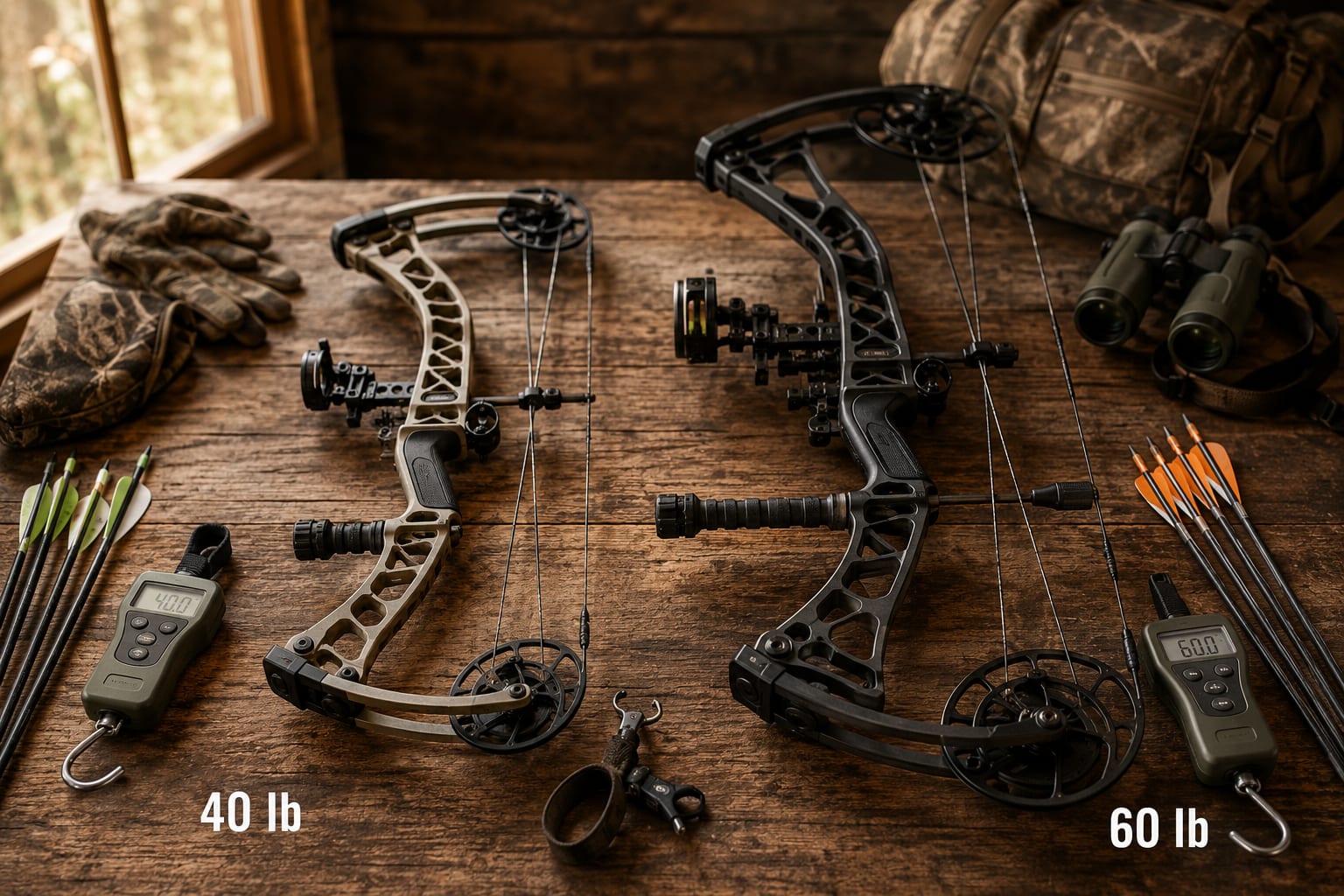
Draw weight is the amount of force (measured in pounds) required to pull a bowstring back to full draw position. When you see a bow labeled as “60 lbs,” that means it takes 60 pounds of force to draw the string to its maximum distance.
For compound bows, draw weight works differently than traditional bows because of the cam system. Once you reach full draw on a compound bow, the let-off feature reduces the holding weight by 65-80%. This means a 60-pound compound bow might only require you to hold 12-18 pounds at full draw, making it much easier to aim steadily.
Key factors that affect draw weight:
Choose a draw weight you can pull smoothly 20-30 times in a practice session without fatigue. If you’re struggling by the fifth arrow, your draw weight is too high for consistent accuracy.
Legal minimum draw weights for deer hunting vary by state, typically ranging from 30 to 40 pounds. Most states set their minimums at 40 pounds for compound bows and 35-40 pounds for recurve or longbow setups.
Common state requirements:
Always check your specific state’s hunting regulations before the season, as these laws change periodically. Some states also specify minimum arrow weight (typically 300-400 grains) in addition to draw weight requirements.
Important note: Just because your state allows 30 or 35 pounds doesn’t mean it’s ethical or effective. Legal minimums represent the absolute floor, not the recommended standard. Most experienced hunters and wildlife agencies suggest 40-50 pounds as the practical minimum for consistent, humane deer harvests.
For whitetail deer, 50-60 pounds of draw weight provides the ideal balance of power and control for most adult hunters using compound bows. This range generates 40-60 foot-pounds of kinetic energy at typical hunting distances (20-30 yards), which is more than sufficient to achieve complete pass-throughs on broadside shots.
Draw weight recommendations by experience level:
Whitetail deer have relatively thin hides and lighter bone structure compared to elk or moose. A well-placed arrow from a 50-pound bow with a sharp broadhead will penetrate both lungs and often exit the opposite side, creating the blood trail needed for recovery.
The real-world test: Can you draw your bow smoothly, anchor properly, and hold steady for 30-45 seconds while a deer approaches? If not, reduce your draw weight by 5-10 pounds. A 45-pound bow you shoot accurately beats a 65-pound bow that causes you to shake and jerk the trigger.
Yes, a 50-pound bow can absolutely kill a deer when combined with proper shot placement and quality broadheads. A 50-pound compound bow generates approximately 45-50 foot-pounds of kinetic energy with a 400-grain arrow, which exceeds the 25-30 foot-pounds generally considered the minimum for ethical deer hunting.
Why 50 pounds works for deer:
Critical success factors at 50 pounds:
Thousands of deer are harvested annually with 45-50 pound bows. The limitation isn’t the bow’s capability but the hunter’s discipline to pass on marginal shots. A 50-pound setup demands better shot selection than a 65-pound bow, but it’s perfectly adequate for whitetail deer when used responsibly.
Beginner bow hunters should start with 40-50 pounds for men and 35-45 pounds for women, prioritizing form development and accuracy over raw power. Starting too heavy is the most common mistake new hunters make, leading to bad habits, poor accuracy, and potential shoulder injuries.
Why beginners should start lighter:
Progression plan for beginners:
Beginner mistake to avoid: Don’t let experienced hunters or pro shop staff pressure you into a heavier draw weight than you can handle comfortably. A 45-pound bow you shoot accurately will harvest more deer than a 65-pound bow that causes you to develop target panic or flinching.
The difference between 40 and 60 pounds of draw weight is approximately 15-20 foot-pounds of kinetic energy and about 30-40 feet per second of arrow speed, but both are fully capable of killing whitetail deer with proper shot placement. The practical differences matter more for shot flexibility and margin of error than basic effectiveness.
Performance comparison (with 400-grain arrow):
| Factor | 40 lb Bow | 60 lb Bow |
|---|---|---|
| Arrow speed | ~240 fps | ~270 fps |
| Kinetic energy | ~35 ft-lbs | ~55 ft-lbs |
| Effective range | 25-30 yards | 30-40 yards |
| Penetration | Adequate for broadside | Excellent for most angles |
| Shot angle flexibility | Broadside/quartering-away only | More forgiving on angles |
When 40 pounds is sufficient:
When 60 pounds is better:
The accuracy factor: A 40-pound bow you shoot with perfect form and confidence will outperform a 60-pound bow that causes you to anticipate the shot or shake at full draw. Most hunters who switch from 60 to 50 pounds report improved accuracy and more consistent groups.
Elk hunting requires 55-65 pounds of draw weight compared to the 45-55 pounds adequate for deer, primarily because elk have thicker hides, denser bone structure, and larger body cavities requiring deeper penetration. The extra 10-15 pounds of draw weight translates to approximately 15-20 additional foot-pounds of kinetic energy, which matters significantly when driving arrows through an elk’s vitals.
Why elk demand more power:
Recommended draw weights:
Arrow setup matters more for elk: Beyond draw weight, elk hunters should use heavier arrows (450-550 grains) with high FOC (Front of Center) balance and cut-on-contact broadheads. A 60-pound bow shooting a 500-grain arrow often outpenetrates a 70-pound bow shooting a 350-grain arrow.
If you hunt both deer and elk, set your bow at 60 pounds, it’s adequate for elk and won’t be excessive for deer. Many western hunters run 60-65 pounds year-round for versatility across species.

Your draw weight is too high if you cannot smoothly draw and hold at full draw for 30-45 seconds without shaking, struggling, or breaking proper form. Physical strain at full draw leads to poor accuracy, target panic, and increased injury risk, all of which undermine hunting success far more than a few extra pounds of draw weight would help.
Clear warning signs your draw weight is too high:
The 30-second test: Draw your bow and hold at full draw while counting slowly to 30. If you’re shaking significantly or must let down before 30 seconds, reduce your draw weight by 5-10 pounds. In hunting situations, you often need to hold while waiting for a deer to turn broadside or step into a shooting lane.
The cold-weather test: If you can barely draw your bow in summer clothing, you definitely can’t draw it wearing heavy winter layers with cold, stiff muscles. Test your draw weight while wearing your hunting clothes in realistic conditions.
Reducing draw weight by 10 pounds typically improves accuracy more than it reduces effectiveness. A well-placed arrow from a 50-pound bow kills deer just as dead as a poorly placed arrow from a 70-pound bow, and the 50-pound setup makes accurate placement far easier.
If draw weight is too low for deer hunting (below 35-40 pounds), arrows may lack sufficient kinetic energy for complete penetration, potentially resulting in wounded deer that escape and die slowly rather than clean, ethical kills. Inadequate draw weight becomes especially problematic on less-than-perfect shot angles or when arrows encounter heavy bone.
Risks of insufficient draw weight:
Minimum thresholds for ethical hunting:
When low draw weight works: Experienced hunters with 40-45 pound setups can successfully harvest deer by being extremely selective about shot opportunities. This means passing on any shot that isn’t a perfect broadside or slight quartering-away angle within 25 yards, using heavy arrows (450+ grains), and employing razor-sharp fixed-blade broadheads.
The ethical standard is simple: your equipment must reliably produce complete pass-throughs on broadside shots at your intended hunting distance. If you’re consistently getting only partial penetration during practice on 3D targets, your draw weight is too low.
Women do not need different draw weight for deer hunting based on gender, they need appropriate draw weight based on individual strength, just like male hunters. Many women comfortably shoot 50-60 pounds, while some men are better suited to 45-50 pounds. Physical conditioning and proper form matter far more than gender.
Realistic draw weight ranges for women:
Why the “women need lighter bows” myth persists:
The truth about strength and archery: Proper bow shooting technique relies primarily on back muscles, not arm or shoulder strength. Women who learn correct form often discover they can handle more draw weight than they initially thought. The key is gradual progression and technique development, not gender.
Practical advice for women hunters:
Many successful women bowhunters run 55-65 pounds and harvest elk, deer, and other game with no issues. Choose your draw weight based on what you can shoot accurately and comfortably, not based on gender stereotypes.
Compound bows require 10-15 pounds less draw weight than recurve bows for equivalent deer hunting performance because of the let-off feature that reduces holding weight by 65-80% at full draw. A 50-pound compound bow is roughly equivalent to a 60-65 pound recurve bow in terms of effective hunting power.
Draw weight equivalents for deer:
Why compound bows need less weight:
Why recurve shooters need more weight:
Choosing between compound and recurve for deer:
Choose compound if you want maximum forgiveness, longer effective range (30-40 yards), and easier shooting for beginners. Choose recurve if you prefer traditional archery, enjoy the challenge, and plan to limit shots to 25 yards or less.
Both are perfectly capable of harvesting deer ethically. Compound bows dominate modern hunting because they’re easier to shoot accurately, but thousands of hunters successfully use recurve and longbows every season with slightly higher draw weights.
The most common mistake when choosing bow draw weight is selecting a weight that’s too heavy to shoot accurately, prioritizing power over precision. This leads to poor form, decreased accuracy, and often results in fewer successful hunts than a lighter, more controllable setup would provide.
Top draw weight mistakes hunters make:
1. Maxing out draw weight at the pro shop
2. Matching a friend’s or mentor’s draw weight
3. Ignoring the 30-second hold test
4. Increasing weight too quickly
5. Believing “more is always better”
6. Forgetting about arrow weight and setup
The smart approach: Start conservative, practice extensively, and increase gradually only if you maintain perfect form and accuracy. Most hunters find their sweet spot at 50-60 pounds and stay there for their entire hunting career.
To increase draw weight for hunting season, add 2-5 pounds every 4-6 weeks while maintaining proper form and accuracy, allowing your muscles to adapt gradually without injury. Rushing the process leads to bad habits, decreased accuracy, and potential shoulder or back injuries that can sideline you for months.
Safe draw weight progression plan:
Phase 1: Baseline assessment (Week 1)
Phase 2: Gradual increase (Weeks 2-6)
Phase 3: Consolidation (Weeks 7-10)
Phase 4: Reassess and repeat (Week 11+)
Exercises to support draw weight increases:
Warning signs to stop increasing:
Remember: hunting season success depends on accuracy under pressure, not maximum draw weight. A 50-pound bow you shoot confidently beats a 65-pound bow that causes anxiety or poor form.
Yes, 70 pounds of draw weight is overkill for whitetail deer hunting and often reduces accuracy without providing meaningful benefits over 55-60 pounds. While 70 pounds is appropriate for large game like elk or moose, it’s excessive for deer and increases the risk of poor form, target panic, and shoulder injuries without improving kill effectiveness.
Why 70 pounds is too much for deer:
When 70 pounds makes sense:
The data on overkill: Studies of arrow penetration show that 50-60 pounds with proper arrow setup (400-450 grain arrows, sharp broadheads) produces complete pass-throughs on broadside deer 95%+ of the time. Increasing to 70 pounds improves that to perhaps 97-98%, a marginal gain that doesn’t justify the accuracy and injury costs.
Better alternatives to increasing draw weight:
If you’re currently shooting 70 pounds for deer and experiencing any accuracy issues, target panic, or physical discomfort, try reducing to 60 pounds for a month. Most hunters report improved accuracy, more enjoyable practice sessions, and identical hunting results with the lower weight.
What is the minimum draw weight to kill a deer?
The minimum draw weight to kill a deer ethically is 40 pounds for compound bows and 45 pounds for recurve bows, though many states set legal minimums at 30-35 pounds. However, 40-45 pounds should be considered the practical minimum for consistent, humane kills with complete penetration on broadside shots.
Can you hunt deer with a 30 pound bow?
While some states allow 30-pound bows for deer hunting, this weight is marginal and should only be used by experienced hunters who strictly limit shots to perfect broadside angles within 20 yards. Most hunters should use at least 40-45 pounds for reliable, ethical deer harvests.
Is 60 lbs too much draw weight for a beginner?
Yes, 60 pounds is typically too much for most beginners and can lead to poor form, bad habits, and potential injuries. Beginners should start at 40-45 pounds for men and 35-40 pounds for women, focusing on proper technique before gradually increasing weight over time.
What draw weight do most deer hunters use?
Most deer hunters use 50-60 pounds of draw weight on compound bows, with 55 pounds being the most common setting. This range provides more than adequate power for whitetail deer while remaining manageable for accurate shooting and extended practice sessions.
How much draw weight do you lose with age?
Hunters typically lose 5-10 pounds of comfortable draw weight per decade after age 50, though this varies greatly based on fitness level and continued practice. Many older hunters successfully transition from 60-65 pounds in their 30s-40s down to 45-50 pounds in their 60s-70s without sacrificing hunting effectiveness.
Should I get an adjustable draw weight bow?
Yes, adjustable draw weight bows are excellent for beginners, growing youth hunters, or anyone wanting flexibility to increase weight gradually. Most modern compound bows offer 10-15 pounds of adjustment range (such as 50-60 or 40-50 pounds) without requiring a bow press.
What happens if I shoot a bow with too much draw weight?
Shooting a bow with excessive draw weight causes poor form, decreased accuracy, target panic, and increased risk of rotator cuff or shoulder injuries. You’ll likely develop bad habits like jerking the trigger, dropping your bow arm, or anticipating the shot, all of which reduce hunting success.
Can a woman hunt deer with a 40 pound bow?
Yes, a 40-pound bow is perfectly adequate for women (or men) to hunt deer when combined with proper shot selection, quality broadheads, and shots limited to 25-30 yards on broadside angles. Many women successfully harvest deer with 40-45 pound setups every season.
Is 50 or 60 pounds better for deer hunting?
Both 50 and 60 pounds are excellent for deer hunting, with 60 pounds offering slightly more margin for error on shot angles while 50 pounds is easier to shoot accurately. Choose 50 pounds if you prioritize accuracy and comfort, or 60 pounds if you want maximum versatility for various shot angles and potentially larger game.
How do I know what draw weight I can handle?
Test your appropriate draw weight by drawing the bow and holding at full draw for 30-45 seconds without significant shaking or struggling. If you can’t hold steady for 30 seconds, reduce the weight by 5 pounds. Your ideal weight is the heaviest you can shoot accurately for 20-30 arrows without fatigue.
Does draw weight affect arrow speed significantly?
Yes, draw weight significantly affects arrow speed, with each 10-pound increase adding approximately 15-20 feet per second. However, for deer hunting at typical distances (20-30 yards), the speed difference between 50 and 60 pounds has minimal practical impact on arrow drop or penetration.
What draw weight is needed for a 30-yard shot on deer?
A 50-pound draw weight is more than sufficient for 30-yard shots on deer, generating adequate kinetic energy and flat enough trajectory for accurate shooting. Most hunters can effectively shoot deer out to 35-40 yards with 50-55 pounds when using proper arrow setup and practicing at those distances.
Choosing the right draw weight for deer hunting comes down to finding the balance between adequate power and shooting accuracy. For most hunters, 50-60 pounds on a compound bow provides the sweet spot, enough kinetic energy for complete pass-throughs on whitetail deer while remaining manageable for consistent, accurate shooting throughout a practice session or long day in the stand.
Remember that legal minimums (typically 40 pounds) represent the floor, not the recommendation. Start conservative, especially if you’re new to bowhunting, and prioritize form and accuracy over raw power. A 50-pound bow you shoot confidently will harvest more deer than a 70-pound bow that causes you to shake or anticipate the shot.
Your next steps:
The best draw weight for deer hunting is the one you can shoot accurately, consistently, and comfortably. Don’t let ego or peer pressure push you into a weight that compromises your form or accuracy. Thousands of deer are harvested every year with 45-55 pound bows by hunters who understand that precision beats power every time.


