
Newsletter Subscribe
Enter your email address below and subscribe to our newsletter
All voices matter
All voices matter

 ByTravis
Your dominant eye - not your dominant hand - should decide whether you shoot a left- or right-handed bow. A simple triangle test tells you which eye leads.
Affiliate Disclaimer: We are a participant in the Amazon Services LLC Associates Program, an affiliate advertising program designed to provide a means for sites to earn advertising fees by advertising and linking to Amazon.com. As an Amazon Associate I earn from qualifying purchases. We also participate in other affiliate programs.

Quick Answer: Your dominant eye, not your dominant hand, should determine whether you shoot a left-handed or right-handed bow. If you’re right-eye dominant, you’ll shoot a right-handed bow (holding it with your left hand and drawing with your right). If you’re left-eye dominant, you’ll shoot a left-handed bow. A simple triangle test using your hands can reveal your eye dominance in under 30 seconds.
The triangle test (also called the Miles test) is the fastest and most accurate way to determine eye dominance for archery. Form a small triangle with your hands by overlapping your thumbs and index fingers, extend your arms fully, and look through the triangle at a distant object with both eyes open. Without moving your hands, close your left eye, if the object stays centered in the triangle, you’re right-eye dominant. If the object disappears from view, you’re left-eye dominant.
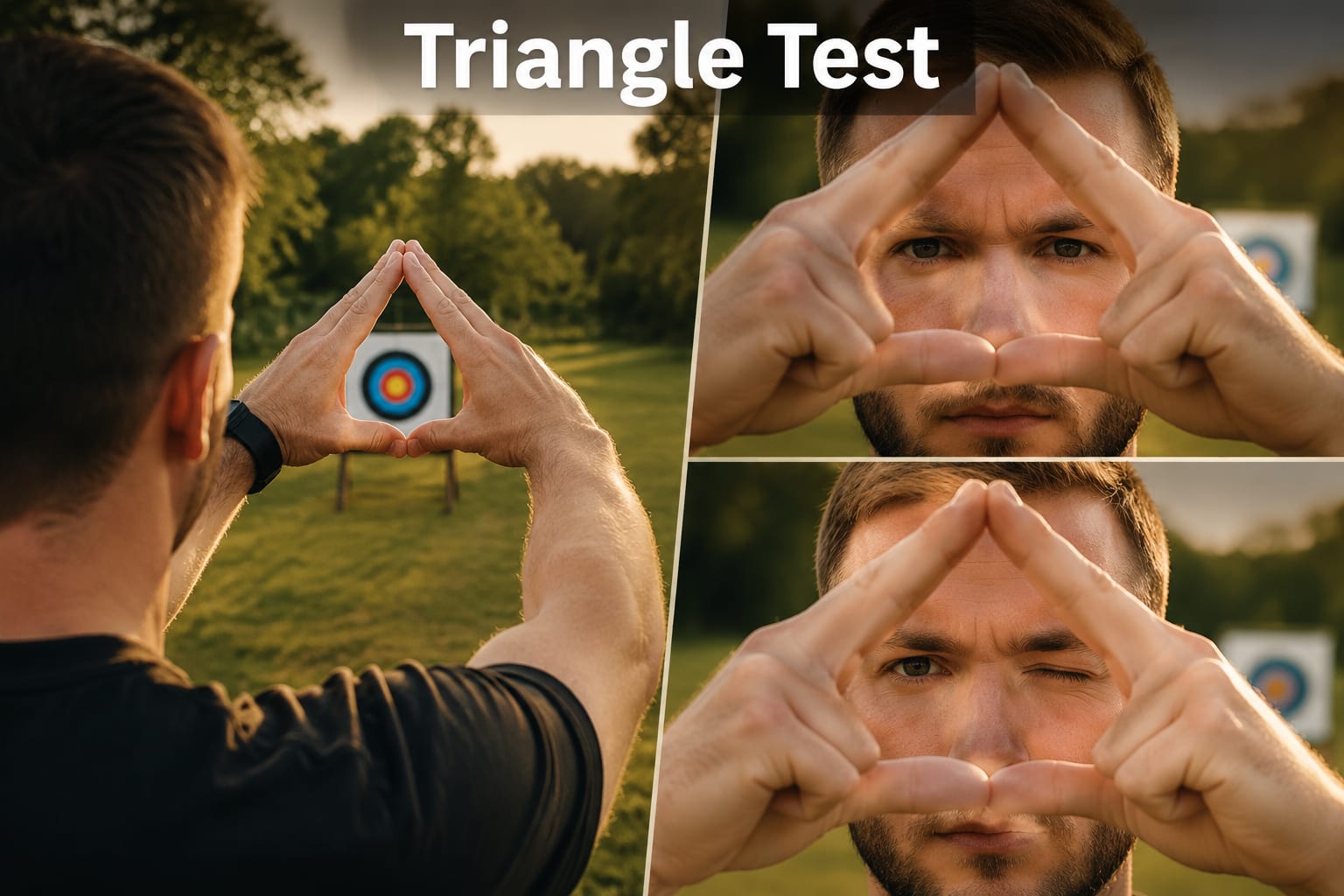
Here’s the step-by-step process:
Alternative test method: Point at a distant object with one finger, keeping both eyes open. Alternate closing each eye. The eye that keeps your finger aligned with the object is your dominant eye.
Common mistake: Moving your hands when you close one eye invalidates the test. Keep your arms locked in position throughout the entire process.
Yes, eye dominance is significantly more important than hand dominance when choosing a bow. Your dominant eye controls your aiming and target acquisition, while your hands simply hold and draw the bow. Shooting with the wrong eye creates a misalignment between where you’re looking and where the arrow will actually go, making consistent accuracy nearly impossible.
When you aim a bow, your dominant eye naturally takes over to focus on the target and align the sight. If you’re using a bow that forces you to aim with your non-dominant eye, your brain receives conflicting visual information. This creates a phenomenon called “cross-firing,” where your sight picture doesn’t match your actual point of aim.
Why eye dominance wins:
Choose eye dominance if: You’re a beginner, shooting for accuracy matters, or you want to develop proper form from the start.
Consider hand dominance only if: You have a physical limitation (injury, missing fingers, limited mobility) that prevents you from drawing with one arm.
Cross-dominance (having your dominant eye and dominant hand on opposite sides) is common and affects approximately one in three people. If you’re cross-dominant, you should still choose your bow based on your dominant eye, not your dominant hand. Most cross-dominant archers adapt to using their non-dominant hand within a few weeks of practice.
For example, if you’re right-handed but left-eye dominant, you’ll shoot a left-handed bow. This means holding the bow in your right hand and drawing the string with your left hand. While this feels awkward initially, the motor skills required for archery are new to both hands anyway, so the learning curve is similar.
Adaptation timeline for cross-dominant shooters:
Success factors: Consistent practice (3-4 sessions per week), proper coaching on form, and patience during the initial adjustment period.
If you’re left-eye dominant but right-handed, you should use a left-handed bow. This means you’ll hold the bow with your right hand (your dominant hand) and draw the string with your left hand. While this seems counterintuitive, it allows you to aim with your dominant left eye, which is critical for accuracy and consistency.
The terminology can be confusing: a “left-handed bow” is designed for left-eye dominant shooters, regardless of hand preference. You’ll anchor the string near your left cheek and look down the arrow with your left eye.
Benefits of matching your bow to your dominant eye:
What happens if you ignore eye dominance: You’ll develop compensatory habits like tilting your head, closing one eye, or shifting your anchor point, all of which reduce accuracy and create bad form that’s hard to correct later.
The triangle test is the gold standard for determining eye dominance because it’s quick, requires no equipment, and provides clear results. Unlike other tests that can be ambiguous, the triangle test gives you an immediate, definitive answer about which eye your brain prefers for aiming.
Detailed triangle test instructions:
Why this test works: Your brain automatically positions the triangle in front of your dominant eye when both eyes are open. Closing one eye reveals which eye was actually being used for alignment.
Edge case: If the target stays partially visible with either eye closed, you may have mixed or weak dominance. In this case, perform the pointing test as a secondary confirmation.
Yes, you can train your non-dominant eye for archery, but it requires 6-12 months of dedicated practice and may never feel as natural as using your dominant eye. This approach is typically only recommended for archers who have already invested years shooting with the “wrong” bow and don’t want to start over, or those with vision problems in their dominant eye.
Training methods for switching eye dominance:
Success rate: Approximately 60-70% of archers who attempt this transition can achieve functional accuracy with their non-dominant eye, but most report it never feels completely natural.
Better alternative for most shooters: Switch to a bow that matches your dominant eye. Even experienced archers typically regain their previous skill level within 3-6 months when switching to the correct bow orientation.
A right-handed bow is designed for right-eye dominant shooters who hold the bow in their left hand and draw with their right hand. A left-handed bow is the mirror image, designed for left-eye dominant shooters who hold the bow in their right hand and draw with their left hand. The key difference is the placement of the arrow rest, sight, and other accessories.

Physical differences:
| Component | Right-Handed Bow | Left-Handed Bow |
|---|---|---|
| Arrow rest | Left side of riser | Right side of riser |
| Sight mounting | Left side | Right side |
| Grip orientation | Shaped for left hand | Shaped for right hand |
| Sight window | Cut on left | Cut on right |
| Stabilizer threads | Positioned for left-hand hold | Positioned for right-hand hold |
How to identify a bow’s handedness: Look at the arrow rest position. If the rest is on the left side of the riser (when viewing the bow from the shooter’s perspective), it’s a right-handed bow. If the rest is on the right side, it’s a left-handed bow.
Important note: You cannot simply flip a bow to change its handedness. The riser is machined specifically for one orientation, and accessories are permanently positioned for either right or left-handed shooting.
Cross-dominance is relatively common, affecting approximately 30% of the general population and a similar percentage of archers. Being cross-dominant (having your dominant eye opposite your dominant hand) is completely normal and doesn’t put you at any disadvantage once you choose the correct bow orientation.
Many elite archers are cross-dominant and perform at the highest levels of competition. The key is identifying your eye dominance early and selecting your equipment accordingly, rather than defaulting to your hand preference.
Cross-dominance statistics:
Why cross-dominance happens: Eye dominance and hand dominance are controlled by different areas of the brain and develop independently. There’s no correlation between the two, which is why any combination is possible.
Advantage for cross-dominant archers: Your dominant hand holds the bow (the less complex task), while your dominant eye handles aiming (the more critical task). Some coaches argue this is actually ideal.
Beginners should always choose their bow based on eye dominance, not hand dominance. Since you’re learning archery skills from scratch, both hands are equally inexperienced, making this the perfect time to establish correct form. Starting with the wrong bow orientation creates bad habits that are difficult and time-consuming to correct later.
Why beginners should prioritize eye dominance:
Timeline for beginners: Most new archers feel comfortable with their draw hand within 2-3 weeks, regardless of whether it’s their dominant hand. The initial awkwardness disappears quickly with regular practice.
Choose hand dominance only if: You have a physical limitation, injury, or disability that prevents you from using one arm effectively for drawing.
Using the wrong handed bow for your eye dominance forces you to aim with your non-dominant eye, creating a misalignment between your natural sight picture and your actual point of aim. This results in chronic accuracy problems, inconsistent groupings, and compensatory habits like head tilting, squinting, or closing one eye, all of which limit your potential and can cause eye strain.
Specific problems caused by using the wrong bow:
Real-world impact: Archers using the wrong bow orientation typically group 3-5 inches wider at 20 yards compared to when they switch to the correct orientation.
The fix: Switch to a bow that matches your eye dominance. Most archers see immediate improvement in consistency, even if raw accuracy takes a few weeks to rebuild.
You can tell if a bow is left or right handed by looking at the arrow rest position on the riser. When holding the bow upright as if you’re about to shoot, a right-handed bow has the arrow rest on the left side of the riser, while a left-handed bow has the arrow rest on the right side. The sight window cutout and accessory mounting positions also indicate handedness.
Visual identification checklist:
Quick memory trick: The arrow rest is on the opposite side from the hand that holds the bow. A right-handed bow is held in your left hand, so the arrow rest is on the left side (from the shooter’s view).
When buying used equipment: Always verify handedness before purchasing. Unlike some sports equipment, bows cannot be converted from one handedness to another, the riser is permanently machined for one orientation.
Ambidextrous bows: Some traditional longbows and simple recurves without cut-out sight windows can be shot from either side, but these are rare and not recommended for target archery or hunting.
Yes, both compound bows and recurve bows follow the same eye dominance rules. Regardless of bow type, your dominant eye should determine whether you shoot right-handed or left-handed. The fundamental principle of eye-to-sight alignment applies equally to all bow styles, including traditional longbows, Olympic recurves, and modern compound bows.
Why all bow types use the same rule:
Minor differences by bow type:
Switching between bow types: If you shoot a right-handed compound bow, you’ll also shoot a right-handed recurve or longbow. Your eye dominance doesn’t change based on equipment.
Switching to shoot with your non-dominant eye after years of shooting is extremely difficult and rarely successful. While technically possible through intensive training with occlusion methods, most experienced archers who attempt this switch report it never feels natural and their accuracy suffers. The better solution is switching to a bow that matches your dominant eye, which typically takes 3-6 months to regain previous skill levels.
Why switching eye dominance is so difficult:
Success factors if you must try:
Better alternative: Switch to the correct bow orientation for your dominant eye. Even archers with 10+ years of experience typically regain their previous accuracy within 6 months when switching to the correct bow, and often exceed their previous performance because they’re finally using proper eye alignment.
When switching eye dominance makes sense: Only if you have vision loss or injury in your dominant eye that makes it unusable for aiming.
Can I shoot a bow with both eyes open?
Yes, you should shoot with both eyes open for better depth perception and peripheral vision. Your dominant eye will naturally take over for aiming while your non-dominant eye provides supporting visual information. Closing one eye reduces your field of view and depth perception.
What if I have no eye dominance or mixed dominance?
About 1-2% of people have mixed or no clear eye dominance. Perform multiple eye dominance tests on different days. If results remain inconsistent, choose the bow orientation that feels most comfortable when aiming, or try shooting with your dominant hand and train that eye to take over.
Does eye dominance change with age?
Eye dominance typically remains stable throughout life, though vision changes from aging, injury, or conditions like cataracts can occasionally shift dominance. If you notice aiming difficulties after years of consistent shooting, retest your eye dominance.
Can I use a right-handed bow if I’m left-eye dominant?
You can physically shoot any bow, but using a right-handed bow when you’re left-eye dominant will cause chronic accuracy problems and force you to develop compensatory habits. Always match your bow to your dominant eye for best results.
How long does it take to adjust to shooting with my non-dominant hand?
Most archers feel comfortable drawing with their non-dominant hand within 2-4 weeks of regular practice (3-4 sessions per week). Full muscle memory and smooth execution typically develop within 2-3 months.
Should I test eye dominance before buying my first bow?
Absolutely. Testing eye dominance takes 30 seconds and ensures you buy the correct equipment from the start. Bows cannot be converted from one handedness to another, so buying the wrong orientation means replacing the entire bow.
Do I need different arrows for left vs right-handed bows?
No, arrows are universal and work with both left and right-handed bows. However, you may need different arrow spine (stiffness) depending on your draw weight and length, which can vary between your dominant and non-dominant arms.
What percentage of archers are left-handed?
Approximately 35% of archers shoot left-handed bows (because about 35% of people are left-eye dominant). This is higher than the percentage of left-handed people (10-12%) because bow handedness follows eye dominance, not hand dominance.
Can glasses or contacts affect eye dominance?
Corrective lenses don’t change your eye dominance, but they can make testing more accurate by ensuring both eyes see clearly. Always test eye dominance while wearing your normal vision correction.
Is it harder to find left-handed bows and accessories?
Left-handed bows are less common in retail stores but readily available online from all major manufacturers. Prices are typically the same as right-handed models, though selection may be slightly more limited for some brands.
Should I retest my eye dominance periodically?
Retest your eye dominance if you experience unexplained accuracy problems, after eye surgery or injury, or if you’ve had significant vision changes. Otherwise, eye dominance remains stable and doesn’t require regular retesting.
Can I teach myself archery if I’m cross-dominant?
Yes, cross-dominance doesn’t make learning archery more difficult once you’ve selected the correct bow orientation. Follow the same learning progression as any beginner, and your non-dominant hand will adapt quickly to the drawing motion.
Choosing between a left or right-handed bow comes down to one critical factor: your eye dominance. The triangle test takes just 30 seconds to perform and provides a clear answer that should guide your equipment selection. Remember, a right-handed bow is for right-eye dominant shooters (regardless of hand preference), and a left-handed bow is for left-eye dominant shooters.
If you’re cross-dominant, with your dominant eye opposite your dominant hand, don’t let that discourage you. Approximately 30% of archers are in the same situation, and they perform just as well as same-side dominant shooters once they choose the correct bow orientation. Your non-dominant hand will adapt to the drawing motion within a few weeks, while proper eye alignment will serve you for your entire archery journey.
Your next steps:
Starting with the correct bow orientation from day one sets you up for faster skill development, better accuracy, and proper form that will last throughout your archery career. The few weeks of initial adjustment are a small investment compared to the years of improved performance you’ll gain from matching your equipment to your dominant eye.


