
Newsletter Subscribe
Enter your email address below and subscribe to our newsletter

All voices matter
All voices matter

 ByTravis
Most archers should practice 3-4 times a week for 60-90 minutes to see consistent improvement without overdoing it - beginners do best with shorter, more frequent sessions.
Affiliate Disclaimer: We are a participant in the Amazon Services LLC Associates Program, an affiliate advertising program designed to provide a means for sites to earn advertising fees by advertising and linking to Amazon.com. As an Amazon Associate I earn from qualifying purchases. We also participate in other affiliate programs.

Quick Answer: Most archers should practice 3-4 times per week for 60-90 minutes per session to see consistent improvement while avoiding injury. Beginners benefit from shorter, more frequent sessions (20-30 minutes, 3-5 times weekly), while competitive archers often practice 5-6 days per week with structured training blocks. The optimal frequency depends on your skill level, goals, physical conditioning, and whether you’re shooting for recreation, hunting, or competition.
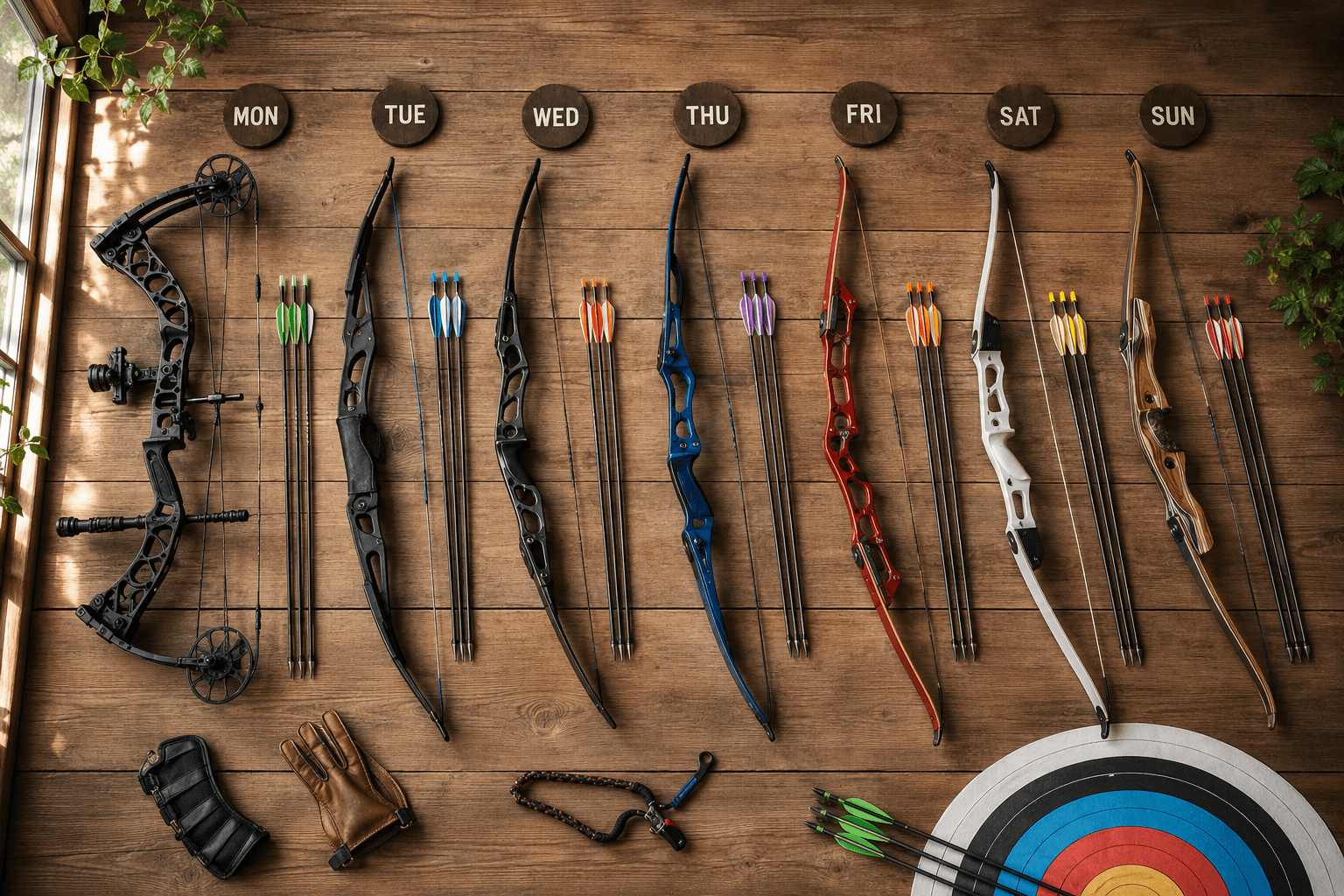
Beginners should practice archery 3-5 times per week in short 20-30 minute sessions during their first three months. This frequency allows new archers to build muscle memory and consistent form while preventing the fatigue that leads to bad habits. Starting with shorter, more frequent sessions is more effective than occasional long practice days because archery technique relies on precise neuromuscular patterns that develop through repetition.
New archers face a specific challenge: their stabilizer muscles, back, and shoulders aren’t conditioned for the repetitive motion of drawing a bow. Pushing through fatigue in early sessions teaches poor form that becomes harder to correct later.
Beginner practice guidelines:
Common mistake: New archers often practice until their arms shake or form breaks down, then continue shooting. Stop each session when you notice your anchor point shifting, your bow arm dropping, or your release becoming inconsistent. These are signs that fatigue is teaching your body the wrong patterns.
Choose 3 times weekly if you’re over 50, have previous shoulder injuries, or are shooting a bow above 30 pounds draw weight. Choose 5 times weekly if you’re younger, physically active, and shooting lighter draw weights below 25 pounds.
Practicing archery once per week is generally not enough to see meaningful improvement, though it can maintain existing skills for experienced archers. Research on motor skill acquisition shows that spacing practice across multiple days per week produces significantly better retention than massed practice in single sessions. For beginners and intermediate archers actively trying to improve, once-weekly practice leads to slow progress and frequent regression between sessions.
The neuromuscular patterns that create consistent archery form require frequent reinforcement. When you practice only once per week, your body essentially relearns the same movements each session rather than building on previous progress.
What once-weekly practice can accomplish:
What it cannot accomplish:
If once per week is your only option, maximize effectiveness by keeping a detailed practice journal, filming your form each session for comparison, and doing bow-free exercises (drawing with resistance bands, holding form with a light bow) 2-3 additional days weekly.
Professional and Olympic-level archers typically practice 4-6 hours per day, 5-6 days per week, with practice divided into multiple sessions. Elite archers rarely shoot continuously for four hours; instead, they structure their day with a 2-3 hour morning session focused on technical work, followed by a 1-2 hour afternoon session emphasizing mental training, competition simulation, or physical conditioning. This approach prevents overuse injuries while maximizing quality repetitions.
The training volume for professional archers varies by season and competition schedule. During base training periods (off-season), professionals might shoot 200-300 arrows daily. During competition season, volume often decreases to 100-150 arrows daily with greater emphasis on mental preparation and maintaining peak form rather than building it.
Typical professional archer daily schedule:
Important distinction: Professional archers have spent years building the physical conditioning and technical foundation to handle this volume. They also have access to sports medicine professionals, coaches providing real-time feedback, and equipment perfectly tuned to their form. Attempting professional training volumes without this foundation leads to injury, not improvement.
Olympic archers preparing for major competitions may increase volume to 300-400 arrows daily during specific training blocks, but this is always periodized with recovery weeks to prevent burnout and overuse injuries.
Practicing archery too much leads to overuse injuries, form deterioration, and performance plateaus rather than improvement. The most common injuries from excessive practice include rotator cuff tendonitis, medial epicondylitis (golfer’s elbow), lateral epicondylitis (tennis elbow), and thoracic outlet syndrome. These conditions develop gradually when archers shoot through fatigue without adequate rest days, and they can sideline you for weeks or months.
Beyond physical injury, excessive practice creates diminishing returns. When you continue shooting after your stabilizer muscles fatigue, you’re training poor form. Your body compensates for tired muscles by recruiting different muscle groups and altering your biomechanics, essentially practicing bad habits that become harder to correct.
Warning signs you’re practicing too much:
Recovery requirements: Most archers need at least 1-2 complete rest days per week with no shooting. During these days, light stretching and mobility work is beneficial, but avoid any bow drawing or resistance band exercises that mimic the shooting motion.
If you notice declining performance despite regular practice, take 3-5 days completely off from shooting. Many archers report improved accuracy and tighter groups after a short break because their muscles have fully recovered and they return with renewed mental focus.
Hunting archers and target archers require different practice schedules because they’re training for fundamentally different demands. Target archers need to shoot dozens of consistent arrows at known distances under controlled conditions, while bowhunters need to make single high-pressure shots at unknown distances from awkward positions. These different goals require different training approaches.
Target archery practice schedule (3-4 days per week):
Bowhunting practice schedule (2-4 days per week, seasonal):
Key difference: Bowhunters should practice the specific shot they’ll take in the field. If you hunt from a tree stand at 15-25 yards, spend 70% of your practice time shooting from elevation at those distances. If you spot-and-stalk hunt in mountains, practice uphill and downhill shots at unknown distances.
Pre-season hunting preparation: Begin 8 weeks before your hunting season with 4 practice sessions weekly. Focus the first 4 weeks on form and accuracy at known distances, then shift the final 4 weeks to field simulation with unknown distances, awkward positions, and elevated heart rate (do jumping jacks before shooting to simulate buck fever).
Both disciplines benefit from off-season strength training focused on back, shoulder, and core stability, but bowhunters especially need to maintain shooting ability with heavy clothing and in cold conditions if hunting in winter months.

You can practice archery every day without injury only if you carefully manage volume, intensity, and listen to your body’s signals. Many Olympic and professional archers do shoot six days per week, but they’ve spent years building the physical conditioning to handle daily practice, they work with sports medicine professionals, and they adjust their training when early warning signs appear. For recreational and intermediate archers, daily practice significantly increases injury risk.
The key factors that determine whether daily practice is sustainable:
Physical conditioning: Daily practice requires well-developed stabilizer muscles in your shoulders, back, and core. If you haven’t been shooting regularly for at least 6-12 months, your body isn’t ready for daily sessions.
Volume management: Shooting 30-40 arrows daily is very different from shooting 100+ arrows daily. If you practice every day, keep most sessions short (30-45 minutes) with one or two longer sessions weekly.
Form quality: The moment your form breaks down, end the session. Daily practice only works if every arrow reinforces correct technique. Shooting through fatigue with poor form accelerates injury.
Active recovery: Daily archers should incorporate shoulder mobility work, stretching, and antagonist muscle strengthening (pushing exercises to balance the pulling motion of archery) into their routine.
Practical daily practice approach:
Better approach for most archers: Practice 4-5 days per week with 2-3 complete rest days. This schedule provides nearly the same skill development as daily practice but with significantly lower injury risk and better long-term sustainability.
Each archery practice session should last 45-90 minutes for intermediate and advanced archers, while beginners should limit sessions to 20-40 minutes. Session length should be determined by when your form begins to deteriorate rather than by a fixed time goal. Quality practice with perfect form for 30 minutes produces better results than 90 minutes of shooting with progressively worse technique.
The ideal session length depends on several factors: your physical conditioning, the intensity of practice (technical drills vs. casual shooting), environmental conditions, and your experience level.
Session length by skill level:
Structure for a 60-minute intermediate session:
Signs to end your session early:
Environmental factors also affect optimal session length. In hot weather above 85°F, shorten sessions by 25-30% and increase hydration. In cold weather below 40°F, extend your warm-up and consider shorter sessions since cold muscles are more injury-prone.
Not improving despite regular practice usually indicates you’re reinforcing errors rather than correcting them, practicing without specific goals, or training at too high a volume with degraded form. Archery improvement requires deliberate practice focused on specific technical elements, not just shooting arrows. Simply putting in hours without structured feedback creates plateaus where you maintain your current skill level but don’t advance.
Common reasons for practice plateaus:
Lack of specific focus: Shooting arrows at a target without working on particular form elements doesn’t create improvement. Each practice session should have a specific technical goal (improving release consistency, refining anchor point, strengthening bow arm stability).
Practicing mistakes: If you’re shooting 100 arrows per session but 60 of them are with poor form due to fatigue, you’re training bad habits. Reduce volume and focus on perfect execution of every shot.
No external feedback: You can’t see your own form errors. Without video analysis, coaching, or a knowledgeable shooting partner, you may be unaware of technical flaws limiting your progress.
Equipment issues: A bow that doesn’t fit you, arrows with incorrect spine, or a sight that’s difficult to adjust can create artificial performance ceilings. Have an experienced archer or pro shop evaluate your equipment setup.
Inadequate physical conditioning: If your muscles fatigue quickly, you can’t maintain form long enough to develop consistency. Add strength training focused on back, shoulders, and core.
Mental game neglect: Advanced archery is largely mental. If you’re not practicing shot routine, breathing techniques, and mental reset between arrows, you’ll plateau even with perfect physical form.
Breaking through plateaus:
Sometimes plateaus indicate you’ve reached the limit of your current equipment or training approach and need to make a change rather than simply practicing more.
Olympic archers typically practice 5-6 days per week rather than every single day, with at least one complete rest day built into their training schedule. Elite archers understand that rest and recovery are essential components of training, not obstacles to it. The highest-performing Olympic archers use periodized training schedules that vary intensity and volume throughout the year, with strategic rest days and recovery weeks preventing overuse injuries and mental burnout.
During peak training blocks leading up to major competitions, Olympic archers may train six consecutive days, but they carefully manage volume and intensity across those days. A typical week includes 2-3 high-intensity days with competition simulation and mental pressure training, 2-3 moderate days focused on technical refinement, and 1-2 complete rest days.
Olympic training week example:
Periodization throughout the year:
The myth that Olympic athletes train every single day without rest comes from confusing training with practice. Olympic archers do something related to their sport nearly every day (video analysis, mental training, equipment maintenance, strength conditioning), but they don’t shoot arrows every day.
Rest days are when your body adapts to training stress and builds the neuromuscular patterns you’ve been practicing. Without adequate rest, you’re breaking down tissue faster than it can repair, leading to injury and declining performance.
Practicing archery more often with shorter sessions is generally more effective than less frequent longer sessions, especially for beginners and intermediate archers. Motor skill research consistently shows that distributed practice (spreading training across multiple days) produces better retention and skill transfer than massed practice (concentrating training into fewer, longer sessions). For archery specifically, frequent short sessions allow you to practice with fresh muscles and consistent form, while long sessions often deteriorate into practicing mistakes.
Why frequency beats duration:
Muscle memory development: Neural pathways strengthen through repetition over time, not through high volume in single sessions. Shooting 40 arrows with perfect form across four days creates better motor patterns than shooting 160 arrows in one day with declining form quality.
Fatigue management: Archery form relies on small stabilizer muscles that fatigue quickly. In a 90-minute session, your first 30 minutes might be excellent practice while the final 30 minutes reinforces compensatory movement patterns.
Mental freshness: Archery requires intense concentration. Multiple shorter sessions allow you to maintain focus throughout practice, while long sessions lead to mental fatigue and careless errors.
Recovery optimization: Your body adapts to training during rest periods between sessions. More frequent sessions with rest between them provide more adaptation opportunities.
Practical comparison:
Option B will produce faster improvement for most archers despite less total time and fewer arrows because the quality of each arrow is higher and the practice is distributed more effectively across the week.
When longer sessions make sense:
Optimal approach: Practice 4-5 times per week for 45-60 minutes per session. This provides enough frequency for skill development while allowing sessions long enough to work through warm-up, technical drills, and distance practice without rushing.
The most common mistakes when setting up an archery practice routine include starting with too much volume, practicing without specific goals, neglecting rest days, and failing to track progress. Many archers approach practice with a “more is better” mindset, leading to rapid burnout, injury, or plateaus. An effective practice routine balances frequency, intensity, recovery, and deliberate skill development rather than simply maximizing arrows shot.
Critical mistakes to avoid:
Starting too aggressively: New archers often practice daily for 60-90 minutes in their first weeks, leading to overuse injuries within a month. Start with 3 sessions weekly at 20-30 minutes and gradually increase over months, not weeks.
No session structure: Showing up at the range and shooting arrows at a target without a plan wastes practice time. Every session should have a warm-up, specific technical focus, and cool-down.
Ignoring form breakdown: Continuing to shoot after your form deteriorates trains bad habits. Set a rule: when you notice three consecutive arrows with form errors, end the session or take a 10-minute break.
Practicing only what you’re good at: Archers naturally gravitate toward distances and drills where they perform well. Effective practice focuses disproportionately on weaknesses.
No tracking or measurement: Without recording scores, group sizes, or specific form elements you’re working on, you can’t identify what’s working or what needs adjustment.
Skipping rest days: Rest is when your body adapts to training. Practicing 7 days per week prevents adaptation and leads to declining performance.
Equipment neglect: Practicing with a poorly tuned bow, damaged arrows, or equipment that doesn’t fit you creates artificial performance limits.
Building an effective practice routine:
Sample beginner routine (first 3 months):
Sample intermediate routine (6+ months experience):
To maintain competition-ready consistency, archers should practice 4-5 times per week during competition season, with at least one session per week dedicated to competition simulation under pressure. Competitive archery requires not just technical skill but also mental resilience, shot routine consistency, and the ability to perform under pressure. Practicing less than 3 times weekly makes it difficult to maintain the precision and mental focus required for competitive performance.
Competition preparation should be periodized throughout the year rather than maintaining constant intensity. The training approach changes based on how close you are to major competitions.
Competition season practice schedule (4-6 weeks before events):
Off-season maintenance (competition season ended):
Pre-competition taper (1-2 weeks before major event):
Competition simulation practice:
Effective competition practice replicates tournament conditions as closely as possible. This means:
Maintaining consistency between competitions:
The gap between competitions is where many archers lose their edge. Maintain competition readiness by:
Warning sign you’re under-practicing for competitions: If your practice scores are significantly better than your competition scores, you’re not practicing under enough pressure. Add more competition simulation sessions and practice with other archers watching.
Warning sign you’re over-practicing: If your practice scores are declining despite increased volume, you’re likely fatigued. Reduce volume by 25-30% and add an extra rest day.
The minimum practice frequency to maintain existing archery skills without regression is 2 sessions per week for experienced archers, with each session lasting 45-60 minutes. This maintenance frequency prevents skill decay but won’t produce improvement. For beginners with less than one year of experience, 2 sessions weekly is insufficient for maintenance because their motor patterns aren’t yet deeply ingrained; they need at least 3 sessions weekly to prevent regression.
Maintenance practice differs fundamentally from improvement practice. When maintaining skills, you’re reinforcing existing motor patterns and keeping muscles conditioned for the shooting motion. When improving, you’re building new neural pathways and correcting technical flaws, which requires higher frequency and more deliberate practice.
Maintenance practice guidelines:
For experienced archers (2+ years):
For intermediate archers (6 months – 2 years):
For beginners (under 6 months):
Situations where maintenance practice makes sense:
What happens with less than minimum frequency:
Practicing once per week or less leads to gradual skill decay. You’ll notice:
Returning from a break:
If you’ve taken weeks or months away from archery, don’t immediately return to your previous practice frequency. Rebuild gradually:
The longer your break, the more conservative your return should be. After 3+ months away, treat yourself as an intermediate archer rebuilding skills rather than an experienced archer maintaining them.
Maintenance practice structure:
A maintenance session doesn’t require elaborate drills or intense focus. A simple effective structure:
The key is maintaining the neuromuscular patterns and muscle conditioning without the intensity required for improvement. Think of it as “keeping the engine running” rather than “building a faster engine.”
How long does it take to get good at archery?
Most archers reach intermediate proficiency (consistent grouping at 20 yards) within 6-12 months of regular practice at 3-4 sessions per week. Advanced skill levels requiring competitive accuracy take 2-3 years of dedicated practice. Becoming truly expert at archery typically requires 5-10 years of structured training.
Can you practice archery in your backyard?
You can practice archery in your backyard if you have adequate space (minimum 20 yards of clear shooting lane), a safe backstop that will stop arrows, and compliance with local ordinances. Always check city and county regulations, ensure arrows cannot leave your property, and position targets so missed arrows hit a solid backstop, not fences or buildings.
Should I practice archery on rest days?
No, rest days should involve no shooting to allow muscles and connective tissues to recover. You can do archery-related activities like equipment maintenance, video analysis of previous sessions, or light stretching, but avoid drawing a bow or using resistance bands that mimic the shooting motion.
How many arrows should a beginner shoot per practice session?
Beginners should shoot 30-50 arrows per practice session during their first 3-6 months. This volume allows adequate repetition for skill development while preventing the fatigue that leads to poor form. Increase volume gradually as your conditioning improves and you can maintain consistent form for longer periods.
What’s better for improvement: practicing alone or with others?
Practicing alone is better for focused technical work and deliberate practice on specific form elements. Practicing with others is valuable for competition simulation, mental pressure training, and receiving feedback on your form. An ideal schedule includes both: 2-3 solo technical sessions and 1-2 group sessions weekly.
How do I know if I’m practicing too much?
Signs of excessive practice include persistent soreness that doesn’t resolve with rest days, declining accuracy despite increased volume, difficulty maintaining anchor point or release consistency, and decreased motivation to practice. If you experience these symptoms, take 3-5 days completely off and reduce your practice frequency when you return.
Should I practice archery when sore?
Mild muscle soreness (DOMS) from previous practice is normal and you can practice through it with a thorough warm-up. Sharp pain, joint pain, or soreness that worsens during shooting indicates potential injury and you should rest until it resolves. When in doubt, take an extra rest day rather than risking injury.
Can you learn archery without a coach?
You can learn basic archery without a coach using online resources and video analysis, but most self-taught archers develop form flaws that limit their progress. Even 3-5 sessions with a certified coach during your first few months will identify and correct issues you can’t see yourself, accelerating your improvement significantly.
How long before hunting season should I start practicing?
Begin dedicated bowhunting practice 8-10 weeks before your hunting season opens. The first 4-5 weeks should focus on accuracy and form at known distances, while the final 4-5 weeks should emphasize field conditions, unknown distances, elevated shooting positions, and shot opportunities in hunting scenarios.
What should I do if my accuracy gets worse with more practice?
Declining accuracy with increased practice indicates you’re reinforcing errors through fatigue or practicing without adequate focus. Immediately reduce your practice volume by 40-50%, shorten session length, and focus exclusively on perfect form execution. Consider video recording your sessions or working with a coach to identify technical flaws.
Is it normal to plateau in archery?
Plateaus are normal in archery skill development and typically occur every 6-12 months as you reach the limit of your current technique or equipment. Break through plateaus by reducing practice volume while increasing focus on specific technical elements, seeking coaching feedback, or taking a complete week off to allow mental and physical recovery.
How often do you need to practice archery to hunt effectively?
To hunt effectively, practice 3-4 times per week for 8-10 weeks before hunting season, then maintain skills with 2 sessions weekly during the season. Focus practice on the specific shots you’ll encounter hunting: distances of 15-30 yards, elevated positions if using tree stands, and shooting with elevated heart rate to simulate adrenaline.
Determining how often you should practice archery depends on your skill level, goals, and physical conditioning, but most archers see optimal results with 3-4 focused sessions per week lasting 45-90 minutes each. Beginners should start with shorter, more frequent sessions (20-30 minutes, 3-5 times weekly) to build foundational technique without fatigue, while competitive archers typically practice 5-6 days per week with structured periodization and mandatory rest days.
The key to effective archery practice isn’t simply maximizing volume but rather maintaining quality throughout every session. Stop shooting when your form deteriorates, prioritize frequent shorter sessions over occasional marathon practices, and remember that rest days are when your body adapts to training and builds the motor patterns you’ve been practicing.
Take action on your archery practice routine:
Remember that consistency over months and years matters more than intensity in any single week. An archer who practices 3 times weekly for a year will dramatically outperform someone who practices daily for two months then burns out. Build a sustainable routine that fits your life, focus on quality over quantity, and trust that regular deliberate practice will produce steady improvement.


