
Newsletter Subscribe
Enter your email address below and subscribe to our newsletter
All voices matter
All voices matter

 ByTravis
Bowfishing for beginners requires a specialized setup - a bowfishing bow, retriever reel, barbed arrows with safety slides, and polarized sunglasses to see through water glare.
Affiliate Disclaimer: We are a participant in the Amazon Services LLC Associates Program, an affiliate advertising program designed to provide a means for sites to earn advertising fees by advertising and linking to Amazon.com. As an Amazon Associate I earn from qualifying purchases. We also participate in other affiliate programs.
Bowfishing for beginners requires a specialized setup including a bowfishing bow (30-50 pound draw weight), a retriever reel, barbed arrows with safety slides, and polarized sunglasses to see through water glare. Most states require a valid fishing license and restrict bowfishing to invasive or rough fish species like carp, gar, and buffalo fish. The sport combines archery skills with fishing regulations, and beginners can start from shore or boat during daylight hours before progressing to night fishing with lights.

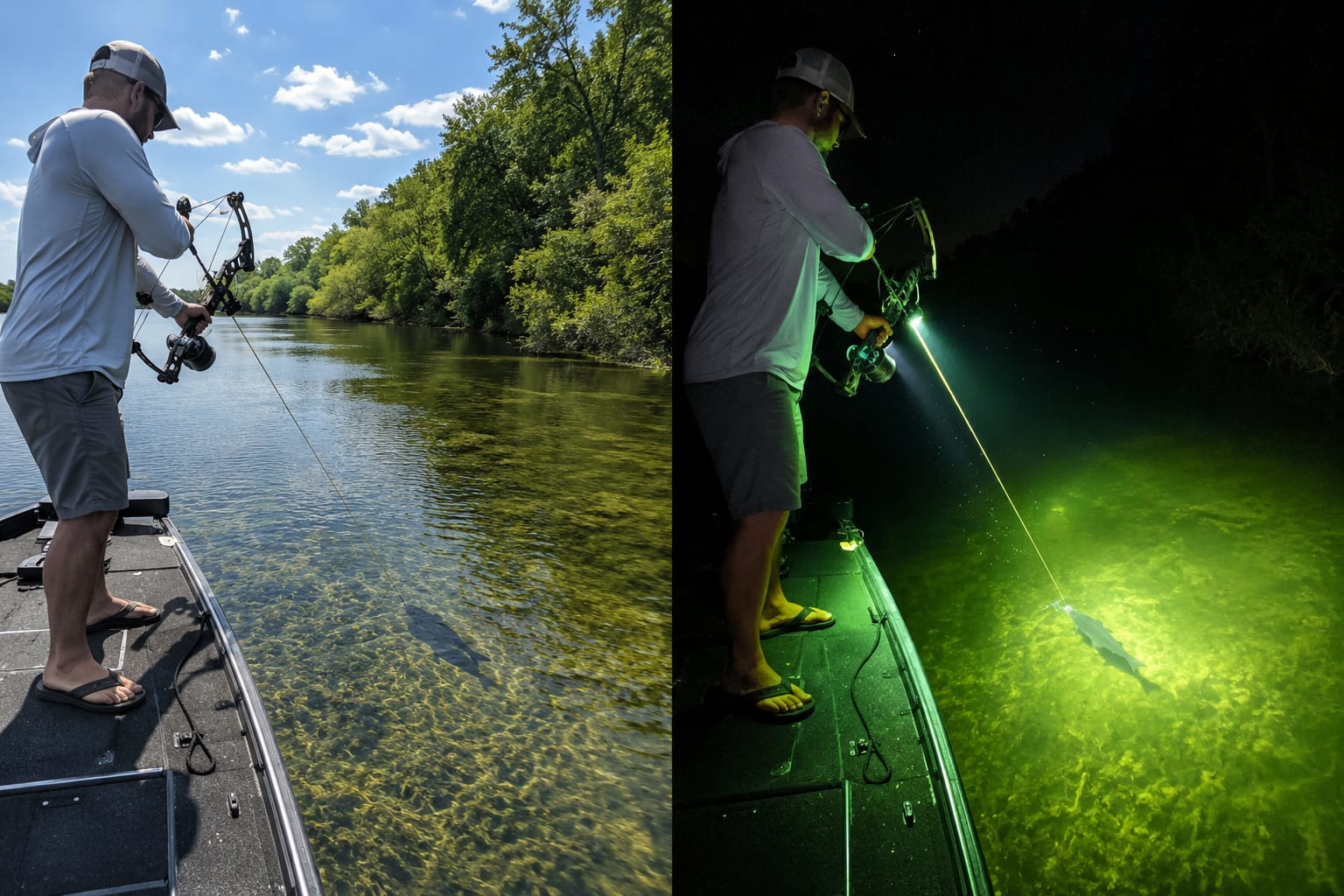
Bowfishing is a method of fishing that uses specialized archery equipment to harvest fish in shallow water, typically targeting invasive or rough fish species that thrive in freshwater environments. Unlike traditional fishing with rod and reel, bowfishers shoot arrows attached to heavy line into the water to strike and retrieve fish.
The process works through direct visual targeting. Bowfishers spot fish swimming in shallow water, aim their bow to compensate for water refraction, and release an arrow connected to a retrieval system. The barbed arrow penetrates the fish, and the angler reels in the line to land the catch.
Key differences from traditional fishing:
Water refraction creates the biggest challenge for newcomers. Light bends as it passes through water, making fish appear 6-12 inches higher than their actual position depending on depth and angle. Bowfishers must aim low to compensate, a skill that develops with practice.
The sport gained popularity as an effective method for controlling invasive fish populations while providing archery enthusiasts with a challenging outdoor activity. Many conservation agencies encourage bowfishing for species like Asian carp that damage native ecosystems.
A complete bowfishing setup for beginners requires five essential components: a bow, a retriever reel, specialized arrows, a fishing license, and polarized sunglasses. These items form the foundation of bowfishing for beginners gear and rules compliance.
Essential bowfishing equipment:
Recommended but optional gear:
The retriever reel distinguishes bowfishing from regular archery. This specialized reel mounts on the bow and holds heavy line that connects to the arrow. When you shoot, the line pays out, and you manually retrieve it to bring in the fish. Bottle-style reels cost less and work well for beginners, while AMS retrieval systems offer faster line recovery.
Barbed arrow points are legal for bowfishing in most states because they prevent fish from sliding off during retrieval. Safety slides on the arrow shaft keep the line from tangling during the shot. Without these components, you’ll lose fish and arrows regularly.
Choose fiberglass arrows over aluminum for durability. Bowfishing arrows hit rocks, boat hulls, and other hard surfaces frequently. Fiberglass flexes and survives impacts that would bend or break aluminum arrows.
Bowfishing bows are built for durability and quick shooting in wet environments, while hunting bows prioritize accuracy and quiet operation for single, precise shots. The main differences involve draw weight requirements, accessories, and construction materials that withstand constant water exposure.
Critical distinctions:
| Feature | Bowfishing Bow | Hunting Bow |
|---|---|---|
| Draw weight | 30-50 lbs (lower for volume shooting) | 50-70+ lbs (higher for penetration) |
| Let-off | 0-40% (allows quick draw cycles) | 65-80% (reduces holding strain) |
| Sights | Often removed or simple pin | Multi-pin or single-pin adjustable |
| Arrow rest | Reinforced or removed | Whisker biscuit or drop-away |
| Finish | Corrosion-resistant coating | Standard finish |
| Accessories | Reel mount, no stabilizer | Stabilizer, quiver, silencers |
Bowfishing bows typically feature lower draw weights because shooters take dozens or hundreds of shots per outing. A 40-pound bow provides sufficient power to penetrate fish at close range (5-15 feet) without causing excessive fatigue. Hunting bows need higher draw weights to ensure lethal penetration on game animals at longer distances.
The lack of let-off on many bowfishing bows allows faster shooting. Let-off reduces holding weight at full draw, which helps hunters aim steadily at distant targets. Bowfishers shoot instinctively at moving targets in shallow water, making quick draw-and-release cycles more valuable than prolonged aiming.
Corrosion resistance matters significantly. Bowfishing equipment gets soaked with water, mud, and fish slime. Stainless steel components and waterproof finishes prevent rust and degradation. Standard hunting bows use materials that corrode when exposed to constant moisture.
Most bowfishers remove or simplify sights because shooting happens at close range with significant refraction compensation. Instinctive shooting or a single reference point works better than multi-pin sights calibrated for specific distances.
You can convert a hunting bow for bowfishing by adding a retriever reel and using bowfishing arrows, but the setup will experience accelerated wear and may not perform optimally. Hunting bows work as entry-level bowfishing equipment if you accept the trade-offs in durability and functionality.
Conversion requirements:
The primary concern involves moisture damage. Hunting bow strings, cables, and metal components will corrode faster when exposed to water regularly. Expect to replace strings more frequently and watch for rust on cams, axles, and mounting hardware.
Draw weight considerations matter less for conversion. If your hunting bow pulls 50-60 pounds, it will work for bowfishing, though you may tire more quickly during extended sessions. Lower draw weight hunting bows (40-50 pounds) actually perform better for bowfishing volume shooting.
Choose conversion if:
Buy a dedicated bowfishing bow if:
Many archers start by converting their hunting bow, then purchase dedicated bowfishing equipment after confirming they enjoy the sport. This approach minimizes financial risk while providing hands-on experience with bowfishing for beginners gear and rules.
A complete beginner bowfishing setup costs between $150-$400 depending on whether you choose budget-friendly or mid-range components. Entry-level packages provide everything needed to start bowfishing, while individual component purchases allow customization based on specific preferences and fishing conditions.
Budget breakdown by component:
Sample starter setups:
Minimal budget ($150-$200):
Recommended beginner setup ($300-$400):
Ready-to-shoot kits from manufacturers like Cajun Bowfishing and AMS offer the best value for absolute beginners. These packages include matched components that work together reliably, eliminating compatibility concerns. The trade-off involves less customization and typically lower-quality bows compared to buying components separately.
Arrows represent an ongoing cost. Beginners lose arrows to snags, broken line, and missed shots. Budget for replacing 3-6 arrows during your first season as you develop retrieval skills and learn to avoid obstacles.
Night fishing equipment adds significant cost but isn’t necessary for beginners. Start with daytime shore fishing to develop skills before investing in lights, generators, and boat-mounted systems that can cost $200-$500 or more.

Bowfishing requires a valid fishing license in all 50 states, and some states mandate additional bowfishing-specific endorsements or stamps. The licensing requirements fall under fishing regulations rather than hunting rules, even though the activity uses archery equipment.
Licensing requirements by category:
Check your specific state’s fish and wildlife agency website for exact requirements. Regulations change annually, and enforcement officers actively patrol popular bowfishing areas. Fines for fishing without proper licenses range from $100-$500 for first offenses.
Some states require reporting your bowfishing harvest, particularly for species like alligator gar or paddlefish that have conservation concerns. These reporting requirements typically involve online forms or phone calls within 24-48 hours of harvest.
Common licensing mistakes:
Purchase licenses online through your state wildlife agency or at sporting goods retailers. Digital licenses on smartphones satisfy legal requirements in most states, but keep a backup photo or screenshot in case of connectivity issues on the water.
Non-resident licenses cost significantly more than resident licenses, typically 2-5 times the price. If you plan to bowfish in multiple states, budget accordingly or focus on locations within your home state for the first season.
Legal bowfishing targets include invasive species and rough fish that aren’t classified as game fish, with common carp, grass carp, buffalo fish, gar species, and bowfin permitted in most states. Game fish like bass, walleye, trout, and catfish are strictly prohibited for bowfishing across nearly all jurisdictions.
Commonly legal bowfishing species:
Universally protected species (never legal for bowfishing):
State-specific variations create the biggest compliance challenge for bowfishing beginners. Grass carp are legal in some states but protected in others due to stocking programs. Alligator gar require special permits in Texas and Louisiana. Some states allow bowfishing for catfish, while neighboring states prohibit it.
Critical identification skills:
Learn to distinguish carp from buffalo fish and suckers. These species look similar to beginners but have different body shapes and mouth positions. Carp have barbels (whiskers) near their mouths, while buffalo fish have smooth faces. Shooting a protected species, even by accident, results in citations and fines.
Time restrictions apply in some states. Certain waters may prohibit bowfishing during spawning seasons for game fish to avoid accidental harvest. Check local regulations for seasonal closures on specific lakes or rivers.
Asian carp (bighead and silver carp) are highly encouraged targets in many states. These invasive species damage ecosystems and outcompete native fish. Some states offer no bag limits on Asian carp and actively promote their removal through bowfishing.
When in doubt, don’t shoot. If you can’t positively identify a fish as a legal species, let it pass. Take photos of unfamiliar fish and consult with local fish and wildlife officers or experienced bowfishers before targeting them.
The best beginner bowfishing setup combines a 40-pound draw weight recurve or entry-level compound bow, a bottle-style retriever reel, six fiberglass arrows with barbed points, and quality polarized sunglasses. This configuration balances affordability, ease of use, and reliability while you develop fundamental skills.
Recommended beginner configuration:
Recurve bows offer simplicity with fewer moving parts to maintain or break. They’re lighter, easier to maneuver in boats, and cost less than compound bows. The trade-off involves less power and no let-off, meaning you hold the full draw weight while aiming.
Compound bows provide more power with less effort due to let-off, making them better for extended shooting sessions. They’re heavier and more complex but offer advantages when targeting larger fish like big carp or gar in deeper water.
Bottle-style reels work perfectly for beginners despite being the most basic retrieval system. They’re inexpensive ($30-$40), virtually indestructible, and teach proper line management. You’ll appreciate the simplicity when you’re learning to handle line, shoot, and retrieve simultaneously.
Why six arrows:
Beginners lose arrows regularly through broken line, snags on underwater obstacles, and shots that bury arrows in mud. Starting with six arrows means you can continue fishing after losing one or two without ending your trip early. As skills improve, you’ll lose fewer arrows and can reduce your quiver size.
Fiberglass arrows in 32-inch length provide the right balance of durability and weight for most bowfishing situations. Shorter arrows (28-30 inches) work for compound bows with shorter draw lengths, but 32-inch arrows offer more versatility and better line clearance.
Copper or amber polarized lenses cut glare effectively in both bright sun and overcast conditions. These lens colors enhance contrast, making it easier to spot fish against muddy or vegetated bottoms. Green or gray lenses work well in extremely bright conditions but reduce visibility in lower light.
Setup mistakes to avoid:
A draw weight of 30-50 pounds works best for bowfishing, with 40 pounds being the sweet spot for most beginners. This range provides sufficient power to penetrate fish at typical bowfishing distances (5-15 feet) without causing excessive fatigue during high-volume shooting sessions.
Lower draw weights (30-40 pounds) suit beginners, smaller-framed shooters, and situations involving extended shooting sessions with dozens of shots. The reduced physical demand allows you to maintain consistent form and accuracy throughout a full day of fishing.
Higher draw weights (45-50 pounds) benefit shooters targeting larger species like big carp, gar, or buffalo fish in deeper water (3-4 feet). The additional power ensures complete penetration through thick scales and muscle tissue.
Draw weight selection factors:
Bowfishing requires significantly less draw weight than hunting because shots happen at close range. A 40-pound bowfishing bow delivers adequate power at 10 feet, while hunters need 50-70 pounds for ethical kills at 20-40 yards.
Test your draw weight capability by drawing the bow 10 times in succession. If you struggle on the eighth or ninth draw, the weight is too heavy for bowfishing. You should complete 10 draws with consistent form and without excessive strain.
Common draw weight mistakes:
Many experienced bowfishers use 35-40 pound bows regardless of their ability to pull heavier weights. The reduced physical demand allows them to focus on shot placement, fish identification, and line management rather than fighting bow fatigue.
If you’re between two draw weights, choose the lighter option. You can always upgrade to a heavier bow later if you find your arrows lack penetration, but starting too heavy often leads to poor form, reduced accuracy, and shortened fishing trips due to fatigue.
Daytime bowfishing is better for beginners because it allows easier fish identification, simpler equipment requirements, and better visibility for learning proper aiming techniques. Night fishing offers more fish activity and better shooting opportunities but requires additional equipment, safety considerations, and species identification skills that beginners haven’t yet developed.
Daytime bowfishing advantages:
Night bowfishing advantages:
Start with daytime shore fishing for your first 5-10 trips. This approach lets you focus on shooting mechanics, fish identification, and retrieval techniques without the complexity of lights, boats, and nighttime safety concerns. Once you can consistently identify and hit fish during the day, transition to night fishing.
Night fishing requires significant additional equipment. A basic setup includes 12-volt LED lights (minimum 50,000 lumens), a deep-cycle battery, wiring, and mounting hardware. Quality systems cost $200-$500, representing a substantial investment before you know if you’ll enjoy bowfishing long-term.
Safety considerations for night fishing:
Fish behavior differs significantly between day and night. Carp and buffalo fish move into extremely shallow water (6-18 inches) at night to feed, providing easier shots. During the day, these species stay in slightly deeper water (2-4 feet) and spook more easily.
Light color matters for night fishing. Green and white lights penetrate water effectively and attract baitfish, which in turn attract rough fish. Some bowfishers prefer green lights because they create less surface glare, while others use white lights for better fish identification.
Progression path for beginners:
Many successful bowfishers continue fishing primarily during the day despite the advantages of night fishing. Daytime fishing offers a more relaxed pace, better scenery, and eliminates the equipment complexity and safety concerns of night operations.
New bowfishers commonly shoot at protected game fish species, aim directly at fish without compensating for refraction, and use equipment that’s poorly matched to bowfishing conditions. These mistakes lead to legal violations, lost arrows, and frustration that causes many beginners to quit before developing competency.
Critical mistakes and solutions:
1. Poor species identification
Shooting bass, catfish, or other game fish results in expensive citations. Learn to identify carp (barbels, large scales), buffalo fish (smooth face, humped back), and gar (long snout, cylindrical body) before your first trip. When uncertain, don’t shoot.
2. Aiming directly at fish
Water refraction makes fish appear higher than their actual position. Aim 6-12 inches below where the fish appears, with deeper compensation for fish in deeper water or at steeper angles. This is the single most common reason beginners miss shots.
3. Using inadequate arrow weight
Light arrows (under 1,000 grains) bounce off fish or fail to penetrate scales. Use arrows specifically designed for bowfishing with proper weight and barbed points. Hunting arrows don’t work effectively.
4. Shooting at excessive distances
Bowfishing is a close-range activity. Effective range is 5-15 feet for beginners. Shots beyond 20 feet have low success rates due to refraction, arrow drop, and fish movement. Wait for fish to come closer rather than attempting long shots.
5. Poor line management
Tangled line causes missed shots and lost arrows. Keep line organized in the reel, check for tangles before each shot, and practice smooth retrieval techniques. Line management improves significantly after 20-30 shots.
6. Ignoring local regulations
Bowfishing regulations vary by water body, season, and species. Some lakes prohibit bowfishing entirely, while others have specific hours or area restrictions. Check regulations for each location before fishing.
7. Inadequate sun protection
Bowfishing happens in full sun with water reflection intensifying UV exposure. Wear sunscreen, protective clothing, and polarized sunglasses. Sunburn and eye strain end trips prematurely.
8. Shooting in murky water
You can’t hit what you can’t see. Fish in water with less than 12 inches of visibility. Murky conditions lead to frustration and wasted arrows. Find clearer water or wait for better conditions.
9. Not practicing on land first
Shoot practice targets on land to develop muscle memory and consistent form before adding the complexity of water refraction and moving targets. Ten practice shots on land save hours of frustration on the water.
10. Fishing alone as a beginner
Bowfishing with an experienced partner accelerates learning dramatically. They’ll help with species identification, shot placement, and equipment troubleshooting. Join local bowfishing groups or hire a guide for your first few trips.
Equipment-specific mistakes:
Track your mistakes during early trips. Note what went wrong with each missed shot or lost arrow. Patterns emerge quickly, allowing you to focus practice on specific weaknesses rather than general shooting volume.
Bowfishing is harder than regular fishing for beginners because it requires archery accuracy, species identification skills, and compensation for water refraction, while traditional fishing relies primarily on bait presentation and patience. However, bowfishing provides immediate feedback on technique and eliminates the waiting time associated with rod-and-reel fishing.
Skill comparison:
| Aspect | Bowfishing | Traditional Fishing |
|---|---|---|
| Learning curve | Steeper initial curve | Gradual progression |
| Physical demand | Moderate to high | Low to moderate |
| Success feedback | Immediate (hit or miss) | Delayed (bites may not hook) |
| Species knowledge | Critical for legal compliance | Helpful but less critical |
| Equipment complexity | Moderate | Low to high (varies by method) |
| Weather dependence | High (needs visibility) | Moderate |
The physical demands of bowfishing exceed traditional fishing. You’re constantly moving, drawing a bow repeatedly, and retrieving fish by hand. A typical bowfishing session involves 30-100 shots compared to casting and waiting in traditional fishing.
Mental demands differ significantly. Bowfishing requires constant visual scanning, quick target identification, rapid shooting decisions, and precise aim compensation. Traditional fishing involves reading water, selecting appropriate bait or lures, and detecting subtle bites.
Bowfishing is easier than traditional fishing for:
Traditional fishing is easier than bowfishing for:
Success rates favor bowfishing once you develop basic competency. A skilled bowfisher might shoot 20-50 fish in a good session, while traditional anglers might catch 5-15 fish in the same timeframe. However, reaching that competency level requires more initial practice and skill development.
The learning curve for bowfishing is front-loaded. Your first five trips will be challenging with low success rates. Trips 6-15 show rapid improvement as refraction compensation becomes intuitive. After 20 trips, most bowfishers achieve consistent success.
Traditional fishing has a gentler learning curve with earlier success. Beginners can catch fish on their first trip using simple techniques, but mastering advanced methods takes years of experience.
Legal bowfishing locations include public lakes, rivers, and reservoirs where fishing is permitted, provided the specific water body doesn’t have bowfishing restrictions. Check with your state fish and wildlife agency for a list of approved bowfishing waters, as some locations prohibit the practice to protect game fish populations or for safety reasons.
Finding legal bowfishing locations:
Location types ranked by beginner accessibility:
Waters commonly restricted or prohibited:
Call or visit your state fish and wildlife office to get specific location recommendations. Officers can identify productive public waters near you and explain any special restrictions. This conversation also demonstrates your commitment to legal compliance, which officers appreciate.
Local bowfishing groups on social media provide valuable location information. Join state or regional bowfishing forums and ask for beginner-friendly spots. Experienced bowfishers often share general locations (though they may keep their best spots secret).
Location scouting tips:
Respect private property boundaries. Many prime bowfishing locations border private land. Trespassing damages the sport’s reputation and can result in criminal charges. When in doubt, assume property is private and seek permission.
Some states offer interactive maps showing public water access points and fishing regulations by water body. These tools help identify legal bowfishing locations and understand specific rules for each area.
Shore fishing is better for first-time bowfishers because it provides stable shooting platforms, eliminates boat operation complexity, and allows focus on fundamental shooting and fish identification skills. Boat fishing offers access to more fish and better shooting angles but adds equipment costs, safety considerations, and the challenge of shooting from an unstable platform.
Shore fishing advantages:
Boat fishing advantages:
Start with shore fishing for your first 3-5 trips. Find public lakes or slow rivers with accessible shorelines and shallow water. Wade into position wearing water shoes or wading boots to get closer to fish and improve shooting angles.
Effective shore fishing locations:
Wading extends your effective range significantly. Standing on shore limits you to fish within 10-15 feet of the bank. Wading 20-30 feet out puts you in position to shoot fish that would otherwise be out of range.
Transition to boat fishing when:
Boat selection matters for bowfishing. Flat-bottom jon boats (14-16 feet) work best for beginners. They’re stable, affordable, and easy to maneuver in shallow water. Avoid V-hull boats that rock excessively when you move or draw your bow.
Boat fishing safety requirements:
Kayaks and canoes work for solo bowfishing but require excellent balance and boat control. They’re unstable when drawing a bow and difficult to maneuver while managing line and fish. Consider these options only after mastering shore fishing and gaining experience in stable boats.
Boat positioning is critical for success. Position the boat so the sun is behind you, illuminating fish and reducing glare. Keep the boat 15-25 feet from target areas, allowing comfortable shooting distance without spooking fish.
Many successful bowfishers continue using shore fishing techniques even after gaining boat experience. Shore fishing during spawning seasons when rough fish move into extremely shallow water can be more productive than boat fishing in deeper areas.
Can you eat fish you catch while bowfishing?
Yes, most fish caught while bowfishing are edible, though carp and buffalo fish require proper preparation to remove mud veins and strong flavors. Gar, when cleaned properly, produces firm white meat similar to lobster. Many bowfishers harvest fish for consumption, pet food, or fertilizer rather than wasting the resource.
Do I need special insurance for bowfishing?
Standard fishing licenses cover liability for bowfishing in most states, but check with your homeowner’s or renter’s insurance about coverage for archery-related activities. Boat insurance should specifically include bowfishing if you fish from a boat, as some policies exclude archery activities.
How long does it take to get good at bowfishing?
Most beginners achieve consistent success after 15-20 hours of practice spread across 8-12 trips. The first 5 trips focus on learning refraction compensation and species identification, while trips 6-12 develop accuracy and retrieval efficiency. Archery experience accelerates the learning curve significantly.
Can kids participate in bowfishing?
Children can bowfish if they have the strength to draw an appropriate bow (typically 20-30 pounds) and can follow safety rules consistently. Most states allow children under 16 to fish without a license. Supervision is essential, and youth-specific bows make the activity more accessible for younger participants.
What’s the best time of day for bowfishing?
Early morning (dawn to 10 AM) and late afternoon (4 PM to dusk) provide the best daytime bowfishing, when fish are most active and sun angles reduce glare. Night fishing from 9 PM to 2 AM is most productive when using lights, as rough fish feed aggressively in shallow water during darkness.
How do you remove a bowfishing arrow from a fish?
Grasp the fish firmly, push the arrow completely through if the barb has penetrated, then cut or unscrew the point to remove the arrow. Never pull a barbed arrow backward through a fish, as this damages the arrow and makes removal difficult. Pliers help with stubborn points.
Is bowfishing legal in all states?
Bowfishing is legal in all 50 states, but specific regulations vary significantly regarding legal species, locations, seasons, and equipment. Some states restrict bowfishing to certain waters or prohibit it entirely in designated areas. Always check current state regulations before fishing.
What happens if you accidentally shoot a game fish?
Accidentally shooting a protected game fish requires immediate reporting to fish and wildlife authorities in most states. Honest mistakes typically result in warnings for first-time offenders, but repeated violations or attempts to conceal illegal harvest result in substantial fines and potential license suspension.
Can you bowfish in saltwater?
Saltwater bowfishing is legal in coastal states, targeting species like stingray, sheepshead, and mullet depending on local regulations. Saltwater bowfishing requires corrosion-resistant equipment and a saltwater fishing license. The sport is growing in popularity in Gulf Coast and Atlantic states.
How far can you shoot a bowfishing arrow?
Effective bowfishing range is 5-15 feet for beginners and 5-20 feet for experienced shooters. Arrows lose velocity quickly in water, and refraction compensation becomes increasingly difficult beyond 15 feet. Most successful shots happen within 10 feet of the shooter.
Do bowfishing arrows float?
Standard bowfishing arrows sink because they’re made from fiberglass or carbon and include heavy barbed points. Some manufacturers offer floating arrows with foam inserts, but most bowfishers prefer sinking arrows because they’re more durable and penetrate better. The attached line prevents arrow loss.
What’s the biggest fish ever taken by bowfishing?
Alligator gar over 200 pounds have been taken by bowfishing, along with large buffalo fish exceeding 80 pounds and grass carp over 60 pounds. Record-class fish require heavy equipment, strong line, and considerable skill to land successfully. Most bowfishing targets weigh 5-25 pounds.
Bowfishing for beginners combines archery skills with fishing regulations to create an accessible and exciting outdoor sport. Success requires understanding the essential gear, including a 30-50 pound bow, retriever reel system, barbed arrows, and polarized sunglasses, along with strict compliance with state fishing licenses and species regulations that protect game fish while targeting invasive and rough fish species.
Start your bowfishing journey with daytime shore fishing using a basic setup in the $150-$300 range. Focus on mastering species identification, refraction compensation, and shooting fundamentals before investing in boats, lights, and advanced equipment. The learning curve is steep initially, but most beginners achieve consistent success after 8-12 trips and 15-20 hours of practice.
Take these action steps to begin bowfishing:
The sport rewards patience during the learning phase and offers unlimited opportunities for skill development. Whether you pursue bowfishing as occasional recreation or develop it into a serious passion, the combination of archery challenge and fishing excitement provides a unique outdoor experience that grows more rewarding with each trip.


