
Newsletter Subscribe
Enter your email address below and subscribe to our newsletter
All voices matter
All voices matter

 ByTravis
Cheap compound bows under are a solid choice for beginners, casual shooters, and youth archers, though they come with trade-offs in build quality and adjustability.
Affiliate Disclaimer: We are a participant in the Amazon Services LLC Associates Program, an affiliate advertising program designed to provide a means for sites to earn advertising fees by advertising and linking to Amazon.com. As an Amazon Associate I earn from qualifying purchases. We also participate in other affiliate programs.
Quick Answer: Cheap compound bows (typically under $300) are absolutely worth it for beginners, casual target shooters, and youth archers who want to learn proper form without a major financial commitment. They can deliver acceptable accuracy at shorter ranges and handle light hunting duties, but expect compromises in build quality, adjustability, and longevity compared to mid-range or premium models. For serious competitive shooting or frequent hunting, investing $400-$800 will provide better long-term value.

The price difference between budget and premium compound bows comes down to materials, manufacturing precision, and adjustability features. Cheap bows use cast aluminum risers, basic cam systems, and generic strings, while expensive models feature machined or forged risers, precision-engineered cam systems with micro-tuning options, and custom strings made from premium materials.
Material and construction differences:
Adjustability and fit options:
Expensive bows offer draw length adjustments from 24-31 inches without needing a bow press, while cheap bows may require module changes or offer no adjustment at all. Draw weight adjustability on budget models typically spans 10-15 pounds; premium bows often adjust across 20-30 pound ranges. This matters because proper fit directly affects accuracy and shooting comfort.
Common mistake: Assuming all the extra cost goes into performance. Much of the premium pricing covers brand reputation, pro-staff endorsements, and cosmetic features that don’t improve accuracy for recreational shooters.

Plan to spend $250-400 on your first compound bow if you’re serious about the sport, or $150-250 if you’re testing the waters. This range gets you a bow from an established manufacturer with a warranty, basic adjustability, and components that will last through your learning phase.
Budget breakdown by shooter type:
What your money buys at each price point:
At $150-200, expect a basic ready-to-shoot package with low-quality sight, rest, and stabilizer that you’ll want to replace within 6 months. At $250-350, you get better core bow components but still budget accessories. At $400-500, you’re entering the mid-range category with significantly better build quality and often better included accessories.
Choose the lower end if: You’re under 16 and still growing, you plan to shoot less than once monthly, or you’re genuinely unsure if archery will stick as a hobby. Choose the higher end if you have previous archery experience, you’re full-grown and want a bow that fits long-term, or you plan to hunt within your first year.
Budget compound bows don’t typically break catastrophically, but they do wear out faster and develop problems sooner than quality bows. With proper maintenance and reasonable use, a $200-300 bow should last 2-4 years before requiring significant repairs or replacement, compared to 5-10+ years for a well-made mid-range bow.
Realistic durability expectations:
Most cheap bows will handle 3,000-5,000 shots before showing serious wear, while quality bows routinely exceed 10,000-15,000 shots. The difference isn’t in sudden failure but in gradual degradation of performance. Strings stretch faster, cam bearings develop play, limb pockets loosen, and accuracy suffers.
Factors that accelerate wear on budget bows:
Common failure modes: The string serving separates at the nocking point after 800-1,200 shots, cam bearings develop noise and wobble after 1-2 seasons, limb pocket bolts loosen requiring frequent tightening, and cable slides wear through faster than on premium bows.
Edge case: Some budget bows from reputable manufacturers (Bear, Diamond, PSE entry models) use trickle-down technology from their premium lines and can outlast their price point suggests, especially with light use.
For a new archer shooting at 20 yards, there’s virtually no accuracy difference between a $200 bow and an $800 bow because shooter error vastly exceeds equipment limitations. An experienced archer shooting at 40+ yards will see the expensive bow group 2-3 inches tighter due to better cam timing, stiffer risers, and more consistent energy transfer.
Real-world accuracy comparison:
At 20 yards, both budget and premium bows in the hands of a practiced shooter should group within 3-4 inches. At 40 yards, a quality bow might group 4-6 inches while a budget bow spreads to 6-9 inches. At 60 yards, the gap widens significantly, with premium bows grouping 6-10 inches and budget bows spreading 12-18 inches or more.
What creates the accuracy gap:
The honest truth: If you’re shooting groups larger than 6 inches at 20 yards, the bow isn’t your limiting factor, your form, release, and practice routine are. Upgrading equipment won’t fix fundamental technique issues.
Decision rule: If you can’t consistently hit a paper plate at 30 yards, don’t blame the budget bow. If you’re regularly shooting tight groups at 40+ yards and want to compete or hunt at longer ranges, then equipment upgrades start to matter.
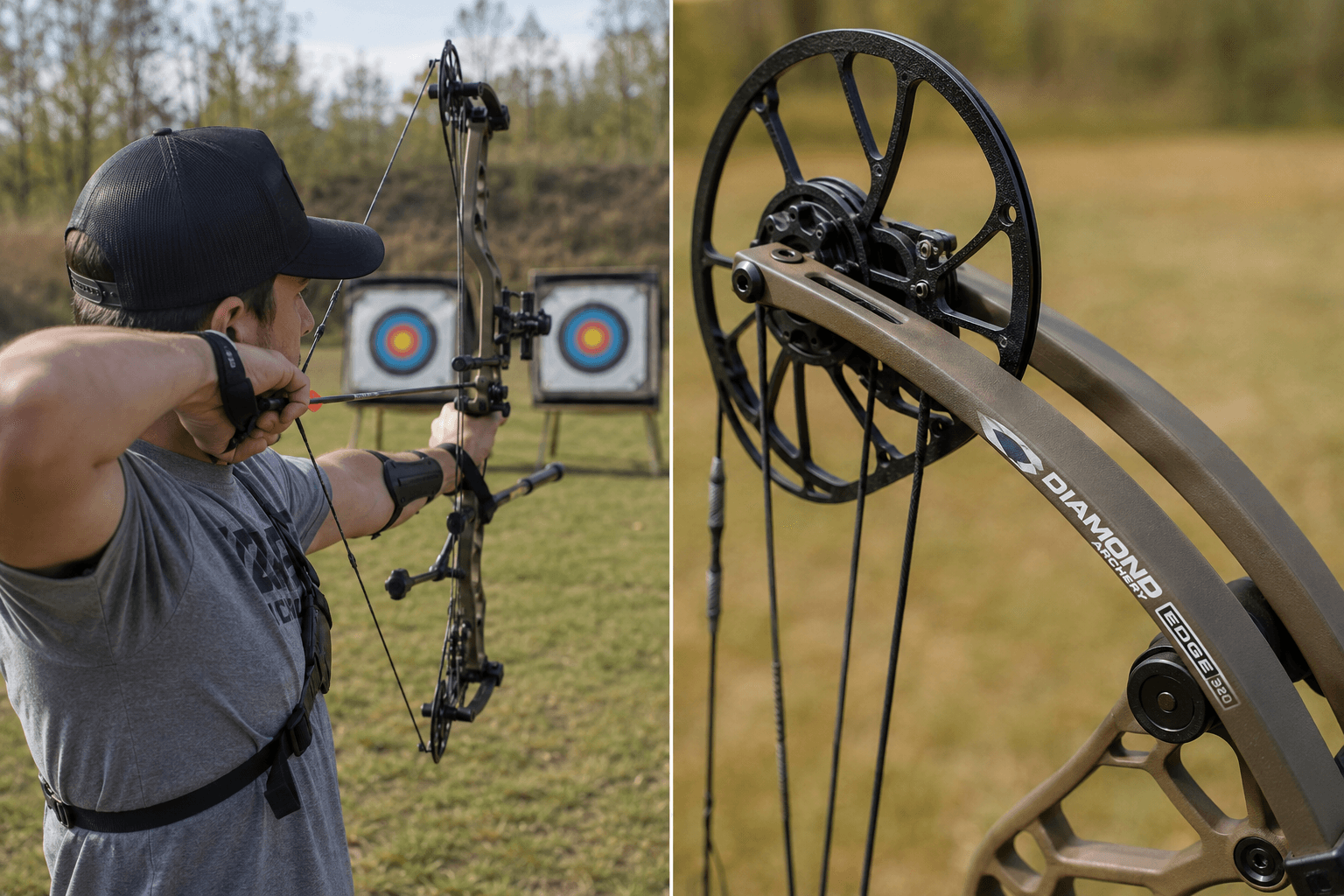
The best budget compound bows in 2026 come from established manufacturers offering entry-level models with proven designs. Look for the Bear Cruzer G2 ($299), Diamond Infinite Edge Pro ($279), PSE Stinger Max ($249), and SAS Rage ($189) as reliable options that balance cost with performance.
Top picks by use case:
For maximum adjustability (growing youth or unsure adults):
For best value hunting bow:
For absolute lowest cost:
For best included accessories:
What to verify before buying:
Check that the draw length range includes your measurement (have a pro shop measure you first). Confirm the bow comes with a manufacturer warranty of at least one year. Read recent reviews to ensure quality control hasn’t declined. Verify that replacement parts and strings are readily available.
Avoid these red flags: No-name brands sold only on Amazon with generic names, bows without any warranty information, packages that seem too good to be true (full setup under $150 usually means everything is junk), and bows with no adjustability if you’re still growing or new to archery.
Yes, you can successfully hunt deer, turkey, and similar game with a cheap compound bow if it meets your state’s minimum draw weight requirements (typically 40 pounds) and you practice enough to shoot accurately within 30 yards. The animal doesn’t know if your bow cost $200 or $2,000, shot placement and arrow setup matter far more than bow price.
Legal and ethical considerations:
Most states require 40-45 pounds minimum draw weight for deer hunting. Budget bows easily meet this requirement. The ethical consideration is accuracy, you must be able to consistently hit a 6-inch circle at your maximum intended shooting distance. If you can’t do that reliably, the bow price is irrelevant; you’re not ready to hunt.
Effective hunting range with budget bows:
Limit shots to 30 yards or less with a cheap compound bow. At this range, arrow speed and kinetic energy are sufficient for clean kills on deer-sized game, and accuracy limitations of budget equipment are minimized. Experienced archers might stretch to 35-40 yards, but beginners should stay under 25 yards regardless of equipment.
Setup requirements for hunting:
You’ll need to upgrade the arrow rest to something more reliable than the basic whisker biscuit included in most packages (budget $30-50). Install a quality sight with fiber optics for low-light conditions ($40-60). Use proper hunting arrows with appropriate broadheads, don’t cheap out here, as arrow quality affects penetration more than bow cost. Add a stabilizer to reduce noise and vibration ($25-40).
Common mistake: Assuming you need an expensive bow to hunt ethically. Shot placement beats equipment every time. A $200 bow with a practiced archer behind it is far more effective than a $1,500 bow in the hands of someone who shoots twice a year.
Cheap compound bows commonly develop string serving separation, noisy cam bearings, loose limb pocket hardware, and cable slide wear within the first 1-2 years of regular use. These issues are annoying and require maintenance but rarely make the bow unusable if addressed promptly.
Most frequent issues ranked by occurrence:
Prevention and fixes:
Wax your string every 2-3 weeks of regular shooting to extend serving life. Check and tighten all bolts monthly, especially limb pocket bolts. Replace cable slides with upgraded versions ($10-15) at first sign of wear. Learn to tie in a new nocking point or have a shop do it ($10-15). Budget $50-100 annually for maintenance on a cheap bow versus $20-40 for a quality bow.
When to repair vs. replace:
Repair if the issue is strings, serving, or minor hardware (total cost under $75). Replace if limbs crack, cams break, or the riser develops cracks (repair costs approach or exceed bow value). Most budget bows aren’t worth more than $100-150 in repairs over their lifetime.
Cheap compound bows are excellent for beginners because they minimize financial risk while you learn proper form, discover your preferences, and determine your commitment level to archery. Starting with a $250-350 bow makes more sense than a $800 bow you might not use after six months.
Why budget bows suit beginners:
New archers don’t yet have the consistency to benefit from premium equipment. Your groups at 20 yards will be limited by form, release technique, and muscle memory, not by whether your riser is cast or machined. Budget bows let you make mistakes, experiment with different shooting styles, and learn maintenance without worrying about damaging expensive equipment.
The learning curve reality:
Most beginners take 3-6 months to develop consistent anchor points, release technique, and aiming habits. During this period, you’re building muscle memory and strength. A budget bow provides everything you need for this learning phase. After 6-12 months of regular practice, you’ll have much better understanding of what features matter to you and whether you want to upgrade.
Adjustability matters more than price:
Choose a budget bow with good adjustability over a slightly cheaper bow with none. Being able to change draw length and weight as your form improves is worth an extra $50-75. Many beginners start at lower draw weights (45-50 lbs) and work up to hunting weights (60-70 lbs) over several months.
When beginners should skip budget bows:
If you have significant previous archery experience (recurve, traditional, or compound years ago), you might outgrow a budget bow quickly, consider starting at the $400-600 mid-range level. If you’re certain you’ll hunt within 6 months and plan to practice 2-3 times weekly, the mid-range investment makes sense from day one.
Upgrade from a cheap compound bow when you’re shooting 2-3 times per week consistently, you’ve outgrown the adjustability range, you’re experiencing accuracy limitations at 40+ yards, or you’re ready to compete beyond local club level. For most archers, this happens 12-24 months after starting the sport.
Clear upgrade signals:
Don’t upgrade yet if:
Your groups are still inconsistent at 20 yards (work on form first). You shoot less than twice monthly (equipment isn’t your limiting factor). Your current bow still functions properly and meets your needs. You’re still growing or changing physically. You haven’t identified specific features you need that your current bow lacks.
Smart upgrade strategy:
When you do upgrade, move to the $500-800 mid-range category rather than jumping to $1,200+ flagship models. This range offers 85-90% of the performance of top-end bows at 40-50% of the cost. Keep your budget bow as a backup, for loaning to friends, or for practice in bad weather when you don’t want to risk your good bow.
Timeline for typical archers:
Casual target shooters (once weekly): 2-3 years before upgrading makes sense. Serious recreational archers (2-3 times weekly): 12-18 months. Hunters who practice regularly: 12-24 months. Competitive archers: 6-12 months or start mid-range from the beginning.
Cheap compound bows lose 60-70% of their value immediately and have minimal resale market because buyers can often find new budget bows on sale for similar prices. A $250 budget bow might sell used for $75-100 after one year, while a $700 mid-range bow might fetch $350-450 in the same timeframe.
Resale value by price category:
Why budget bows depreciate so heavily:
The used market competes directly with frequent sales and closeouts on new budget models. Buyers shopping at the budget level are price-sensitive and often prefer new with warranty over used without. Budget bows show wear more obviously than quality bows. The pool of buyers for used budget equipment is smaller because serious archers skip this category entirely.
Maximizing resale value:
Keep all original packaging, accessories, and documentation. Maintain the bow properly with regular waxing and tuning. Sell locally through archery clubs or pro shops rather than online where shipping costs eat into value. Time your sale for late winter/early spring when new archers are starting and hunters are preparing for season.
Better financial strategy:
Don’t buy a budget bow expecting to recoup much money. Instead, view it as a learning expense similar to lessons or range fees. If resale value matters to you, buy a quality used mid-range bow for $300-400 instead of a new budget bow, you’ll lose less money when you eventually sell.
String serving, cam bearings, and cable slides fail first on budget compound bows, typically within the first 12-18 months of regular use. These are wear items on any bow but degrade 2-3 times faster on cheap models due to lower-quality materials and looser manufacturing tolerances.
Failure timeline for common components:
String and cables (12-18 months with regular use):
The serving at the nocking point separates first, followed by general string stretch and wear. Budget strings use lower-grade materials that fray faster. Replacement cost: $60-100 for custom strings or $30-50 for generic replacements.
Cam bearings/bushings (12-24 months):
Cheap bearings or simple bushings develop play and noise. You’ll hear squeaking or grinding during the draw cycle. This affects cam timing and arrow speed consistency. Replacement cost: $40-80 for parts and press time at a shop.
Cable slide (6-12 months):
Plastic slides wear grooves or crack from friction. You’ll see visible wear tracks or the slide may break entirely. Replacement cost: $10-20 for the part, easy DIY fix.
Limb pocket hardware (ongoing):
Bolts loosen regularly, requiring monthly checks. Not really a failure but constant maintenance. If ignored, can lead to limb alignment issues. Prevention cost: free, just check and tighten.
Arrow rest (6-12 months):
Basic rests included in packages wear quickly or break. Whisker biscuits flatten, drop-away mechanisms fail. Replacement cost: $30-80 depending on upgrade choice.
Parts worth upgrading proactively:
Replace the cable slide immediately with a roller slide ($25-40) to prevent cable wear. Upgrade the arrow rest within the first few months to something more reliable ($40-70). Budget for string replacement at 12 months rather than waiting for failure. These upgrades extend the useful life of a budget bow significantly.
Expensive compound bows are not worth it for casual shooters who practice monthly or less and shoot primarily at 20-30 yards for recreation. A $300-500 bow will deliver identical enjoyment and accuracy for this use case, and the extra $500-1,000 spent on a premium bow won’t improve your experience or results.
When premium bows make sense:
You shoot 2-3 times weekly year-round. You compete in leagues or tournaments regularly. You hunt frequently and take shots beyond 35 yards. You have the skill level to actually benefit from tighter tolerances and better components. You simply enjoy having premium equipment and the cost doesn’t strain your budget.
When premium bows are overkill:
You shoot once or twice monthly. Your effective range is under 30 yards. You’re still developing consistent form and technique. You participate in archery purely for relaxation and fun. You have other hobbies competing for your equipment budget.
The diminishing returns curve:
Going from a $200 bow to a $400 bow provides noticeable improvements in adjustability, build quality, and longevity. Going from $400 to $800 provides moderate improvements in refinement, weight, and consistency. Going from $800 to $1,500 provides minimal improvements that only advanced shooters will notice or benefit from.
Better uses for the money:
If you’re a casual shooter considering a $1,200 bow, you’d get more benefit from a $500 bow plus $700 spent on quality arrows, professional coaching, range membership, or a 3D target for home practice. Equipment quality matters far less than practice quantity and quality instruction for recreational archers.
Honest assessment: Premium bows are beautifully engineered and a joy to shoot, but they’re luxury items for casual archers. If you want one and can afford it, buy it for the enjoyment factor, just don’t expect it to transform your shooting.
The biggest mistake when buying a cheap compound bow is prioritizing price over proper fit, leading to a bow with the wrong draw length that forces bad form and limits progress. Always get professionally measured for draw length before buying, even if it means spending an extra $50-75 for a bow that fits correctly.
Critical mistakes that undermine your success:
Buying without trying:
Never buy a compound bow without drawing it first, even if it means driving to a shop instead of ordering online. Draw length and draw cycle feel vary significantly between models. What works for someone else might feel terrible for you.
Ignoring draw length:
A bow that’s too long or too short forces you into poor anchor points and inconsistent form. This is the single most important specification to get right. If you’re between sizes, go shorter rather than longer.
Choosing maximum draw weight:
New archers often buy bows at the top of their strength range (if you can barely draw 60 lbs, you buy a 60 lb bow). This leads to target panic, poor form, and injury. Choose a draw weight you can comfortably draw and hold for 10 seconds, 20 times in a row.
Skipping the warranty:
Budget bows have higher failure rates. Buying from unknown sellers or brands without warranty support means you’re stuck with repair costs that can exceed the bow’s value. Stick with established manufacturers offering at least a one-year warranty.
Buying packages with terrible accessories:
Some budget packages include sights, rests, and stabilizers that are essentially unusable. You’re better off buying the bare bow and adding quality accessories gradually than getting a “complete” package with junk components you’ll immediately replace.
Not budgeting for arrows:
A $250 bow needs $75-150 in proper arrows to shoot well. Cheap arrows fly inconsistently and break easily. Budget for at least 6-12 quality arrows matched to your bow’s specifications.
Falling for gimmicks:
Ignore marketing claims about “laser accuracy” or “professional grade” on budget bows. Focus on specifications: adjustability ranges, draw weight, axle-to-axle length, and brace height. These numbers matter; marketing fluff doesn’t.
Smart buying approach: Get measured at a pro shop, try several bows in your price range, buy from an established manufacturer with warranty support, budget for quality arrows and basic accessories, and plan to upgrade components gradually rather than buying a loaded package with poor-quality extras.
How long do cheap compound bows last?
Cheap compound bows typically last 2-4 years with regular use (2-3 times monthly) before requiring significant repairs or replacement. With light use (monthly or less), they can last 5-7 years. The bow won’t suddenly break but will develop issues like string wear, bearing noise, and loosening hardware that accumulate over time.
Can you hunt elk with a budget compound bow?
Yes, you can hunt elk with a budget compound bow if it meets the minimum draw weight requirements (typically 50 pounds) and you can shoot accurately at 30 yards or less. The bow’s price doesn’t affect arrow penetration, proper arrow setup, shot placement, and staying within your effective range matter far more than equipment cost.
What draw weight should a beginner start with?
Beginners should start with 40-50 pounds for adults and 20-30 pounds for youth. Choose a weight you can comfortably draw and hold for 10 seconds without shaking. You can always increase weight as you build strength and form, but starting too heavy leads to bad habits and potential injury.
Are Amazon compound bows any good?
Some compound bows sold on Amazon from established brands (Bear, PSE, Diamond) are legitimate budget options. However, avoid no-name brands with generic names and no warranty support. Stick with recognized manufacturers even when buying through Amazon, and verify the seller is authorized to ensure warranty coverage.
How often should you replace bow strings?
Replace bow strings on budget bows every 12-18 months with regular use, or sooner if you see fraying, serving separation, or excessive stretch. Quality bows can go 2-3 years between string changes. Waxing strings every 2-3 weeks extends their life significantly.
What’s the difference between 60 and 70 pound draw weight?
A 70-pound bow shoots arrows about 10-15 fps faster than a 60-pound bow, providing slightly flatter trajectory and more kinetic energy. For hunting deer-sized game within 40 yards, 60 pounds is completely adequate. Choose 70 pounds only if you can draw it comfortably and hold it without strain.
Do you need a bow press for maintenance?
You don’t need a bow press for routine maintenance like waxing strings, checking bolts, or replacing arrow rests. You do need a press (or a shop visit) for changing strings, adjusting cam timing, or replacing cables. Most archers use a pro shop for press-required work rather than buying a press.
Can you learn archery without lessons?
You can learn basic archery through videos and practice, but professional lessons accelerate progress significantly and prevent bad habits that are hard to break later. Even 2-3 lessons with a certified instructor will improve your form more than months of self-teaching.
What’s a good grouping size for a beginner?
A good grouping for a beginner at 20 yards is 6-8 inches after 2-3 months of practice. After 6 months, aim for 4-6 inches. After a year, 3-4 inches is achievable. If your groups are larger than this, focus on form and practice rather than blaming equipment.
Should you buy a used compound bow?
Buying a used mid-range bow ($300-400) often provides better value than a new budget bow at the same price. Check for cracks in limbs and riser, excessive cam wear, and string condition. Buy from local archery clubs or shops where you can inspect and draw the bow before purchasing.
How much does it cost to set up a compound bow?
Setting up a compound bow costs $50-100 at a pro shop, including installing accessories, paper tuning, and sight adjustment. Some shops include basic setup free with bow purchase. DIY setup is possible but requires knowledge and tools most beginners don’t have.
What accessories do you actually need?
Essential accessories include a release aid ($20-60), arrows ($75-150 for 6-12), arrow rest ($30-80), sight ($40-100), and wrist sling ($5-10). Optional but helpful: stabilizer ($25-60), bow case ($40-80), and target ($50-150). Budget $200-400 for necessary accessories beyond the bow itself.
Cheap compound bows are absolutely worth it for the right shooter in the right situation. If you’re new to archery, shooting casually, or working with a limited budget, a well-chosen bow in the $250-350 range will serve you well for 2-4 years while you develop skills and determine your commitment to the sport. The key is managing expectations, budget bows require more maintenance, have shorter lifespans, and offer less adjustability than mid-range or premium models, but they can still shoot accurately and handle hunting duties within reasonable ranges.
The decision comes down to honest self-assessment. If you’ll shoot 2-3 times weekly, plan to compete, or know you’ll stick with archery long-term, skip the budget category and invest $500-800 in a mid-range bow from the start. If you’re testing the waters, shooting monthly for fun, or buying for a growing youth archer, a budget bow makes perfect financial sense.
Your next steps:
Remember that shot placement beats equipment quality every time. A $250 bow in practiced hands will outperform a $1,500 bow shot twice a year. Start where your budget and commitment level intersect, practice consistently, and upgrade when your skills and dedication justify the investment.


