
Newsletter Subscribe
Enter your email address below and subscribe to our newsletter
All voices matter
All voices matter

 ByTravis
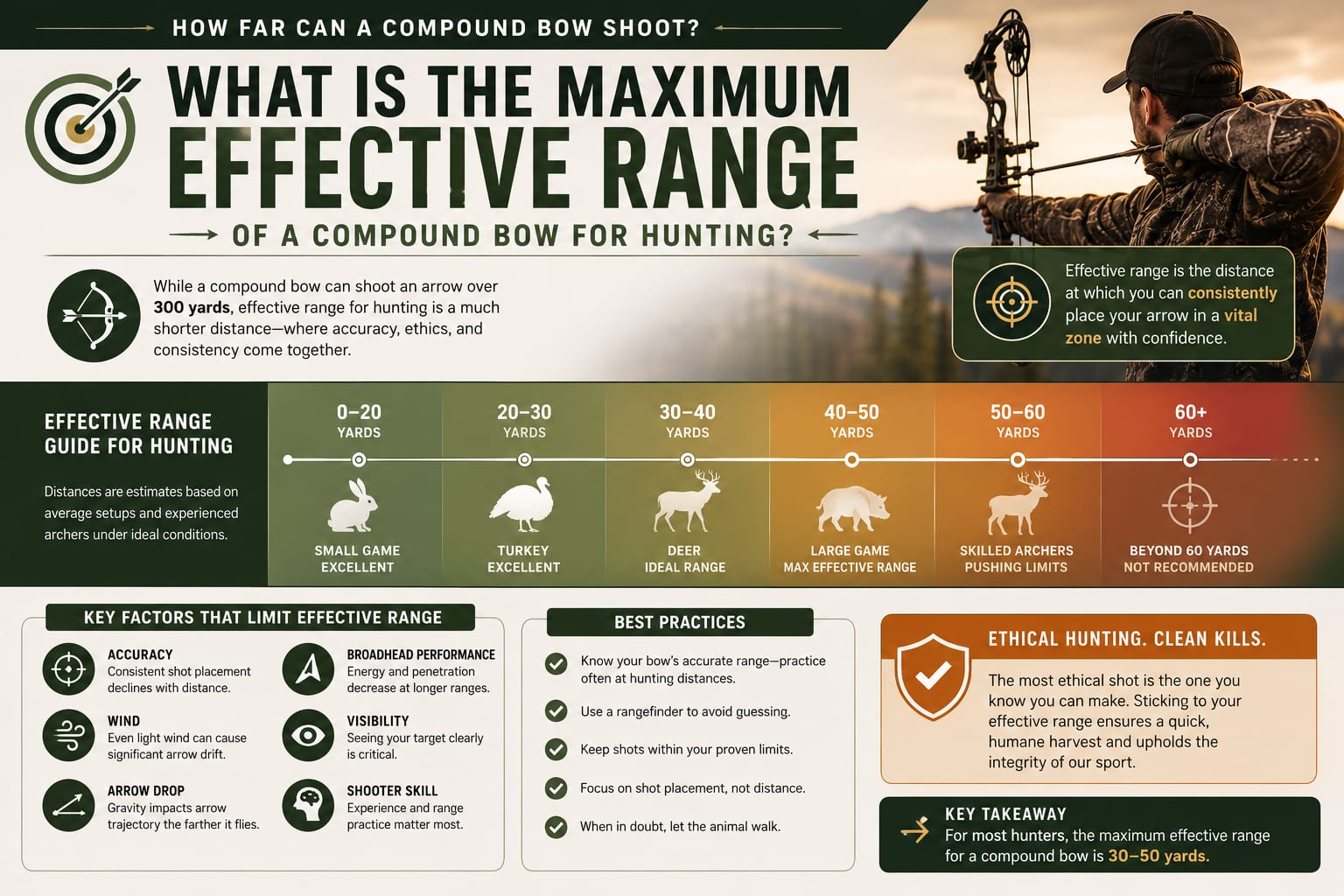
A compound bow can send an arrow over 300 yards, but the effective range for accurate shooting is far shorter - typically 30-60 yards for hunting and up to 100 yards for skilled target archers.
Affiliate Disclaimer: We are a participant in the Amazon Services LLC Associates Program, an affiliate advertising program designed to provide a means for sites to earn advertising fees by advertising and linking to Amazon.com. As an Amazon Associate I earn from qualifying purchases. We also participate in other affiliate programs.

A compound bow can shoot an arrow over 300 yards under ideal conditions, but the effective range for accurate shooting is much shorter, typically 30 to 60 yards for hunting and up to 100 yards for experienced target archers. The maximum distance an arrow travels and the range at which you can consistently hit your target are two very different measurements, and understanding this distinction is essential for both safety and success.
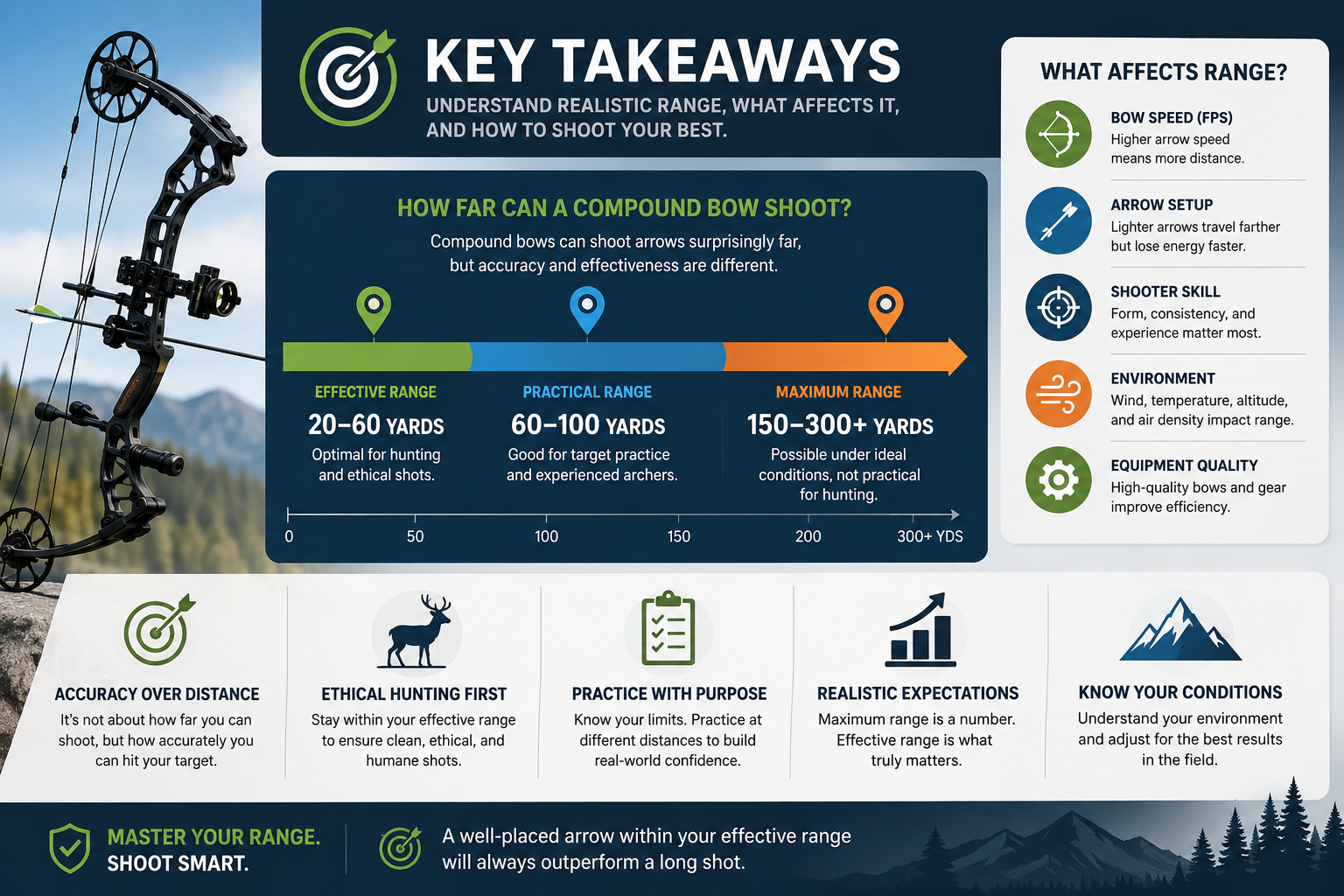
The maximum effective range for hunting with a compound bow is 30 to 60 yards for most archers, with 40 yards being the practical limit for ethical shots on game animals. This range ensures you can place an arrow in the vital zone (typically an 8-10 inch circle) consistently, which is necessary for a quick, humane harvest.
Several factors determine your personal effective hunting range:
Common mistake: Many hunters practice from a comfortable stance on flat ground but hunt from elevated tree stands or uneven terrain, which significantly affects accuracy. Always practice from positions that mirror your actual hunting setup.
Choose 30 yards or less if you’re a beginner, hunting in thick cover, or shooting from an awkward position like a tree stand. Extend to 50-60 yards only if you’ve practiced extensively at that distance, have a high-performance bow setup, and are shooting in open terrain with favorable conditions.
A compound bow can shoot accurately up to 80-100 yards for experienced target archers using competition equipment and proper technique. For recreational shooters, consistent accuracy typically extends to 40-60 yards, while beginners should focus on mastering 20-30 yards before attempting longer distances.
Accuracy at distance depends on several interconnected factors:
Equipment precision:
Archer skill development:
Environmental awareness:
Target archers competing in 3D competitions routinely make accurate shots at 80-100 yards because they’ve eliminated variables through practice and equipment tuning. However, these controlled conditions differ vastly from hunting scenarios where you might be cold, elevated, and shooting at an animal that can move.
Four primary factors determine how far a compound bow can shoot: draw weight, arrow weight, bow speed (IBO rating), and shooting angle. Each factor interacts with the others, creating a complex relationship between distance and performance.
Draw weight (measured in pounds) is the force required to pull the bowstring to full draw. Higher draw weights generate more kinetic energy, propelling arrows farther and faster.
Important constraint: Most states require minimum draw weights (typically 40 lbs) for hunting big game. Check local regulations before purchasing equipment.
Arrow weight (measured in grains) affects both speed and energy retention. The relationship is counterintuitive for many beginners.
Decision rule: Choose lighter arrows for target shooting where flat trajectory matters most. Choose heavier arrows for hunting where penetration and energy retention are critical.
IBO (International Bowhunting Organization) speed ratings measure arrow velocity in feet per second (fps) under standardized conditions (70 lbs draw weight, 30-inch draw length, 350-grain arrow).
Faster bows produce flatter trajectories, reducing the need for precise distance estimation and giving game animals less time to react.
Shooting uphill or downhill changes the effective distance because gravity affects the arrow differently. The horizontal distance (not the actual distance to target) determines arrow drop.
Example: A 40-yard shot at a 45-degree angle has the same arrow drop as a 28-yard horizontal shot. Many rangefinders now calculate this “angle-compensated distance” automatically.
Yes, a compound bow can shoot 100 yards, and experienced archers regularly hit targets at this distance in competition settings. However, shooting 100 yards requires advanced skill, high-performance equipment, and ideal conditions,it’s not a practical distance for hunting or casual target practice.
What you need for consistent 100-yard accuracy:
Equipment requirements:
Skill requirements:
Ideal conditions:
Reality check: At 100 yards, your arrow drops approximately 10-15 feet (depending on setup) and takes roughly 0.5-0.7 seconds to reach the target. A 5 mph crosswind can move your arrow 12-18 inches off target. These factors make 100-yard shots extremely challenging and inappropriate for hunting scenarios where ethical, quick kills are paramount.
Maximum range is the farthest distance an arrow can travel before hitting the ground (300+ yards), while effective range is the distance at which you can consistently place arrows in a vital-zone-sized target (30-60 yards for most hunters). This distinction is critical for both safety and ethical shooting.
Maximum range occurs when you shoot at approximately a 45-degree angle upward, allowing the arrow to travel the greatest horizontal distance before gravity brings it down. Under ideal conditions:
Safety implication: Always know what lies beyond your target. An arrow can travel several football fields, potentially causing injury or property damage far beyond your intended target area. Many archery ranges have safety zones extending 300+ yards behind targets.
Effective range is the distance at which you can maintain ethical accuracy standards,typically defined as the ability to hit a vital-zone-sized target (8-10 inches for deer) at least 80-90% of the time under field conditions.
Effective range by experience level:
Common mistake: Confusing your best shot ever with your effective range. Your effective range should be based on your average performance, not your best group on a perfect day. If you can hit a target 7 out of 10 times at 50 yards, your effective range is closer to 40 yards when accounting for field conditions, adrenaline, and imperfect shooting positions.
Beginners can shoot a compound bow accurately at 15-25 yards after basic instruction and should focus on mastering this distance before attempting longer shots. Rushing to shoot at extended ranges before developing proper form leads to bad habits that are difficult to correct and increases injury risk.
First month (0-4 weeks):
Months 2-3:
Months 4-6:
Months 6-12:
Starting at close distances (10-20 yards) allows you to:
Choose 15 yards if you’re brand new to archery or returning after a long break. Move to 20-25 yards when you can consistently group arrows within a 4-inch circle and have developed a repeatable shot routine.
Your compound bow arrow drops after 40 yards because gravity continuously pulls the arrow downward while air resistance slows its forward velocity, creating an increasingly curved trajectory. The arrow begins dropping the instant it leaves the bow, but the effect becomes dramatically more noticeable beyond 40 yards as the arrow slows down.
When you shoot an arrow, it follows a parabolic arc. At close distances (20-30 yards), the arrow is traveling fast enough that drop is minimal, often just 2-4 inches. But as distance increases:
Arrow drop by distance (typical hunting setup: 60 lbs, 400-grain arrow, 300 fps):
The drop increases exponentially, not linearly, because the arrow is slowing down due to air resistance. A slower arrow is affected more by gravity over the same time period.
Most archers sight their bows with pins at 20, 30, 40, and sometimes 50 yards. The gap between your 30-yard pin and 40-yard pin is relatively small, but the gap between your 40-yard pin and 50-yard pin is much larger. This visual representation reflects the exponential increase in drop.
Factors that increase arrow drop:
Solution: To compensate for drop at longer distances, you need either multiple sight pins set at different distances or an adjustable single-pin sight that you dial to the correct yardage. Many modern sights include third-axis leveling to account for shooting on slopes, which further affects arrow trajectory.
To shoot long distances effectively with a compound bow, you need a draw weight of 60-70 pounds for target shooting beyond 60 yards and 50-60 pounds minimum for hunting at extended ranges (50+ yards). However, draw weight alone doesn’t determine long-range capability, bow efficiency, arrow selection, and shooter skill matter just as much.
Target shooting (3D competitions, long-range practice):
Hunting applications:
Higher draw weight provides more kinetic energy, but it comes with significant drawbacks:
Benefits of higher draw weight:
Drawbacks of higher draw weight:
Decision rule: Choose the highest draw weight you can comfortably hold steady for 30 seconds at full draw without shaking or compromising form. For most adult males, this is 55-65 pounds; for most adult females, 40-50 pounds.
Common mistake: Cranking your bow to maximum draw weight thinking it will make you a better long-range shooter. In reality, if you can’t hold steady, your accuracy suffers more than you gain from the extra 5-10 fps of arrow speed. A 55-pound bow you can shoot accurately beats a 70-pound bow you struggle to control.
A compound bow is excellent for long-range target shooting and is actually preferred over traditional bows for this purpose due to its mechanical advantages, consistency, and accuracy potential. While compound bows are popular for hunting, they dominate long-range archery competitions and 3D target events.
Mechanical let-off: Compound bows reduce holding weight by 65-80% at full draw, allowing archers to hold steady and aim longer without fatigue. This is crucial for precise long-range shots.
Consistent draw length: The mechanical stops ensure you draw to exactly the same length every time, eliminating a major variable that affects traditional bow accuracy.
Faster arrow speeds: Compound bows generate higher arrow velocities (300-360+ fps) compared to recurve bows (180-220 fps), producing flatter trajectories that are easier to judge at distance.
Accessory mounting: Compound bows accommodate sights, stabilizers, and other accessories that significantly improve long-range accuracy.
| Factor | Compound Bow | Olympic Recurve Bow |
|---|---|---|
| Effective accuracy range | 80-100+ yards | 50-70 yards |
| Arrow speed | 300-360+ fps | 180-220 fps |
| Holding weight at full draw | 20-30% of peak (let-off) | 100% of peak weight |
| Sight options | Multi-pin or single adjustable | Single aperture sight |
| Learning curve | Moderate (mechanical aids help) | Steep (pure technique) |
| Competition use | 3D archery, field archery | Olympic target archery (70m) |
Choose compound for long-range target shooting if you want maximum accuracy potential, plan to shoot beyond 60 yards regularly, or compete in 3D archery events. Choose recurve if you prefer traditional archery, compete in Olympic-style target archery, or value the simplicity and challenge of shooting without mechanical aids.
Compound bows excel in several competitive formats:
Professional 3D archers routinely make accurate shots at 100+ yards using compound bows, demonstrating their long-range capability far exceeds typical hunting applications.
Several common mistakes significantly reduce how far you can shoot a compound bow accurately. Addressing these errors can add 10-20 yards to your effective range without changing equipment.
Inconsistent anchor point: Changing where you anchor the string against your face by even a quarter-inch can move your point of impact several inches at 40+ yards. Establish a repeatable anchor with multiple contact points (corner of mouth, nose, cheekbone).
Punching the trigger: Jerking the release trigger instead of applying steady pressure causes the bow to torque, sending arrows left or right. Practice surprise releases where you increase pressure gradually until the release fires.
Peeking: Lifting your head to watch the arrow before completing your follow-through disrupts the shot. Keep your head down and maintain your anchor point until the arrow hits the target.
Gripping the bow too tightly: A death grip on the bow handle torques the bow and creates inconsistent arrow flight. Use a relaxed, open-hand grip and let the bow settle into the web between your thumb and forefinger.
Inconsistent draw length: Not reaching full draw or overdrawing past your mechanical stop changes arrow spine dynamics and point of impact. Draw to the stop consistently every shot.
Wrong arrow spine: Arrows that are too stiff or too weak for your bow’s draw weight and length will not fly straight, especially at distance. Get arrows spine-matched to your specific setup.
Poorly tuned bow: If your bow isn’t paper-tuned and your arrows aren’t flying straight, you’re fighting equipment problems that limit accuracy. A properly tuned bow produces bullet-hole tears through paper.
Inadequate stabilization: Shooting without a stabilizer or with an undersized stabilizer allows the bow to torque and vibrate, reducing accuracy. Add a front stabilizer (at least 6-8 inches for hunting, 10-12+ inches for target shooting).
Sight pins not calibrated: Guessing at distances or using improperly set sight pins guarantees misses at longer ranges. Use a rangefinder and calibrate each pin precisely.
Worn strings and cables: Stretched or frayed strings change your bow’s timing and performance. Replace strings every 2-3 years or after 2,500-5,000 shots.
Only practicing from perfect positions: If you only shoot from a comfortable stance on flat ground but hunt from tree stands or uneven terrain, you’ll miss when it counts. Practice from realistic positions.
Not practicing in wind: Shooting only on calm days leaves you unprepared for field conditions. Practice in 5-10 mph winds to learn how much arrows drift.
Shooting only at known distances: Always using marked distances prevents you from developing distance estimation skills. Practice at unmarked distances regularly.
Inadequate practice volume: Shooting 20 arrows once a month won’t build the muscle memory needed for consistent long-range accuracy. Aim for 50-100 arrows per week during active seasons.
Olympic recurve bows can shoot arrows over 200 yards maximum distance but have an effective accurate range of 50-70 yards for skilled archers, which is 20-30 yards shorter than compound bows due to lower arrow speeds, lack of mechanical let-off, and simpler sight systems.
Arrow speed:
Holding weight:
Sight systems:
Arrow trajectory:
Olympic recurve archery:
Compound bow archery:
Olympic recurve archers are incredibly skilled at their competition distance (70 meters), but compound archers regularly shoot accurately at longer distances (80-100+ yards) due to equipment advantages.
Bottom line: If your goal is maximum long-range accuracy, compound bows have a clear advantage. If you value traditional archery skills and Olympic-style competition, recurve bows offer a purer challenge that emphasizes technique over equipment.
The world record for the longest compound bow shot exceeds 1,200 yards (over two-thirds of a mile), achieved under specialized conditions with custom equipment and extreme shooting angles. However, this record represents the absolute maximum distance possible under ideal circumstances and has no practical application for hunting or target archery.
Long-distance archery records are achieved by:
Specialized equipment:
Ideal conditions:
Important context: These extreme distance shots are not accurate in any meaningful sense. The archer is simply trying to achieve maximum distance, not hit a specific target. Arrow placement at these distances is largely random, affected by minor wind variations and atmospheric conditions.
More relevant to real-world archery are accuracy-based distance records:
Perspective: While it’s impressive that compound bows can launch arrows over 1,200 yards, this capability is irrelevant to practical archery. Focus instead on developing consistent accuracy at hunting and target distances (30-80 yards) where you can actually control shot placement.
Heavier arrows do not shoot farther in terms of maximum distance, they actually travel shorter distances because they start slower and lose velocity more quickly. However, heavier arrows retain energy better and penetrate deeper, making them more effective for hunting at moderate distances (30-50 yards) despite their shorter maximum range.
Lighter arrows (300-400 grains):
Medium arrows (400-450 grains):
Heavier arrows (450-550+ grains):
Two physics concepts explain why heavier arrows are often better for hunting despite shorter range:
Kinetic energy (KE = ½ × mass × velocity²): Measures the arrow’s ability to do work. Lighter, faster arrows often have higher initial kinetic energy.
Momentum (mass × velocity): Measures the arrow’s ability to maintain motion and penetrate. Heavier arrows have higher momentum and penetrate better.
Example comparison (60 lb bow):
The heavier arrow has similar energy but 15% more momentum, resulting in better penetration through hide, muscle, and bone.
Choose lighter arrows (350-400 grains) if:
Choose heavier arrows (450-550 grains) if:
Common mistake: Assuming faster is always better. Many hunters chase maximum arrow speed without considering that a slightly slower, heavier arrow often performs better on game animals due to superior penetration and energy retention.
How far can a 50 lb compound bow shoot?
A 50 lb compound bow can shoot arrows 250-300 yards maximum distance but has an effective accurate range of 30-40 yards for most shooters. This draw weight is suitable for hunting deer-sized game and recreational target shooting at moderate distances.
Is 60 yards too far to shoot a deer with a compound bow?
60 yards is at the extreme edge of ethical hunting range for even experienced archers. Most bowhunting organizations recommend maximum shots of 40 yards, with 50 yards being acceptable only for highly skilled hunters who practice regularly at that distance. At 60 yards, arrow flight time increases, giving deer more time to react and move.
How far do professional archers shoot compound bows?
Professional compound archers regularly shoot accurately at 80-100 yards in competition settings, with some specialized long-range competitors hitting targets beyond 120 yards. However, these distances require years of practice, high-end equipment, and ideal conditions not present in hunting scenarios.
Can you hunt elk at 50 yards with a compound bow?
Yes, you can ethically hunt elk at 50 yards with a compound bow if you have adequate draw weight (60+ lbs), use heavy arrows (450+ grains) for penetration, and have practiced extensively at that distance. However, 40 yards or less is preferable for elk due to their size and the need for precise shot placement through heavy muscle and bone.
Why do my arrows go left at long distance?
Arrows drifting left at long distances typically indicate either wind drift (for right-handed shooters, a left-to-right wind pushes arrows left) or form issues like torquing the bow grip. Check your grip pressure, ensure your bow is properly tuned, and practice shooting in various wind conditions to learn compensation.
What is the best arrow weight for long-distance shooting?
For long-distance target shooting, arrows weighing 350-400 grains provide the best balance of speed and stability, producing flat trajectories that are easier to judge. For long-distance hunting (50+ yards), 400-450 grain arrows offer better energy retention while maintaining manageable trajectory.
How much does temperature affect compound bow shooting distance?
Temperature affects bow performance by changing limb stiffness and string elasticity. Cold temperatures (below 40°F) can reduce arrow speed by 5-10 fps, while hot temperatures (above 90°F) can increase speed slightly. This translates to 1-3 inches of difference in arrow drop at 50 yards, noticeable but manageable with practice.
Do I need a special sight for shooting past 60 yards?
For shooting past 60 yards, a single-pin adjustable sight or a multi-pin sight with additional long-range pins works best. Many archers use a slider sight that allows precise yardage adjustments for distances beyond their fixed pins. Some modern sights include built-in rangefinders and automatic pin adjustment.
How long does it take to learn to shoot 50 yards accurately?
Most archers need 6-12 months of regular practice (2-3 sessions per week) to shoot 50 yards accurately, assuming they’ve already mastered proper form at closer distances. Rushing to long distances before developing solid fundamentals at 20-30 yards typically extends the learning curve and creates bad habits.
What’s the difference between IBO speed and actual arrow speed?
IBO speed is a standardized measurement (70 lbs draw, 30-inch draw length, 350-grain arrow) used to compare bows. Your actual arrow speed will differ based on your specific draw weight, draw length, and arrow weight. Most hunters shoot arrows 20-40 fps slower than the advertised IBO speed due to heavier arrows and accessories.
Can you shoot a compound bow 200 yards?
You can shoot a compound bow 200 yards in terms of maximum distance, but accuracy at this range is extremely limited even for expert archers. Wind, arrow drop (15-20+ feet), and flight time (over 1 second) make consistent accuracy nearly impossible. This distance has no practical application for hunting or target archery.
How often should I practice long-distance shooting?
Practice long-distance shooting (50+ yards) once per week if it’s relevant to your hunting or competition goals, but spend most practice time at your typical shooting distances (20-40 yards). Quality practice at moderate distances builds better fundamentals than struggling with distances beyond your current skill level.
Understanding how far a compound bow can shoot requires distinguishing between maximum distance (300+ yards) and effective accurate range (30-60 yards for most applications). While compound bows are capable of impressive distances, practical accuracy depends on draw weight, arrow selection, bow speed, and most importantly, archer skill and practice.
For hunters, focus on developing consistent accuracy at 40 yards or less, the distance where you can ethically place shots in vital zones under field conditions. For target archers, compound bows offer excellent long-range potential, with experienced shooters regularly hitting targets at 80-100 yards in competition.
Take these next steps to improve your shooting distance:
Remember that ethical shooting, whether hunting or target practice, means knowing your limitations and staying within them. A 40-yard shot you can make confidently is far better than a 60-yard shot that’s beyond your consistent capability.


