
Newsletter Subscribe
Enter your email address below and subscribe to our newsletter
All voices matter
All voices matter

 ByTravis
IBO and ATA speed ratings show the maximum arrow velocity a bow can achieve under standardized test conditions - useful for comparisons, but real-world speed usually runs 20-60 fps slower.
Affiliate Disclaimer: We are a participant in the Amazon Services LLC Associates Program, an affiliate advertising program designed to provide a means for sites to earn advertising fees by advertising and linking to Amazon.com. As an Amazon Associate I earn from qualifying purchases. We also participate in other affiliate programs.

Quick Answer: IBO and ATA speed ratings tell you the maximum arrow velocity a compound bow can achieve under standardized test conditions (70 lb draw weight, 30-inch draw length, specific arrow weights). These numbers provide a baseline for comparing bows, but your actual shooting speed will typically be 20-60 fps slower depending on your draw weight, draw length, arrow weight, and accessories.
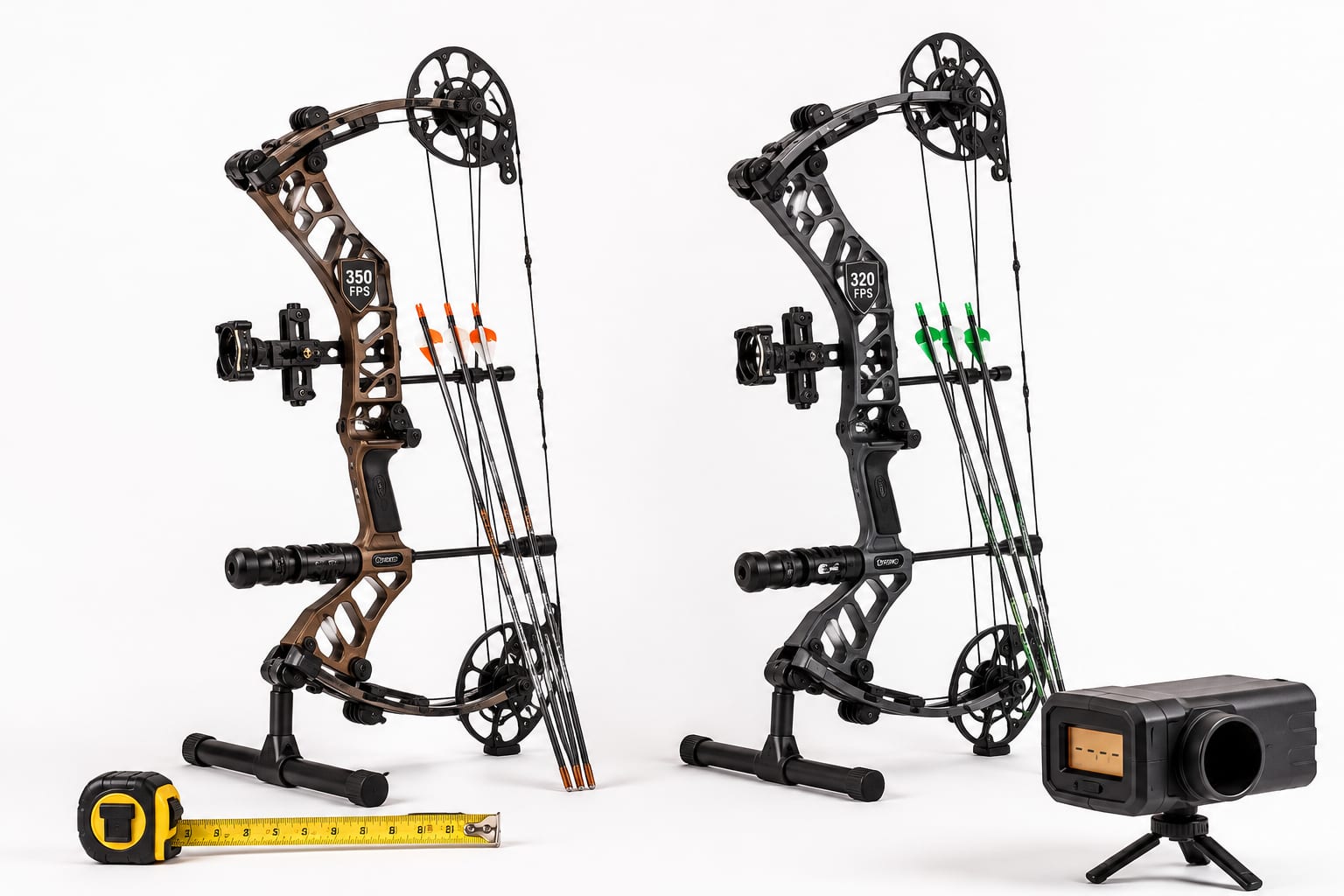
IBO speed is the arrow velocity measured under standards set by the International Bowhunting Organization, using a 70-pound draw weight, 30-inch draw length, and 350-grain arrow with no accessories attached to the bow. This standardized test creates a consistent baseline that allows archers to compare the raw speed potential of different bow models.
The IBO standard was established to give manufacturers and consumers a common reference point. Before standardized testing, companies could advertise speeds using any combination of settings, making honest comparisons nearly impossible.
Key IBO testing parameters:
The resulting number represents the absolute maximum speed that bow platform can achieve. Think of it like a car’s top speed rating, technically achievable, but not what you’ll experience in normal driving conditions.
ATA speed follows the Archery Trade Association’s testing protocol, which uses a 5-grain-per-pound arrow instead of a fixed 350-grain arrow. For a 70-pound bow, this means a 350-grain arrow (identical to IBO), but the standard scales proportionally for other draw weights.
The ATA method produces slightly more conservative and realistic speed estimates because it accounts for the relationship between draw weight and appropriate arrow weight. Most manufacturers now publish both IBO and ATA ratings, though IBO remains more common in marketing materials.
ATA testing parameters:
For practical purposes, ATA speeds typically run 0-25 fps slower than IBO speeds on the same bow, depending on how the manufacturer configures the test and whether they include a rest in the IBO measurement.
The primary difference between IBO and ATA speed ratings lies in the arrow weight calculation method and accessory allowances. IBO uses a fixed 350-grain arrow regardless of draw weight, while ATA uses a proportional 5-grains-per-pound formula.
Comparison table:
| Factor | IBO Standard | ATA Standard |
|---|---|---|
| Arrow weight | Fixed 350 grains | 5 grains per pound |
| Draw weight | 70 lbs | 70 lbs (reference) |
| Draw length | 30 inches | 30 inches |
| Accessories | Bare bow (no accessories) | May include arrow rest |
| Typical result | Higher speed number | 0-25 fps lower |
| Marketing use | Most common | Less common |
Common mistake: Assuming a bow with a higher IBO rating is always faster than one with a lower rating. The difference might simply reflect which standard was used or how generously the manufacturer interpreted the testing conditions.
Choose IBO ratings when you want to compare maximum potential across brands. Choose ATA ratings when you want a more conservative, realistic estimate of what the bow will actually deliver.
IBO speed is measured using a chronograph placed at a specific distance (typically 3-5 feet) from the bow, recording the arrow’s velocity as it passes through the device’s sensors. The bow must be set to exactly 70 pounds of draw weight and 30 inches of draw length, shooting a 350-grain arrow.
Step-by-step measurement process:
Edge case: Some manufacturers test at the high end of tolerance (70.5 lbs instead of 70.0 lbs) or use the single fastest shot rather than an average. This can inflate published speeds by 5-10 fps compared to more conservative testing.
The chronograph measures speed in feet per second (fps), which has become the universal standard in archery. Some international markets use meters per second, but fps dominates North American specifications.
Higher IBO speed does not automatically mean a better bow for most archers. Speed is just one performance factor, and prioritizing it often requires trade-offs in forgiveness, noise, vibration, and shootability that matter more for hunting accuracy and target consistency.
When higher speed helps:
When higher speed doesn’t matter:
The trade-off reality: Bows engineered for maximum speed typically use aggressive cam systems, shorter brace heights, and stiffer limbs. These design choices can create:
A bow shooting 340 fps that you can shoot accurately is far more effective than a 360 fps bow you struggle to control. Speed kills on paper; accuracy kills in the field.
The IBO speed test uses a 350-grain arrow, which includes the total weight of the shaft, nock, insert, and field point. This weight was chosen as a compromise between lightweight target arrows and heavier hunting setups, though it’s lighter than most hunters actually use in the field.
For context, 350 grains represents approximately 5 grains per pound on a 70-pound bow, which is considered the minimum safe arrow weight by most manufacturers. Many experienced hunters use arrows weighing 400-500 grains for better penetration and quieter flight.
Arrow weight categories:
Common mistake: Buying a bow based on IBO speed, then adding 100+ grains of arrow weight and wondering why your actual speed is so much slower. The published number assumes you’re shooting that specific 350-grain arrow.
Converting IBO speed to real-world fps requires accounting for your actual draw weight, draw length, arrow weight, and accessories. A reliable formula subtracts approximately 10 fps per inch of draw length below 30 inches, 15-20 fps per 10 pounds below 70 lbs, and 1 fps per 3 grains of additional arrow weight.
Conversion formula:
Example calculation:
This formula provides a reasonable estimate within ±10 fps for most setups. The only way to know your exact speed is to use a chronograph with your specific configuration.
Your bow is slower than the IBO rating because you’re not shooting under IBO test conditions, most archers use lighter draw weights, shorter draw lengths, heavier arrows, and multiple accessories, all of which reduce velocity. This is completely normal and expected.
Primary speed reducers:
Realistic expectations: If your bow is rated at 350 fps IBO and you’re shooting 280-300 fps with a hunting setup, you’re right in the normal range. A 50-70 fps reduction from IBO to real-world hunting speed is typical.
When to worry: If your speed is more than 80 fps below the IBO rating with reasonable draw weight and length, your bow may need tuning, new strings, or cam synchronization.

IBO speed typically exceeds actual hunting arrow speed by 40-70 fps because hunting setups prioritize penetration, accuracy, and ethical killing power over raw velocity. Most experienced hunters shoot arrows weighing 400-500 grains, which is 50-150 grains heavier than the 350-grain IBO test arrow.
Real-world hunting speed comparison:
Why hunters choose heavier arrows:
Kinetic energy matters more than speed: A 450-grain arrow at 280 fps delivers 78 foot-pounds of kinetic energy, while a 350-grain arrow at 320 fps delivers only 79 foot-pounds, nearly identical despite the 40 fps speed difference. The heavier arrow will penetrate better due to momentum.
Choose heavier arrows if you hunt larger game, shoot through thick cover, or prioritize quiet operation. Choose lighter arrows if you shoot at longer ranges where trajectory matters more than penetration.
You need a minimum of 250-260 fps for ethical whitetail deer hunting at typical ranges (20-30 yards), though 270-290 fps provides better margin for error and extends your effective range. Most modern compound bows easily exceed this threshold, even with heavy hunting arrows and moderate draw weights.
Speed requirements by game:
Why 250 fps is the baseline: At this speed, a properly weighted arrow (400+ grains) generates sufficient kinetic energy (60+ foot-pounds) to penetrate both lungs of a whitetail deer at 30 yards, assuming good shot placement and sharp broadheads.
Range and speed relationship:
Common mistake: Obsessing over speed when shot placement matters far more. A 260 fps arrow through both lungs kills more effectively than a 320 fps arrow through one lung or the shoulder blade.
Edge case: Some states have minimum draw weight requirements (typically 40 lbs) but rarely specify speed minimums. Check your local regulations, but any modern compound bow at legal draw weight will produce adequate speed.
Beginners do not need high IBO speed bows and often benefit from slower, more forgiving models that prioritize smooth draw cycles, comfortable holds, and reduced hand shock. Speed-focused bows typically require better form and consistency to shoot accurately, making them harder to learn on.
Better priorities for beginners:
Speed-focused bow characteristics that challenge beginners:
Realistic beginner speed targets: A bow shooting 280-300 fps with a hunting arrow is more than adequate for learning proper form, building strength, and developing accuracy. Once fundamentals are solid, upgrading to a faster bow makes sense if needed.
Choose a beginner-friendly bow if you’re new to archery, have limited upper body strength, or plan to hunt at typical ranges (under 35 yards). Choose a speed-focused bow if you have prior archery experience, strong fundamentals, and specific long-range goals.
The most common mistake when comparing bow speeds is assuming the advertised IBO number represents what you’ll actually shoot, without accounting for your personal draw length, draw weight, arrow weight, and accessories. This leads to unrealistic expectations and poor purchasing decisions.
Top comparison mistakes:
Better comparison approach:
Decision rule: If two bows are within 15-20 fps of each other, choose based on shootability, comfort, and accuracy rather than the speed difference. That small velocity gap makes almost no practical difference in the field.
Draw length does not affect the published IBO speed rating because all bows are tested at exactly 30 inches of draw length, but your personal draw length dramatically affects your actual shooting speed. Each inch below 30 inches typically costs about 10 fps, while each inch above 30 inches adds approximately 10 fps.
Draw length speed impact:
Why draw length affects speed: Longer draw lengths store more energy in the limbs and allow the arrow to accelerate over a longer power stroke. The relationship is nearly linear within the typical 26-32 inch range.
Common mistake: Buying a bow based on IBO speed when you have a 27-inch draw length, then being disappointed when your actual speed is 30+ fps slower. Always calculate your expected speed based on your actual measurements.
How to measure your draw length: Stand naturally with arms extended, measure fingertip to fingertip across your chest, then divide by 2.5. Or visit a pro shop for a professional measurement using a draw length arrow.
IBO speed is always measured at 70 lb draw weight, but dropping to 60 lbs typically reduces your actual speed by 15-20 fps due to less energy stored in the limbs. This reduction is proportional and predictable, making it easy to estimate your real-world speed at lower draw weights.
Draw weight speed comparison:
Example: A bow rated at 340 fps IBO (70 lbs) will shoot approximately 320-325 fps at 60 lbs with the same 350-grain arrow and 30-inch draw length. Add your personal draw length and arrow weight adjustments on top of this reduction.
Why many hunters choose 60 lbs:
Minimum draw weight considerations: Most states require 40 lbs minimum for big game hunting. At 40 lbs, expect speeds around 50-60 fps below the IBO rating, which still produces 240-260 fps with hunting arrows, adequate for ethical kills at reasonable ranges.
Choose 70 lbs if you have the strength to shoot it comfortably and consistently, hunt at longer ranges, or pursue larger game. Choose 60 lbs if you prioritize accuracy, comfort, and all-day hunting capability over maximum speed.
What is a good IBO speed for a hunting bow?
A good IBO speed for a hunting bow is 320-350 fps, which translates to 270-300 fps with typical hunting arrows and setups. This range provides sufficient speed for flat trajectory and kinetic energy while maintaining shootability and accuracy.
Can I trust manufacturer IBO speed claims?
Most reputable manufacturers provide honest IBO speeds within ±5 fps, but some inflate numbers by testing at the high end of tolerances or using the single fastest shot. Independent chronograph testing is the only way to verify actual performance.
How much does arrow weight affect bow speed?
Arrow weight affects speed at approximately 1 fps per 3 grains. Adding 50 grains to your arrow (from 350 to 400 grains) will reduce speed by roughly 15-17 fps, while removing 50 grains will increase speed by the same amount.
Is 300 fps fast enough for elk hunting?
Yes, 300 fps is more than adequate for elk hunting with proper arrow weight (450+ grains) and sharp broadheads. Many successful elk hunters shoot 270-290 fps with heavy arrows that prioritize penetration over speed.
Why is my chronograph reading different from IBO speed?
Your chronograph reads differently because you’re not shooting under IBO test conditions (70 lbs, 30-inch draw, 350-grain arrow, no accessories). Expect your real-world speed to be 40-70 fps slower than the IBO rating with a typical hunting setup.
Does bow speed affect accuracy?
Bow speed has minimal direct effect on accuracy at typical hunting ranges (under 40 yards). Faster bows offer flatter trajectory and less wind drift, but shootability, consistency, and proper form matter far more for accurate shot placement.
What’s more important: arrow speed or arrow weight?
Arrow weight is generally more important than speed for hunting because heavier arrows penetrate better, fly quieter, and deliver more momentum to the target. A 450-grain arrow at 280 fps outperforms a 350-grain arrow at 320 fps for most hunting applications.
How do I increase my bow speed?
Increase bow speed by: reducing arrow weight (within safe limits), increasing draw weight, lengthening draw length (if appropriate), removing unnecessary accessories, replacing old strings, and ensuring proper cam timing and tuning.
What is the minimum safe arrow weight?
The minimum safe arrow weight is typically 5 grains per pound of draw weight (350 grains for a 70 lb bow). Shooting lighter arrows risks damaging your bow through dry-fire-like shock and provides insufficient mass for ethical hunting.
Do faster bows make more noise?
Faster bows often make more noise because speed-focused designs use aggressive cams and shorter brace heights that create more vibration and string slap. Proper tuning, string dampeners, and heavier arrows can reduce noise significantly.
How accurate are online bow speed calculators?
Online bow speed calculators provide reasonable estimates within ±10-15 fps when you input accurate specifications. They use the same formulas outlined in this article but cannot account for individual bow efficiency, tuning quality, or string condition.
Should I buy the fastest bow available?
You should not buy the fastest bow available unless you specifically need maximum speed for long-range shooting. Most hunters and target archers benefit more from a forgiving, comfortable bow that shoots 300-330 fps IBO rather than an aggressive 360+ fps speed bow.
Understanding what IBO and ATA speed actually tell you transforms these numbers from marketing hype into useful comparison tools. The advertised speed represents maximum potential under ideal test conditions, 70 pounds, 30-inch draw, 350-grain arrow, no accessories, not what you’ll experience with your personal hunting or target setup.
Your real-world speed will typically be 40-70 fps slower than the IBO rating once you account for your actual draw weight, draw length, arrow weight, and accessories. This is completely normal and expected. A bow rated at 340 fps IBO that shoots 280 fps with your 60-pound draw, 28-inch draw length, and 450-grain hunting arrow is performing exactly as physics dictates.
Key actions to take:
Remember that 250-270 fps is sufficient for ethical deer hunting at typical ranges, and most modern bows easily exceed this threshold even with moderate draw weights and heavy hunting arrows. The difference between a 280 fps setup and a 310 fps setup matters far less than your ability to place the arrow accurately under pressure.
Speed is just one factor in bow performance. Forgiveness, comfort, noise level, and how the bow feels when you shoot it will impact your success far more than whether you’re shooting 290 fps or 320 fps. Test multiple bows, use a chronograph to verify real-world performance, and choose the setup that helps you shoot your best.


