
Newsletter Subscribe
Enter your email address below and subscribe to our newsletter
All voices matter
All voices matter

 ByTravis
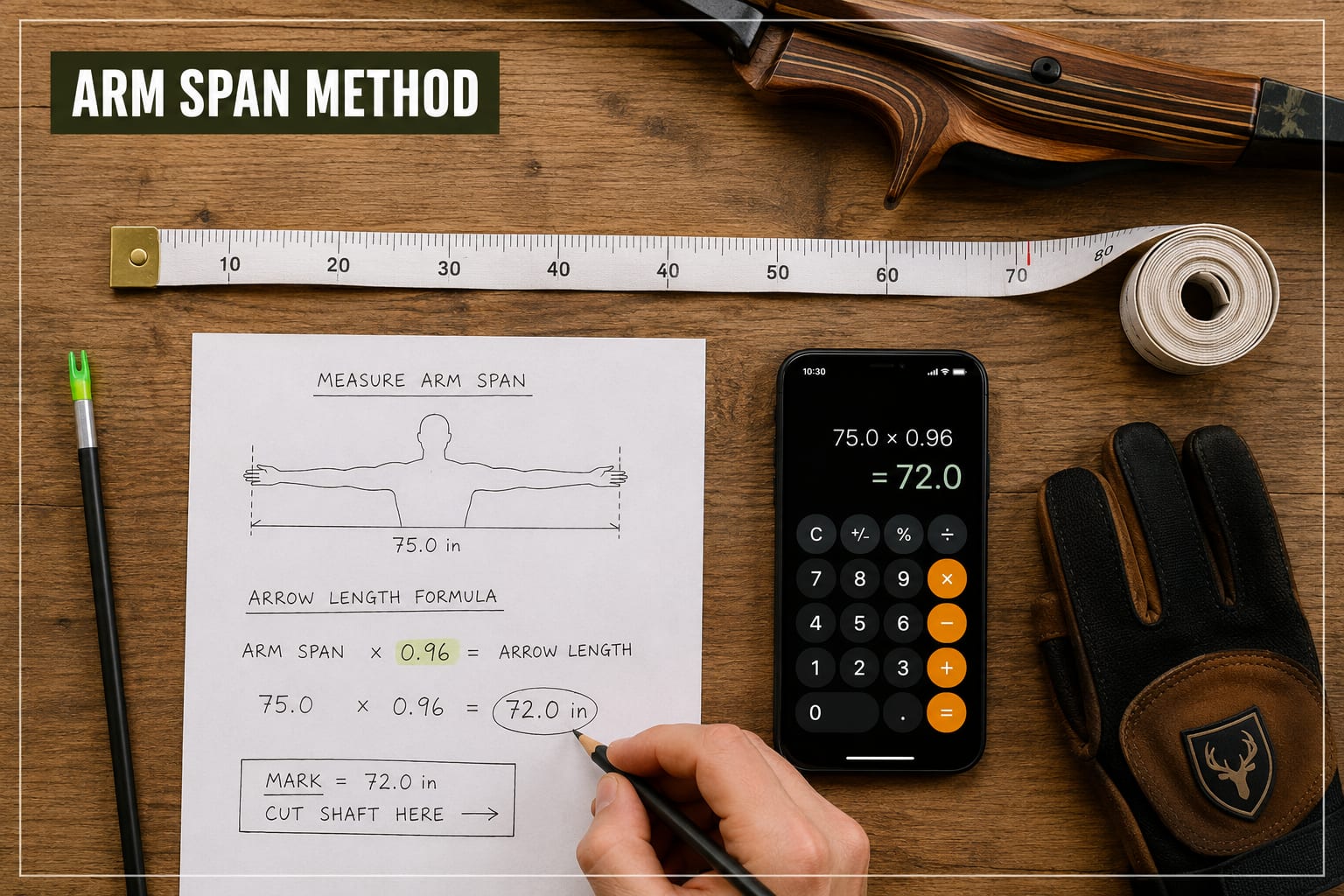
You can measure draw length at home using the arm span method - stand against a wall, measure fingertip to fingertip, then divide by 2.5 for an accurate starting point.
Affiliate Disclaimer: We are a participant in the Amazon Services LLC Associates Program, an affiliate advertising program designed to provide a means for sites to earn advertising fees by advertising and linking to Amazon.com. As an Amazon Associate I earn from qualifying purchases. We also participate in other affiliate programs.

Quick Answer: You can measure your draw length at home using the arm span method by standing against a wall with arms outstretched, measuring fingertip to fingertip, then dividing that number by 2.5. This simple calculation gives you an accurate starting point for selecting the right bow size without needing professional equipment or assistance.
Draw length is the distance from the nocking point on the bowstring to the throat of the grip (the deepest part where your bow hand rests) plus 1.75 inches, measured when you’re at full draw with proper form. This measurement determines which bow size fits your body and shooting style.
For compound bows, draw length is fixed and must match your body measurements. Recurve bows offer more flexibility, but knowing your draw length still helps you choose the right arrow length and achieve consistent form.
Why it matters:
Most adult male archers fall between 28-30 inches, while adult females typically measure 26-28 inches. Youth archers range from 18-26 inches depending on age and size.
The arm span method is the gold standard for measuring draw length at home without assistance. Stand with your back flat against a wall, extend both arms straight out to your sides at shoulder height (forming a T-shape), and have someone measure from the tip of one middle finger to the tip of the other middle finger across your chest.
Step-by-step process:
Example calculation: If your arm span measures 70 inches, your draw length is 70 ÷ 2.5 = 28 inches.
Common mistake to avoid: Don’t stretch or strain to increase your measurement. Use your natural, relaxed arm extension. Artificially inflating this number leads to a draw length that’s too long, causing poor form and accuracy issues.
If you’re measuring completely alone, mark the wall at one fingertip, then carefully turn around and mark where your other fingertip reaches. Measure between the two marks.
Using a measuring tape for the arm span method requires a cloth or flexible tape measure at least 72 inches long. Metal tape measures work but can be awkward to handle alone and may snap back unexpectedly.
Best practices for tape measurement:
Alternative wall-marking method: If you don’t have a long enough tape measure, use a shorter one (even a 12-inch ruler works) and mark the wall in sections, then add up the total distance.
For the most accurate reading, measure in the morning when your body is most relaxed. Muscle tension from workouts or physical labor can temporarily reduce your comfortable arm extension by up to an inch.
You can measure draw length completely alone using the wall-marking method, though having a helper makes the process faster and slightly more accurate. A second person eliminates the need to hold the tape measure while keeping your arms extended, reducing measurement errors from movement or sagging tape.
Solo measurement steps:
When a helper is worth it: If you’re ordering a custom bow or making a significant investment, having someone assist ensures the tape stays level and taut. For recreational archers buying adjustable bows, solo measurements are perfectly adequate.
Digital alternative: Some archers take a photo of themselves against a wall with arms extended next to a yardstick or known measurement, then use photo editing software to calculate the span. This method works but introduces more potential for error due to camera angle and perspective distortion.
Arm span divided by 2.5 is more accurate than other home measurement methods because it accounts for your skeletal structure and natural reach without requiring archery-specific equipment or form knowledge. Direct draw length measurement (pulling an actual bow to full draw and measuring) is technically more precise but requires a bow, proper form, and usually professional assistance.
Why arm span works:
Accuracy comparison:
The 2.5 divisor comes from biomechanical studies showing the average ratio between arm span and optimal draw length across thousands of archers. Some coaches use 2.3 or 2.4 for specific shooting styles, but 2.5 remains the industry standard for general-purpose measurement.
Choose arm span if: You’re new to archery, buying your first bow, or don’t have access to archery equipment. Choose direct measurement if you’re an experienced archer fine-tuning a competition setup.
Incorrect draw length causes immediate form problems and long-term accuracy issues. A draw length that’s too long forces you to overextend, collapsing your bow arm and creating an inconsistent anchor point. A draw length that’s too short crowds your face, reduces power, and can cause string slap on your forearm.

Too long (most common problem):
Too short:
Performance impact: Studies of competitive archers show that draw length errors of just one inch can reduce grouping consistency by 15-20% at 20 yards. At longer distances, the effect compounds significantly.
Physical consequences: Shooting with wrong draw length for extended periods can cause rotator cuff strain, tennis elbow, and chronic shoulder pain. If you experience discomfort after 20-30 shots, your draw length is likely off.
The most common measurement mistake is hyperextending your arms during the arm span test, which artificially inflates your measurement by 1-2 inches. This leads to selecting a draw length that feels too long when shooting and causes form breakdown.
Top measurement errors:
The “more is better” fallacy: Many beginners assume longer draw length means more power, so they intentionally measure high. While longer draw does increase power stroke, it only works if you can maintain proper form. A shorter draw length with good form always outperforms a longer draw with collapsed form.
Verification check: After calculating your draw length, compare it to general guidelines. Adult males under 5’6″ rarely exceed 27 inches; those over 6’2″ rarely measure under 29 inches. If your calculation falls far outside these ranges, remeasure carefully.
Draw length affects accuracy more than any other bow specification because it determines whether you can achieve consistent anchor points and maintain proper form through the shot sequence. Even a half-inch error can shift your point of impact by 3-4 inches at 20 yards and 8-10 inches at 40 yards.
Accuracy factors influenced by draw length:
Real-world impact: Tournament archers report that correcting draw length errors of just 0.5 inches can improve group sizes by 20-30%. For hunting applications, proper draw length is the difference between ethical shot placement and wounding game.
Beyond accuracy: Draw length also affects arrow selection, as it determines the minimum arrow length you need. Arrows that are too short for your draw length can fall off the rest or, in worst cases, be drawn behind the riser, causing catastrophic bow failure.
Draw length can increase by 0.5-1.5 inches as you develop archery-specific strength, flexibility, and form over your first 1-2 years of regular shooting. After that, it typically stabilizes unless you experience significant changes in shoulder flexibility, muscle mass, or shooting technique.
Factors that change draw length:
Youth archers: Children and teenagers should remeasure every 6-12 months during growth spurts. A 12-year-old might gain 2-3 inches of draw length in a single year.
When to remeasure: Check your draw length annually, or immediately if you experience form problems, discomfort, or significant changes in fitness level. Most adjustable compound bows offer 3-4 inches of adjustment range, accommodating gradual changes without needing a new bow.
When your measurement falls between standard bow sizes (which typically come in 1-inch increments), choose the shorter option and adjust up if needed. It’s easier to add length through technique refinement than to compensate for a bow that’s too long.
Decision framework:
Compound bow solutions:
Recurve bow flexibility: Traditional and recurve bows don’t have fixed draw lengths, so in-between measurements matter less. Focus on selecting the correct arrow length instead.
Common scenario: An archer measuring 28.7 inches should start with a 28-inch bow. After 3-6 months of shooting, if form is solid and the bow feels short, adjust up to 28.5 or 29 inches. This approach prevents the collapsed-form problems that plague archers who start too long.
Youth archers use the same arm span measurement method as adults, but their draw lengths change rapidly during growth spurts, requiring more frequent remeasurement and adjustable equipment. Children ages 8-12 typically measure 20-24 inches, while teenagers range from 24-28 inches depending on size and gender.
Youth-specific considerations:
Age-based starting points:
Adult measurement differences: Adults have stable skeletal structure, so measurements remain consistent. Focus on accuracy rather than anticipating growth. The arm span method works identically for all ages, the only difference is frequency of remeasurement.
Parent tip: For children under 10, have them stand naturally rather than stretching to maximum extension. Young archers benefit from slightly shorter draw lengths that allow them to focus on form development rather than struggling with equipment that’s too large.
No reliable smartphone apps currently measure draw length with the accuracy needed for bow selection. While some archery apps claim to calculate draw length using your phone’s camera and AR features, they suffer from perspective distortion and measurement errors of 1-3 inches, making them unsuitable for equipment decisions.
Why apps fall short:
What apps CAN do:
Better alternatives: Use a simple calculator app to divide your arm span measurement by 2.5. This takes 10 seconds and eliminates the variables introduced by camera-based measurement.
Future technology: Some archery retailers are developing in-store kiosks with calibrated cameras and sensors for precise measurement, but these aren’t available for home use as of 2026.
If your draw length feels wrong after shooting, most compound bows can be adjusted by changing draw length modules or rotating existing cams. This process takes 15-30 minutes and requires basic tools (Allen wrenches) plus your bow’s manual for specific instructions.
Signs your draw length needs adjustment:
Compound bow adjustment methods:
DIY vs professional: Simple module swaps can be done at home if you’re mechanically inclined and follow manufacturer instructions carefully. Cable and string adjustments should be done by a certified bow technician to maintain proper timing and avoid safety issues.
Recurve bow adjustments: Traditional and recurve bows don’t have adjustable draw lengths, but you can modify your anchor point or shooting style. If the measurement is significantly off, you may need different arrows or a different bow.
Verification after adjustment: After any draw length change, shoot 30-50 arrows over several sessions to confirm the new setting feels comfortable and improves your form. Don’t make multiple adjustments in one day, give your body time to adapt.
How accurate is the arm span method for measuring draw length?
The arm span divided by 2.5 method is accurate within 0.5 inches for 90% of archers, making it reliable for bow selection. Professional measurement with a bow at full draw may be 0.25 inches more precise but requires equipment and expertise most beginners don’t have.
Can I measure draw length without help?
Yes, you can measure draw length alone by marking a wall at each fingertip while standing with arms extended, then measuring between the marks. Having a helper makes the process easier and slightly more accurate, but solo measurement works fine for recreational archery.
Should I round up or down if I’m between sizes?
Round down to the shorter draw length if you’re between standard bow sizes. It’s easier to extend your draw slightly through form improvement than to compensate for a bow that’s too long, which causes collapsed form and accuracy problems.
How often should I remeasure my draw length?
Adults should remeasure annually or when experiencing form problems or discomfort. Youth archers should remeasure every 6-12 months during growth spurts. Also remeasure after significant changes in strength, flexibility, or shooting technique.
What’s the difference between draw length and arrow length?
Draw length is the measurement from nocking point to grip throat at full draw, while arrow length is the physical length of your arrows. Your arrows should be 1-2 inches longer than your draw length for safety and proper arrow rest clearance.
Does draw weight affect draw length measurement?
No, draw weight (measured in pounds) is independent of draw length (measured in inches). However, if a bow’s draw weight is too heavy for you, you may unconsciously shorten your draw to reduce the effort, making your measurement inaccurate.
Can women and men use the same draw length formula?
Yes, the arm span divided by 2.5 formula works equally well for all genders. Draw length is determined by skeletal structure and arm length, not gender. Women typically measure shorter simply because average female height is less than average male height.
What if my left and right arm measurements are different?
Measure your arm span with both arms extended equally, the measurement accounts for your overall reach, not individual arm length. If you have a significant injury or condition affecting one arm, consult a certified archery instructor for a customized measurement approach.
Is 28 inches a common draw length?
Yes, 28 inches is one of the most common draw lengths for adult archers, particularly males between 5’7″ and 5’10” tall. This is why many bows come with 28-inch modules as the default setting.
Can I use my height to estimate draw length?
Height provides a rough estimate (height in inches divided by 2.5), but arm span is more accurate because people have different proportions. Someone 5’10” with long arms may measure 29 inches, while another 5’10” person with shorter arms measures 27 inches.
Do I need to remeasure if I switch from recurve to compound?
Your physical draw length doesn’t change between bow types, but compound bows require more precise measurement because they have fixed draw lengths. Recurve bows are more forgiving of small measurement variations.
What’s the shortest draw length for adults?
Adult draw lengths rarely go below 24 inches unless the person is under 5 feet tall or has unusually short arms. Most adult women measure 25-28 inches, while most adult men measure 27-30 inches.
Measuring your draw length at home is straightforward and requires only a measuring tape, a wall, and five minutes of your time. The arm span method, measuring fingertip to fingertip and dividing by 2.5, provides accuracy within half an inch for the vast majority of archers, which is more than sufficient for selecting the right bow and achieving consistent shooting form.
Your next steps:
Remember that draw length isn’t static, it can change as you develop strength, flexibility, and proper shooting technique. Start with an accurate home measurement, but don’t hesitate to make small adjustments as you gain experience. A bow that fits your body and shooting style is the foundation of accuracy, consistency, and long-term enjoyment in archery.
If your home measurement reveals significant discrepancies with your current equipment, or if you’re investing in a high-end bow, consider visiting a pro shop for professional verification. But for most recreational archers, the simple arm span method provides everything you need to get started with properly fitted equipment.


