
Newsletter Subscribe
Enter your email address below and subscribe to our newsletter
All voices matter
All voices matter

 ByTravis
NASP (National Archery in the Schools Program) teaches archery to students in grades 4-12 using standardized gear and curriculum, and now runs in over 10,000 schools.
Affiliate Disclaimer: We are a participant in the Amazon Services LLC Associates Program, an affiliate advertising program designed to provide a means for sites to earn advertising fees by advertising and linking to Amazon.com. As an Amazon Associate I earn from qualifying purchases. We also participate in other affiliate programs.
NASP (National Archery in the Schools Program) is an international youth archery education program that teaches students in grades 4-12 basic archery skills using standardized equipment and curriculum in physical education classes. The program operates in more than 10,000 schools across the United States and several other countries, providing a safe, inclusive activity that emphasizes focus, discipline, and self-improvement. NASP uses Genesis compound bows with 10-20 pound draw weights, making archery accessible to students of all physical abilities without requiring fitted equipment.

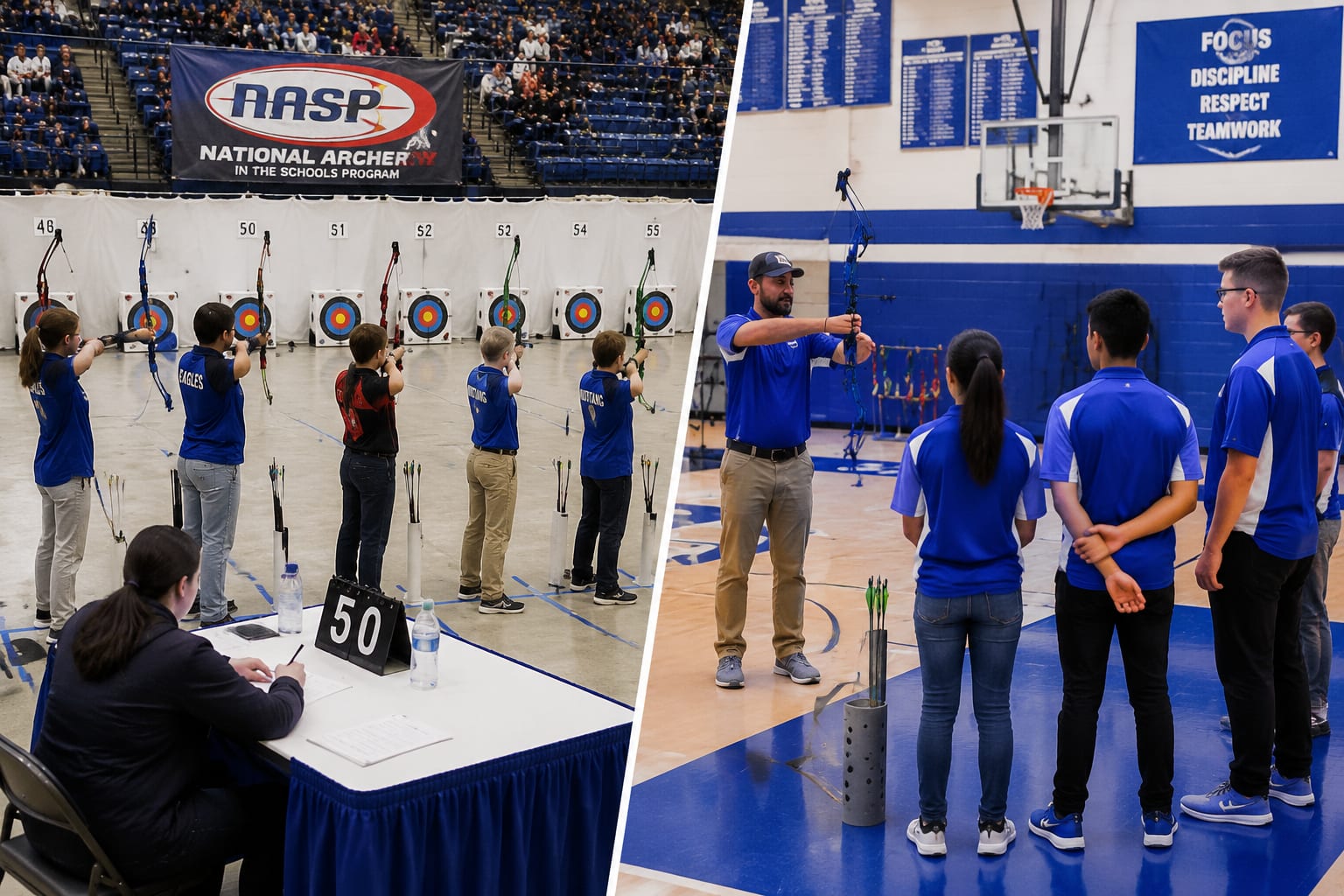
NASP stands for the National Archery in the Schools Program, a curriculum-based archery education initiative launched in 2002 by the Kentucky Department of Fish and Wildlife Resources. The program was created to introduce archery as a physical education activity in schools, providing students with an alternative to traditional team sports while teaching focus, discipline, and self-improvement.
The program has expanded internationally since its founding and now operates under the umbrella of the Archery Trade Association Foundation. NASP maintains strict standards for equipment, instruction, and safety protocols to ensure consistency across all participating schools.
Key characteristics of NASP:
The “National” designation reflects its origin in the United States, though the program now operates in Canada, Australia, New Zealand, South Africa, and several other countries. Some international chapters use regional names but follow the same core curriculum and standards.
NASP archery operates as a structured physical education unit taught by certified instructors during regular school hours. Schools integrate the program into their PE curriculum, typically running it for 4-8 weeks per semester or as an ongoing club activity. The program follows a standardized teaching progression that begins with safety rules and basic shooting form before advancing to accuracy and consistency.
The typical NASP class structure includes:
The program uses a whistle system for range control: one whistle to approach the line, two whistles to begin shooting, three whistles to retrieve arrows, and four or more whistles signals an emergency stop. This standardized approach ensures safety regardless of which school or instructor is running the session.
Schools can choose to participate in optional tournaments at local, state, and national levels, but competition is not required. Many schools run NASP purely as a recreational PE activity focused on skill development and personal achievement.
Students can begin NASP archery in fourth grade, typically around age 9-10, and continue through 12th grade. The program is designed for this age range because students have developed sufficient motor control, attention span, and ability to follow safety instructions consistently. Some schools start NASP in fifth or sixth grade depending on their PE curriculum structure and available resources.
The Genesis bow used in NASP has a draw weight range of 10-20 pounds, which is manageable for most fourth graders while still providing enough resistance for high school students to develop proper form. The adjustable draw weight means the same bow works for a 9-year-old and a 17-year-old without modification.
Age-appropriate considerations:
While NASP officially begins at fourth grade, some schools run introductory archery experiences for younger students using even lighter equipment and modified protocols. However, these younger programs are not considered official NASP and students cannot participate in NASP tournaments until they reach fourth grade.
NASP is generally better for absolute beginners because it uses standardized equipment that requires no fitting or adjustment, operates within the school environment during regular hours, and focuses on basic skill development rather than progression to hunting or competitive archery. 4-H archery programs offer more variety in equipment and shooting styles but require more parental involvement and often expect students to eventually purchase their own gear.
Comparison of key differences:
| Feature | NASP | 4-H Archery |
|---|---|---|
| Equipment | Genesis bows only, school-provided | Multiple bow types, often student-owned |
| Location | School gymnasium during PE | Community centers, ranges, after school |
| Cost to families | Free (school-funded) | Club fees, equipment purchases |
| Instruction focus | PE curriculum, basic skills | Progression to hunting/competition |
| Time commitment | Regular PE class time | After-school meetings, weekend events |
| Competition | Optional, standardized format | Varies by club, multiple disciplines |
NASP works best for students who want to try archery without financial investment, prefer activities during school hours, or need equipment that accommodates physical limitations. The program’s standardized approach means a student can participate at any NASP school with the same equipment and expectations.
4-H archery suits students who want to explore different bow types (recurve, compound, traditional), plan to pursue archery as a serious hobby or hunting skill, or prefer a club environment with mixed-age groups. 4-H programs often have more flexibility in teaching methods and can customize instruction to individual goals.
Many students start with NASP in school and later join 4-H or other archery clubs if they develop a deeper interest in the sport. The basic skills learned in NASP transfer directly to other archery disciplines.

Starting a NASP program at a school typically costs between $3,000 and $5,000 for the initial setup, which includes instructor training, basic equipment package, liability insurance, and curriculum materials. This investment covers approximately 10-15 students shooting simultaneously, with most schools adding equipment over time as the program grows.
Breakdown of typical startup costs:
Schools can apply for grants through the NASP Foundation, state wildlife agencies, and local archery retailers to offset these costs. Many programs receive donated or discounted equipment from archery manufacturers and community sponsors.
Ongoing annual costs include:
The per-student cost is minimal once the program is established, typically under $10 per student per year for consumables. This makes NASP one of the most cost-effective PE activities compared to team sports requiring uniforms, field maintenance, and travel.
Schools with limited budgets can start smaller with 6-8 bows and expand as funding allows. The equipment is durable and, with proper care, bows and targets can last 10-15 years.
Students need no personal equipment for NASP archery because schools provide all necessary gear as part of the program. The standardized equipment includes Genesis compound bows, aluminum arrows, arm guards, finger tabs, and safety glasses, all of which are shared among students and stored at the school.
Standard NASP equipment provided by schools:
The Genesis bow is specifically designed for NASP and cannot be modified with sights, stabilizers, release aids, or other accessories. This keeps the focus on fundamental form and eliminates equipment advantages in tournaments.
Students should wear close-fitting clothing without loose sleeves or dangling jewelry that could catch the bowstring. Athletic shoes are required, and long hair should be tied back. Some schools provide NASP team shirts for students participating in tournaments, but these are optional.
What students should NOT bring:
The standardized equipment approach ensures safety, fairness, and accessibility. Students of different sizes, strengths, and abilities can all use the same equipment successfully, which is unique to NASP compared to traditional archery programs.
NASP archery is extremely safe for middle school students when proper protocols are followed, with injury rates significantly lower than traditional PE activities like basketball, soccer, or gymnastics. The program’s safety record stems from strict range procedures, low draw-weight bows, controlled shooting environments, and mandatory instructor certification that emphasizes safety above all other aspects.
The most common “injuries” in NASP are minor string slaps on the forearm (prevented by arm guards) and occasional finger soreness (prevented by finger tabs). Serious injuries are exceptionally rare because students shoot at stationary targets in controlled lines, never at moving objects or in outdoor environments with variables.
NASP safety protocols include:
The 10-20 pound draw weight of Genesis bows is light enough to prevent overuse injuries while teaching proper form. Students cannot “overbuild” muscle imbalances or develop repetitive stress injuries common in higher-poundage archery.
Schools must maintain liability insurance and follow NASP safety guidelines to remain certified. Instructors receive specific training in managing groups of students on the range, identifying unsafe behavior, and responding to the rare equipment failure or medical emergency.
Parents concerned about safety should know that NASP has operated in thousands of schools since 2002 with an outstanding safety record, and the program is approved by school districts nationwide specifically because of its comprehensive safety protocols.
Homeschool students can participate in NASP through homeschool co-ops, community education programs, and archery clubs that offer NASP-certified instruction. While NASP is primarily a school-based program, the organization recognizes homeschool divisions at tournaments and many states have established homeschool NASP teams that practice together and compete as a group.
Options for homeschool participation:
Homeschool students who participate in NASP programs can compete in tournaments under homeschool team designations. State and national NASP tournaments include homeschool divisions with the same rules and scoring as traditional school teams.
Requirements for homeschool participation:
Parents interested in starting a homeschool NASP program should contact their state NASP coordinator, who can provide information about existing homeschool teams, instructor training opportunities, and equipment purchasing. Some states offer grants or discounted equipment specifically for homeschool groups.
The main challenge for homeschool participation is finding or creating a program, since NASP equipment and instruction must meet specific standards. Homeschool families cannot simply purchase Genesis bows and participate in tournaments without going through certified instruction and program registration.
NASP archery competitions follow standardized rules where students shoot 15 arrows total: 10 arrows from 10 meters and 5 arrows from 15 meters, all at 80cm bullseye targets with scoring rings from 1 to 10 points. Tournaments are scored individually and as teams, with the top male and female scores in each grade division contributing to school team totals.
Basic tournament format:
Team scoring divisions:
Each school’s team score is calculated by adding the top scores from each division and gender. For example, a middle school team score would include the top male and female scores from grades 6, 7, and 8.
Equipment rules for competition:
Shooting line procedures:
Tournaments can be held at local, state, regional, and national levels. The NASP National Tournament, held annually, attracts thousands of students and is one of the largest youth archery events in the world. Schools qualify for nationals by meeting minimum score requirements at state tournaments.
Common tournament divisions beyond standard competition:
Students compete for individual awards and team trophies, with recognition for top scorers in each grade and gender category. The emphasis remains on personal achievement and sportsmanship rather than winning at all costs.
Finding NASP archery programs near you requires contacting your local school district’s PE department, checking the NASP website’s school directory, or reaching out to your state’s NASP coordinator who maintains a list of all certified programs in your area. Most NASP programs operate through public schools, but some private schools, homeschool co-ops, and community education programs also offer certified instruction.
Steps to locate NASP programs:
If no program exists in your area:
Schools interested in starting a NASP program should contact their state coordinator to learn about instructor training, equipment grants, and implementation support. The startup process typically takes 2-4 months from initial contact to first class.
Parents can advocate for NASP by presenting information to school administrators, PE departments, or parent-teacher organizations. Many programs started because a parent or teacher championed the idea and helped secure initial funding.
Alternative options if NASP isn’t available:
The NASP state coordinator is the best single resource for finding programs, as they maintain current lists and can connect interested families with nearby schools or help start new programs where interest exists.
The most common mistakes when teaching NASP archery to kids include rushing through safety protocols, allowing inconsistent range procedures, neglecting proper form fundamentals in favor of accuracy, and failing to make the activity fun and engaging for students of varying skill levels. New instructors often focus too much on scores and competition rather than personal improvement and skill development.
Frequent instructional errors:
Form mistakes students commonly develop:
Best practices for effective NASP instruction:
Instructors should remember that most students will not become competitive archers, but all students can benefit from the focus, discipline, and self-confidence that archery develops. The goal is to create a positive experience that students remember and value, regardless of their final score.
Yes, you must complete the Basic Archery Instructor (BAI) certification to run an official NASP program at a school or organization. The certification course, typically completed in one or two days, covers safety protocols, teaching methods, equipment maintenance, range setup, and the NASP curriculum. Without this certification, you cannot order NASP equipment, register students for tournaments, or operate under NASP insurance coverage.
BAI certification requirements:
The BAI course costs $300-$500 depending on location and includes all training materials, the NASP curriculum guide, and certification credentials. Many schools pay for PE teachers or coaches to attend as part of professional development.
Who should get certified:
Schools typically need at least one certified instructor, though having two or more allows for larger classes and provides backup coverage. Assistant instructors can help on the range under supervision of a certified instructor but cannot run the program independently.
What the certification covers:
The certification process is straightforward for anyone with basic archery knowledge, though prior archery experience is not required. The course teaches everything needed to run a safe, effective program even for complete beginners to archery.
Contact your state NASP coordinator to find upcoming BAI courses in your area. Some states offer courses several times per year, while others may require travel to a neighboring state or waiting for scheduled training sessions.
NASP archery differs from traditional archery lessons by using standardized equipment that requires no individual fitting, teaching in a group PE setting rather than individual instruction, focusing on basic form and participation rather than progression to hunting or competitive archery, and operating within schools as an educational program rather than a recreational activity. Traditional archery lessons typically involve fitted equipment, smaller instructor-to-student ratios, and progression toward specific archery disciplines.
Key differences:
| Aspect | NASP | Traditional Lessons |
|---|---|---|
| Equipment | Genesis bows only, no fitting needed | Multiple bow types, individually fitted |
| Class size | 15-30 students per instructor | 3-8 students per instructor |
| Setting | School gymnasium, PE class | Archery range, after-school |
| Cost | Free (school-funded) | $15-$40 per hour |
| Goal | Basic skills, PE credit | Skill progression, competition prep |
| Customization | Standardized curriculum | Individualized instruction |
| Equipment ownership | School-owned, shared | Student often purchases own gear |
NASP works best for students who want to try archery without commitment, need an alternative to team sports in PE, or prefer activities during school hours. The program provides a solid foundation in archery basics that transfers to other disciplines if students choose to pursue archery further.
Traditional archery lessons suit students who have decided archery is a serious interest, want to progress to hunting or competitive shooting, need equipment fitted to their specific measurements, or prefer smaller classes with more individual attention. These lessons typically cost $60-$160 per month for weekly sessions.
Skill development comparison:
NASP teaches fundamental form, safety, and basic accuracy at short distances (10-15 meters). Students learn consistent anchor points, proper release, and follow-through. The program does not cover advanced topics like tuning, different arrow types, varying distances, or outdoor shooting.
Traditional lessons progress through beginner, intermediate, and advanced levels, eventually covering equipment selection, tuning, different shooting styles (Olympic recurve, barebow, compound), longer distances, and outdoor conditions. Instruction is tailored to individual goals whether recreational, competitive, or hunting-focused.
Many archers start with NASP in school and transition to traditional lessons or club archery if they develop serious interest. The basic form learned in NASP provides a solid foundation, though students will need to adapt to fitted equipment and different bow types.
Students with disabilities can participate in NASP archery with accommodations and adaptive equipment, as the program is designed to be inclusive and accessible to students of all physical abilities. The Genesis bow’s adjustable draw weight, lack of required fitting, and simple operation make it suitable for students with various physical, cognitive, and sensory disabilities when appropriate modifications are implemented.
Common accommodations for different disabilities:
The low draw weight of Genesis bows (10-20 pounds) makes archery accessible to students with limited upper body strength. Unlike sports requiring running, jumping, or quick reactions, archery is self-paced and allows students to work within their physical capabilities.
Benefits of NASP for students with disabilities:
Schools should work with special education staff, occupational therapists, and parents to determine appropriate accommodations for individual students. The NASP curriculum includes guidance on inclusive instruction and adaptive techniques.
Safety considerations:
Students with disabilities must be able to understand and follow basic safety rules, though the level of understanding and method of communication can be adapted. Instructors may need to provide additional supervision, use visual or tactile cues for range commands, or assign peer helpers to ensure safe participation.
NASP tournaments welcome students with disabilities and provide accommodations as needed. Some competitions include adaptive divisions, while others integrate students with disabilities into standard divisions with appropriate modifications.
The program’s emphasis on personal achievement rather than competition makes it particularly well-suited for students with disabilities, who can set individual goals and measure progress against their own baseline rather than comparing themselves to classmates.
What does NASP stand for?
NASP stands for National Archery in the Schools Program, an international youth archery education program that teaches students in grades 4-12 basic archery skills using standardized equipment and curriculum in physical education classes.
How much does NASP cost for students?
NASP costs nothing for students because schools provide all equipment and instruction as part of the physical education curriculum. Families only pay if students choose to participate in optional tournaments, which typically cost $10-$25 per event.
What bow does NASP use?
NASP uses the Genesis compound bow exclusively, which features a single-cam design with 10-20 pound adjustable draw weight and fits draw lengths from 15-30 inches without modification. No other bow types or modifications are permitted in the program.
Can adults participate in NASP?
NASP is designed specifically for students in grades 4-12, and adults cannot participate in the program or compete in NASP tournaments. Adults interested in archery should explore community archery clubs, ranges, or adult education programs.
How long does it take to get good at NASP archery?
Most students develop basic proficiency in NASP archery within 4-6 weeks of regular practice, shooting consistent groups and scoring 200+ out of 300 possible points. Advanced students who practice regularly may reach scores of 270-290 within a year.
Is NASP archery the same as Olympic archery?
No, NASP archery uses compound bows without sights at short distances (10-15 meters), while Olympic archery uses recurve bows with sights at 70 meters. The basic form principles are similar, but equipment and competition formats differ significantly.
Do you need your own bow for NASP?
No, students do not need their own bow for NASP because schools provide all equipment. Students are not permitted to use personal bows in NASP programs or tournaments, as only Genesis bows meeting program specifications are allowed.
What is a good score in NASP archery?
A good score for beginners is 200-220 out of 300 possible points, intermediate students typically score 230-260, and advanced students score 270-290. The highest possible score is 300, achieved by hitting the 10-ring with all 30 arrows.
Can you get a scholarship for NASP archery?
Some colleges offer archery scholarships, but these are typically for NCAA archery programs that differ from NASP. However, NASP participation demonstrates dedication and skill development that can strengthen college applications and may qualify for general athletic or leadership scholarships.
How many arrows do you shoot in NASP?
In NASP practice sessions, students typically shoot 15-30 arrows per class. In tournaments, students shoot exactly 15 arrows total: 10 arrows from 10 meters and 5 arrows from 15 meters, all at 80cm bullseye targets.
What happens if you miss the target in NASP?
If you miss the target completely in NASP, that arrow scores zero points. Students retrieve all arrows, including misses, and continue shooting. Missed shots are learning opportunities to adjust form and aim.
Can you do NASP in college?
NASP is designed for grades 4-12 and does not extend to college. However, many colleges have archery clubs or NCAA archery teams that welcome students with NASP experience. The skills learned in NASP transfer well to collegiate archery programs.
NASP (National Archery in the Schools Program) provides an accessible, safe, and inclusive way for students in grades 4-12 to learn archery fundamentals through their school’s physical education program. By using standardized Genesis bows that require no individual fitting and emphasizing personal improvement over competition, NASP removes the barriers that make traditional archery intimidating or expensive for many families. The program’s outstanding safety record, comprehensive instructor training, and focus on life skills like focus and discipline make it a valuable addition to any school’s PE curriculum.
For students interested in trying archery, NASP offers a no-cost, low-pressure introduction that can spark a lifelong interest in the sport. The program accommodates students of all abilities, including those with physical or cognitive disabilities, and provides optional competitive opportunities for those who develop serious interest. Schools benefit from a turnkey curriculum that meets PE standards while offering something different from traditional team sports.
Next steps to get involved:
Whether you’re looking for an alternative to team sports, want to develop focus and discipline, or simply want to try something new, NASP archery provides a structured, supportive environment where students of all backgrounds and abilities can succeed. The skills learned through NASP extend far beyond the archery range, building confidence, patience, and goal-setting abilities that benefit students throughout their lives.


