
Newsletter Subscribe
Enter your email address below and subscribe to our newsletter

All voices matter
All voices matter

 ByTravis
Most kids can safely start archery between ages 6 and 8, once they have the motor skills, focus, and ability to follow safety instructions.
Affiliate Disclaimer: We are a participant in the Amazon Services LLC Associates Program, an affiliate advertising program designed to provide a means for sites to earn advertising fees by advertising and linking to Amazon.com. As an Amazon Associate I earn from qualifying purchases. We also participate in other affiliate programs.
Most children can safely begin archery between ages 6 and 8, when they have developed sufficient motor skills, focus, and the ability to follow safety instructions. Some programs accept children as young as 4 or 5 using modified equipment and foam-tipped arrows, while others recommend waiting until age 7 or older. The right starting age depends on the individual child’s physical development, attention span, and interest level rather than a fixed number.


Children can begin archery as early as age 4 or 5 in specialized programs, but most experts recommend starting between ages 6 and 8 for optimal results. At this age range, kids typically have the physical coordination, attention span, and ability to understand safety rules necessary for safe and enjoyable participation.
The answer depends less on a specific birthday and more on developmental milestones. A mature 5-year-old who can focus and follow multi-step instructions may be ready, while a distractible 7-year-old might benefit from waiting another year.
Key developmental markers that indicate readiness:
Many archery clubs use age 6 as their minimum because it aligns with when most children enter first grade and have developed the discipline and focus required for group instruction. USA Archery’s Junior Olympic Archery Development (JOAD) program accepts participants starting at age 8, though local clubs may have their own age policies.
Five years old is not too young if the program uses age-appropriate equipment and the child demonstrates readiness, but it sits at the lower boundary of what most instructors recommend. Success at this age requires specialized instruction, modified equipment, and realistic parent expectations about attention span and skill development.
Programs that accept 5-year-olds typically use foam-tipped arrows, very light bows (6-10 pound draw weight), and focus heavily on safety and fun rather than technique refinement. Sessions are shorter, usually 30-45 minutes instead of the standard hour, and incorporate games and movement breaks.
What makes a 5-year-old program successful:
If your local program doesn’t offer a 5-year-old option, that’s often a sign they’ve determined their facility or teaching approach isn’t suited for that age group. Waiting until age 6 or 7 often results in faster skill development and more enjoyment for both child and parent.
The optimal age to introduce children to archery is between 7 and 9 years old, when physical development, cognitive ability, and attention span align to create the best learning conditions. At this age, most kids can handle standard youth equipment, maintain focus for full lessons, and understand the connection between technique and results.
Starting in this age range allows children to build proper form from the beginning without the frustration that sometimes comes with starting too early. They’re old enough to understand safety as a serious matter rather than just a rule to follow, and they can typically practice independently with supervision rather than requiring hands-on assistance for every shot.
Advantages of starting at ages 7-9:
That said, the “best” age is ultimately the age when your specific child shows interest and readiness. A passionate 6-year-old will likely progress faster than an uninterested 9-year-old who was pushed into the sport.
Archery programs for toddlers and young children (ages 4-6) differ dramatically from those for older kids (ages 7-12) in equipment, supervision ratios, and safety protocols. Younger children require foam-tipped arrows, extremely light bows, constant one-on-one supervision, and modified ranges with shorter distances and additional barriers.
For children under 6, safety measures include using only foam or suction-cup arrows that cannot penetrate skin, maintaining a 1:2 or 1:3 instructor-to-student ratio, and creating physical barriers between shooting lines and target areas. The focus is on preventing any possibility of injury rather than teaching range independence.
Safety differences by age group:
Ages 4-6:
Ages 7-12:
Older children can learn range commands (like “bows down” and “retrieve arrows”) and follow them reliably, while younger children need physical intervention. This is why many facilities set their minimum age at 6 or 7; it’s the point where verbal safety protocols become effective.
Kids archery classes typically cost between $75 and $200 for a beginner session lasting 4-8 weeks, with most programs charging $100-$150 for a 6-week course that includes equipment use. Drop-in sessions at archery ranges run $15-$30 per hour, while private lessons cost $40-$75 per hour depending on location and instructor credentials.
Initial costs are relatively low compared to many youth sports because most beginner programs include equipment rental in the session fee. Parents don’t need to purchase gear until a child demonstrates sustained interest, usually after completing at least one full session.
Typical cost breakdown:
Beginner group classes (6-8 weeks):
Drop-in sessions:
Private instruction:
Equipment purchase (if continuing):
Many programs offer sibling discounts of 10-20% and multi-session packages that reduce per-class costs. Some schools and community centers offer archery as part of physical education or after-school programs at no additional cost beyond standard fees.
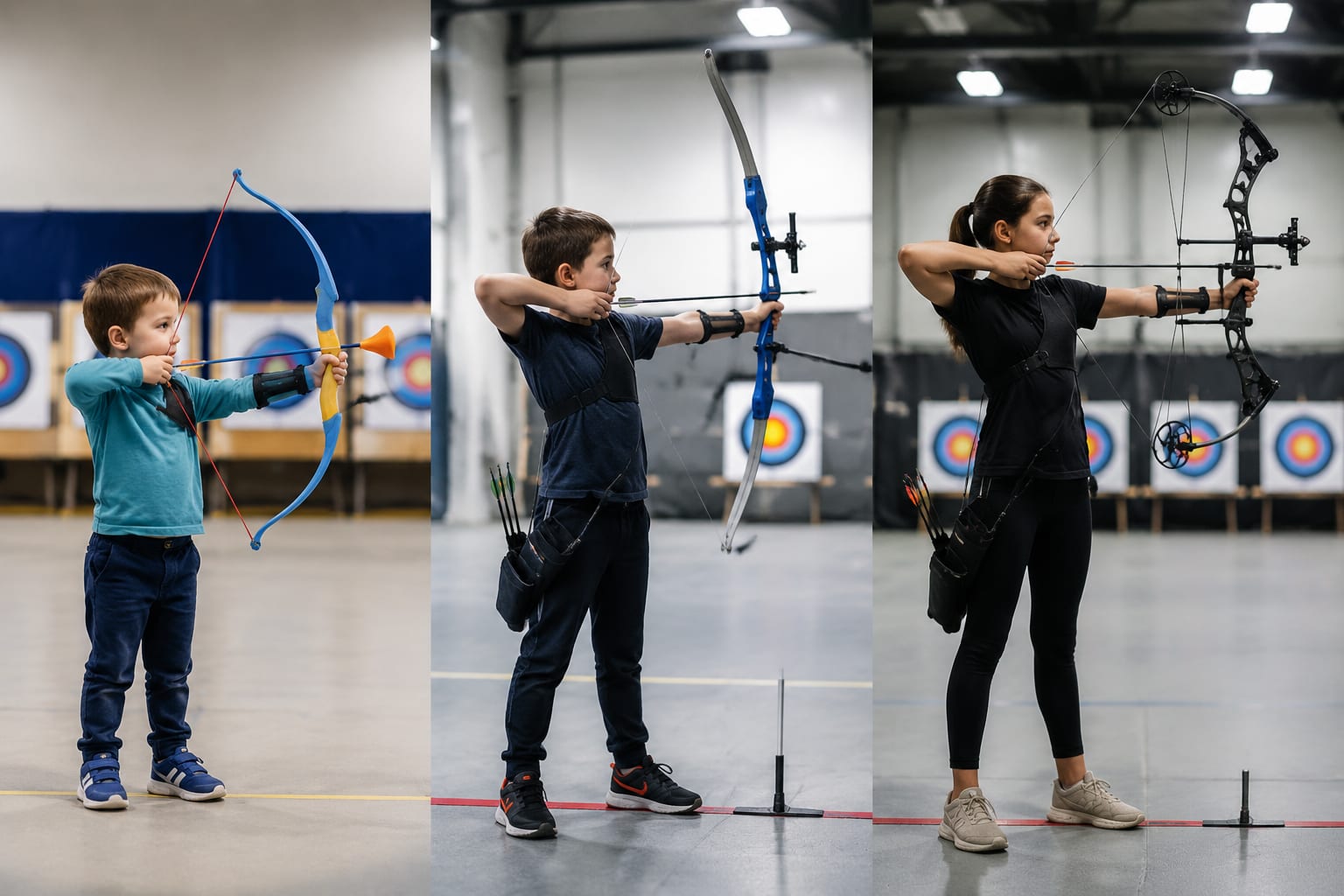
A 7-year-old should use a Genesis-style youth recurve bow or a similar adjustable recurve bow with a draw weight between 10-15 pounds and a draw length of 18-22 inches. These bows are specifically designed for children, with no let-off, adjustable draw length, and lightweight construction that allows proper form development without strain.
The Genesis bow, developed in partnership with the National Archery in the Schools Program (NASP), has become the standard for youth archery because it eliminates the need for specific draw length fitting. This matters for 7-year-olds who are still growing rapidly; a Genesis bow can accommodate growth without requiring replacement.
Recommended bow specifications for age 7:
Why not a compound bow at this age:
Compound bows require precise draw length fitting and have mechanical components that can pinch fingers or cause injury if mishandled. Most instructors recommend waiting until age 10-12 for compound bows, after a child has mastered basic form on a recurve.
Popular youth bow models:
When purchasing rather than using program equipment, buy from an archery pro shop where staff can properly fit the bow to your child’s current size and provide guidance on arrows and safety equipment.
A 4-year-old can participate in archery if a specialized program exists in your area, but waiting until age 5 or 6 will likely result in a better experience for both child and parent. At age 4, most children lack the attention span, impulse control, and physical coordination for traditional archery instruction, though some can enjoy modified archery play with toy equipment.
If you choose to start at age 4, look for programs specifically designed for this age group rather than trying to enroll in a standard youth class. These programs use toy-like equipment, focus on gross motor skills and safety awareness, and last only 20-30 minutes per session.
Realistic expectations for 4-year-olds:
Better alternatives for 4-year-olds interested in archery:
Most archery instructors recommend waiting until at least age 5, and preferably 6, unless your child is exceptionally mature and focused for their age. The difference in readiness between 4 and 6 is substantial, and starting later often means faster progress and more enjoyment.
Children with special needs can participate in archery through adaptive programs offered by many clubs, therapeutic recreation departments, and organizations like Adaptive Archery Alliance and Special Olympics. These programs modify equipment, instruction methods, and range setup to accommodate physical, cognitive, and sensory differences while maintaining safety standards.
Archery is particularly well-suited for adaptive sports because it can be performed from a seated position, requires minimal running or quick movements, and allows for individualized pacing. Many children with ADHD, autism spectrum disorders, physical disabilities, and visual impairments successfully participate in archery with appropriate accommodations.
Common adaptations by need:
Physical disabilities:
Cognitive and developmental disabilities:
Visual impairments:
Organizations offering adaptive archery:
Contact local archery clubs directly to ask about adaptive programs or accommodations. Many instructors have experience working with special needs children even if they don’t advertise a specific program.
The most common mistake parents make when starting kids in archery is pushing too hard too soon, treating it like a path to scholarships or Olympic glory before the child has decided they even enjoy the sport. This pressure often backfires, turning what could be a lifelong hobby into a source of stress and eventual dropout.
Other frequent errors include buying expensive equipment before the child has completed beginner classes, comparing their child’s progress to others, and failing to prioritize safety over performance. These mistakes can lead to injury, frustration, and loss of interest.
Top mistakes to avoid:
1. Buying equipment too early: Wait until your child completes at least one full session (6-8 weeks) before purchasing a bow. Preferences and sizing change rapidly, and rental equipment is included in most programs.
2. Choosing the wrong program: Enrolling a 5-year-old in a class designed for ages 8-12 sets everyone up for failure. Match the program to your child’s actual age and ability, not where you hope they’ll be.
3. Focusing on outcomes over process: Obsessing over target scores and accuracy in the first year creates pressure. Instead, celebrate effort, improvement, and safety awareness.
4. Ignoring safety protocols: Allowing casual attitudes toward range rules or equipment handling teaches dangerous habits. Safety must be non-negotiable from day one.
5. Comparing to other kids: Every child develops at their own pace. Comparisons create unnecessary pressure and can damage self-confidence.
6. Forcing practice: If archery becomes a chore rather than a choice, interest will evaporate. Let your child set the practice frequency after initial classes.
7. Skipping proper instruction: Trying to teach archery yourself from YouTube videos often instills bad habits that are hard to break. Invest in proper instruction from certified coaches.
8. Overlooking physical readiness: Enrolling a child who cannot yet handle the draw weight leads to poor form, potential injury, and frustration. Be honest about current capabilities.
The best approach is to view the first year as exploration. Let your child discover whether archery is their sport without pressure or expectations beyond safety and effort.
Age 12 is absolutely not too old to start archery; in fact, many successful competitive archers began at this age or later. Starting at 12 offers advantages including better physical strength, longer attention span, faster skill acquisition, and more mature understanding of technique and practice requirements.
Older beginners often progress more quickly than younger children because they can understand and implement technical feedback, have the physical strength to handle adult-sized equipment sooner, and possess the mental discipline for focused practice. Many Olympic and professional archers started in their early teens.
Advantages of starting at age 12 or older:
Competitive opportunities for late starters:
USA Archery’s JOAD program and Scholastic 3D Archery (S3DA) both welcome beginners through age 18. Many state and national competitions have divisions for different skill levels, not just age groups, so a 12-year-old beginner competes against other beginners regardless of when they started.
Several Olympic archers began archery in their teens, including some who started at 14 or 15. The sport rewards dedication and practice more than early starting age, unlike gymnastics or figure skating where early specialization is nearly mandatory.
If your 12-year-old expresses interest in archery, encourage it. They haven’t missed any critical window, and they may actually find the learning process more rewarding than they would have at a younger age.
Your child is ready for archery when they can follow multi-step instructions consistently, maintain focus for at least 30 minutes, understand that arrows can cause injury, and show genuine interest in trying the sport. Physical readiness includes the ability to pull and hold 10-12 pounds of resistance and stand in one position for several minutes.
Readiness is more important than age. A focused 6-year-old may be more prepared than a distractible 8-year-old. Use these assessment criteria to evaluate whether now is the right time or if waiting a few months would be better.
Readiness checklist:
Cognitive readiness:
Physical readiness:
Emotional readiness:
Social readiness:
Testing readiness before committing:
Take your child to an archery range that offers drop-in sessions or attend an archery demonstration at a fair or event. Watch how they respond to the environment, whether they maintain interest, and how they handle waiting and watching before trying.
If they’re borderline ready, consider waiting 3-6 months. The difference in maturity and physical development over half a year can be significant for young children, and starting when truly ready leads to better experiences.
Beginner youth archery equipment should be purchased from dedicated archery pro shops rather than big-box sporting goods stores, as pro shops provide proper fitting, quality equipment, and expert advice that prevents costly mistakes. Expect to spend $150-$300 for a complete starter package including bow, arrows, quiver, arm guard, and finger tab.
Wait to purchase equipment until your child has completed at least one beginner session and confirmed sustained interest. Most programs include equipment rental, so there’s no need to buy before trying.
Where to buy youth archery equipment:
Best option: Local archery pro shops
Second option: Online archery retailers
Avoid: Big-box sporting goods stores
Complete beginner package should include:
Buying used equipment:
Used youth bows can be found through archery club bulletin boards, Facebook marketplace, and local classifieds. This can save 30-50% on costs, but have the equipment inspected by a pro shop before purchase to ensure it’s safe and appropriate for your child’s size and strength.
Avoid buying arrows used unless you can verify they’re not damaged. Cracked or splintered arrows can shatter on release and cause injury.
Archery offers unique advantages over team sports for young children, including individual pacing, minimal injury risk, accessibility for various physical abilities, and lower time commitment. Unlike soccer or basketball, archery allows children to progress at their own speed without pressure to keep up with teammates or contribute to wins and losses.
For families evaluating youth sports options, archery provides benefits that complement or contrast with traditional team sports depending on the child’s personality and needs.
Archery advantages:
Archery disadvantages:
Comparison with popular youth sports:
| Factor | Archery | Soccer | Swimming | Martial Arts |
|---|---|---|---|---|
| Injury risk | Very low | Moderate | Low | Low-Moderate |
| Time commitment | Low-Moderate | High | Moderate-High | Moderate |
| Cost (annual) | $300-$600 | $400-$1,200 | $600-$1,500 | $500-$1,000 |
| Team vs Individual | Individual | Team | Individual | Individual |
| Lifetime participation | Excellent | Moderate | Excellent | Excellent |
Archery works well as either a primary sport or a complementary activity alongside team sports. Many young athletes do archery in the off-season of their main sport to maintain focus and discipline while giving their bodies a break from high-impact activity.
If your child cannot comfortably pull a 10-12 pound draw weight, they should wait a few months to build strength naturally through growth and general physical activity rather than forcing archery before they’re physically ready. Attempting archery without adequate strength leads to poor form, potential injury, and frustration that can turn them off the sport entirely.
Draw weight requirements are not arbitrary; they represent the minimum needed to safely shoot an arrow with enough energy to reach the target and stick. Using a bow that’s too heavy causes children to contort their bodies to compensate, teaching bad habits that are difficult to break later.
Building strength for archery:
Natural development (best approach): Simply waiting 3-6 months allows most children to develop the necessary strength through normal growth and activity. This is preferable to forced strength training for young children.
General activities that build archery-relevant strength:
What NOT to do:
Testing draw weight readiness:
Use a resistance band to simulate draw weight. Have your child pull the band to the corner of their mouth (simulating anchor point) and hold for 5 seconds. If they can do this comfortably 10 times without shaking or straining, they’re likely ready for that draw weight in a bow.
If they struggle, wait and test again in a month or two. Physical development happens quickly in children, and what’s impossible in January may be easy by March.
Alternative activities while waiting:
Starting when physically ready leads to faster progress, better form, and more enjoyment than struggling with equipment that’s beyond current capabilities.
Can a 3-year-old do archery?
Three years old is too young for real archery, but toddlers can play with toy bow and arrow sets that use foam or suction-cup projectiles. These toys help develop hand-eye coordination and interest in archery without the safety concerns of actual bows and arrows.
What is the youngest age for competitive archery?
USA Archery’s JOAD competitive program accepts participants starting at age 8, though most children don’t begin competing until age 9 or 10. Local clubs may host fun competitions for younger children, but formal competitive divisions typically start at age 8-9.
How long does it take for a child to learn archery basics?
Most children grasp basic archery safety and technique within 6-8 weeks of weekly lessons, though developing consistency and accuracy takes several months to a year. Progress varies significantly based on age, natural coordination, and practice frequency.
Is archery safe for kids?
Archery is very safe for kids when proper safety protocols are followed, with injury rates lower than most team sports. The key is appropriate supervision, age-appropriate equipment, and consistent enforcement of range rules. Most injuries in youth archery are minor bruises from string slap, prevented by wearing arm guards.
Do kids need their own equipment or can they rent?
Kids should rent or use program-provided equipment for at least the first 6-8 weeks until they confirm sustained interest and their instructor can recommend appropriate specifications. Purchasing too early often results in buying the wrong equipment or equipment they quickly outgrow.
Can kids do archery if they wear glasses?
Children who wear glasses can do archery without any problems. Glasses should be secured with a sports strap to prevent them from falling off during shooting. Some young archers prefer contact lenses, but glasses work perfectly well for archery.
What’s better for kids: recurve or compound bow?
Recurve bows are better for children under 10 because they’re simpler, safer, more forgiving of sizing errors, and better for learning proper form. Compound bows are appropriate for ages 10-12 and up, once a child has mastered basics and has the strength for higher draw weights.
How often should kids practice archery?
Beginners should practice 1-2 times per week for 45-60 minutes per session. More frequent practice doesn’t necessarily speed progress in young children and can lead to burnout. Quality practice with focus is more valuable than quantity.
Can left-handed kids do archery?
Left-handed children should use left-handed bows, which are readily available in youth sizes. Eye dominance matters more than hand dominance in archery; an instructor should test eye dominance to determine whether left or right-handed equipment is appropriate.
What if my child wants to quit after a few lessons?
If a child wants to quit after 2-3 lessons, explore whether the issue is the program, the instructor, timing, or genuine lack of interest. If they complete a full session and still want to quit, respect that decision. Forcing continued participation rarely leads to long-term engagement.
Are there archery scholarships for kids?
College archery scholarships exist but are limited compared to mainstream sports. Fewer than 40 U.S. colleges offer archery scholarships, and most are partial rather than full scholarships. Archery should be pursued for enjoyment and skill development rather than scholarship expectations.
Can kids do archery indoors and outdoors?
Kids can do archery both indoors and outdoors. Indoor ranges operate year-round and offer climate-controlled environments, while outdoor ranges provide longer distances and natural settings. Many programs use indoor facilities in winter and outdoor ranges in warmer months.
Determining what age kids can start archery depends more on individual readiness than a specific birthday. While most children begin between ages 6 and 8, some thrive starting at 5 with appropriate programs, and others benefit from waiting until 9 or 10. The key factors are physical ability to handle draw weight, cognitive ability to follow safety instructions, and genuine interest in the sport.
Parents should prioritize finding quality instruction over rushing to start early. A child who begins at age 7 with proper coaching will quickly surpass one who started at 5 with poor instruction or inappropriate equipment. Focus on safety, proper form, and enjoyment rather than competition or rapid skill development in the early years.
Next steps for parents considering archery for their child:
Archery offers children a unique combination of physical skill, mental discipline, and individual achievement that can last a lifetime. Whether your child starts at 5 or 15, the sport provides valuable lessons in focus, patience, and goal-setting that extend far beyond the range. Start when your child is ready, choose quality instruction, and let their interest guide the pace of involvement.


